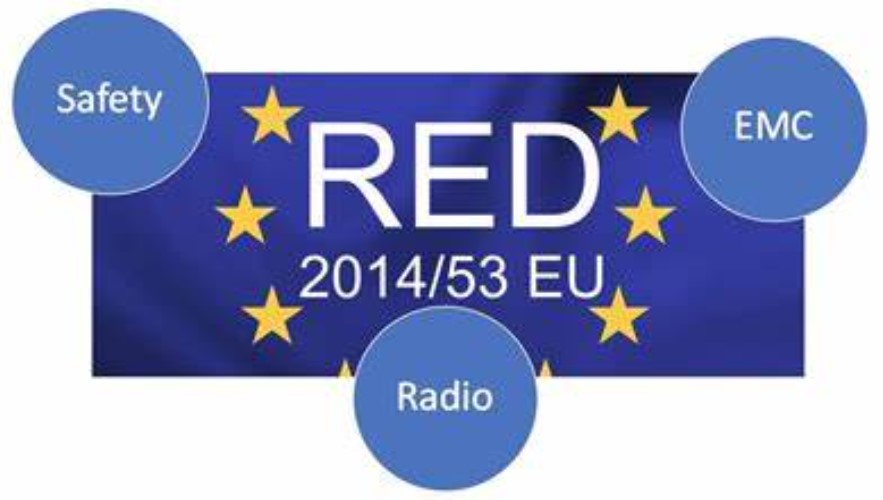
Radio Equipment Directive (RED)

The radio equipment directive 2014/53/EU (RED) establishes a regulatory framework for placing radio equipment on the market. It ensures a single market for radio equipment by setting essential requirements for safety and health, electromagnetic compatibility, and the efficient use of the radio spectrum. It also provides the basis for further regulation governing some additional aspects. These include technical features for the protection of privacy, personal data and against fraud. Furthermore, additional aspects cover interoperability, access to emergency services, and compliance regarding the combination of radio equipment and software.

Update on Articles 3(3)(d), (e) and (f) 

Commission strengthens cybersecurity of radio equipment

The Commission adopted a Delegated Act of the Radio Equipment Directive activating Articles 3(3)(d), (e) and (f) for certain categories of radio equipment to increase the level of cybersecurity, personal data protection and privacy.

Earlier, the Commission authorised a contractor to conduct an impact assessment study on protection in internet-connected radio equipment and wearable radio equipment.
Specifically, it focused on

  • the protection of personal data and privacy
  • the protection from fraud

Different options were considered, in line with the inception impact assessment.
See the final report of the study.

Update on Articles 3(3)(i) and 4

We ask the public and stakeholders to contribute to a data collection exercise. Based on this, we will perform an impact assessment of options that ensure that reconfigurable radio systems approved for Europe’s single market stay compliant with the Radio Equipment Directive after the installation of new or modified software.

The RED aligned the previous directive, the radio and telecommunication terminal equipment directive (1999/5/EC(R&TTED), with the new legislative framework

for the marketing of products.

The revision also took account of the need for improved market surveillance. In particular, for the traceability obligations of manufacturers, importers and distributors. It has improved market surveillance instruments. One example is the possibility for required preregistration of radio equipment in categories with low compliance levels.

The RED was published in the OJEU on 22 May 2014, entered into force on 11 June 2014 and is applicable as of 13 June 2016. It included a one-year transitional period, which ended on 12 June 2017 (Article 48). During the transitional phase, manufacturers were allowed to place on the market radio equipment compliant with either the RED or the EU legislation applicable before 13 June 2016 (e.g. R&TTED).

For more details on the application of the RED, see the RED guide under the guidance section below.

Low Voltage Directive (LVD)

The low voltage directive (LVD) (2014/35/EU) ensures that electrical equipment within certain voltage limits provides a high level of protection for European citizens, and benefits fully from the single market. It has been applicable since 20 April 2016.

About the low voltage directive (LVD)

The low voltage directive (LVD) covers health and safety risks on electrical equipment operating with an input or output voltage of between

  • 50 and 1000 V for alternating current
  • 75 and 1500 V for direct current

It applies to a wide range of electrical equipment for both consumer and professional usage, such as

  • household appliances
  • cables
  • power supply units
  • laser equipment
  • certain components, e.g. fuses

EU legislation in the electrical sector is important to ensure that health and safety requirements are the same across Europe for products placed on the market.

The general product safety directive (2001/95/EC) covers consumer goods with a voltage below 50 V for alternating current, or below 75 V for direct current. It aims to ensure that only safe consumer products are sold in the EU.

ElectroMagnetic Compatibility Testing

WHAT IS ELECTROMAGNETIC COMPATIBILITY (EMC) TESTING?

Electromagnetic compatibility (EMC) testing measures the ability of equipment or systems to function satisfactorily in their electromagnetic environment without introducing intolerable electromagnetic disturbance to anything in that environment.

WHY IS EMC TESTING IMPORTANT?

EMC certifications are a mandatory requirement in most markets, including Europe, the US, China, Korea, Australia and New Zealand. EMC testing is necessary to help you meet regulatory requirements, improve product performance and reduce the risk of costly non-compliance. A third-party EMC test lab can conduct conformity assessments and also help to strengthen your competitive position in the market.

A ONE-STOP SERVICE FOR EMC TESTING AND CERTIFICATION

GZSA experts offer comprehensive testing and certification based on their complete knowledge of EMC legislation, guidelines, and standards. Our testing can cover all types of products, from small appliances to large defence industry machines.

We assist you to resolve any EMC regulatory issues, from design concept to final production. We provide a one-stop service that covers all your testing and certification needs. Our experts provide project management to ensure that your EMC tests run smoothly.

You can choose to have tests performed at our labs, on your premises or anywhere your product is installed.

EMC TESTING PROCEDURE

Our worldwide labs are capable of conducting a comprehensive range of EMC tests and providing you with EMC certifications. Depending on your product, this might include:

  • Antenna immunity to RF voltage
  • Antenna input immunity
  • Antenna screening effectiveness
  • Conducted disturbances immunity
  • Conducted emissions (continuous and discontinuous interference)
  • Electrostatic discharge (ESD) immunity
  • Electrical disturbances from conduction and coupling immunity for vehicles
  • Electrical fast transient / burst immunity
  • Harmonic current emission
  • Harmonics and interharmonics immunity
  • Immunity from radiated fields
  • Immunity to induced voltages
  • On-site EMC testing
  • Power frequency magnetic field / oscillatory waves immunity
  • Power interference
  • Power supply conditioning
  • Radiated emissions
  • Radiated field immunity
  • Voltage fluctuation / flicker
  • Voltage surge immunity
  • Voltage dips / interruptions immunity
  • Magnetic filed measurement (EMF)
  • Electric field measurement (EMF)
  • Electromagnetic field measurement (EMF)
  • Induced current density due to the electric field (EMF for lightning equipment)

Electromagnetic Compatibility (EMC) Directive

All electric devices or installations influence each other when interconnected or close to each other, e.g. interference between TV sets, GSM handsets, radios and nearby washing machine or electrical power lines. The purpose of electromagnetic compatibility (EMC) is to keep all those side effects under reasonable control. EMC designates all the existing and future techniques and technologies for reducing disturbance and enhancing immunity.

The electromagnetic compatibility (EMC) Directive 2014/30/EU ensures that electrical and electronic equipment does not generate, or is not affected by, electromagnetic disturbance.