Optical module UL 62368-1 certification

Optical modules are optoelectronic devices for photoelectric and electro-optical conversion. The sending end of the optical module converts the electrical signal into an optical signal, and the receiving end converts the optical signal into an electrical signal. The optical modules are classified according to the packaging form. The common ones are SFP, SFP+, SFF, Gigabit Ethernet Road Interface Converter (GBIC), etc. The optical module is composed of optoelectronic devices, functional circuits and optical interfaces. The optoelectronic devices include two parts: transmitting and receiving. In short, the function of the optical module is to convert the electrical signal to the optical signal at the sending end, and then convert the optical signal to the electrical signal at the receiving end after transmission through the optical fiber.

UL CBTL Laboratory Zeng Gong 139 2899 3907 (WeChat same number)
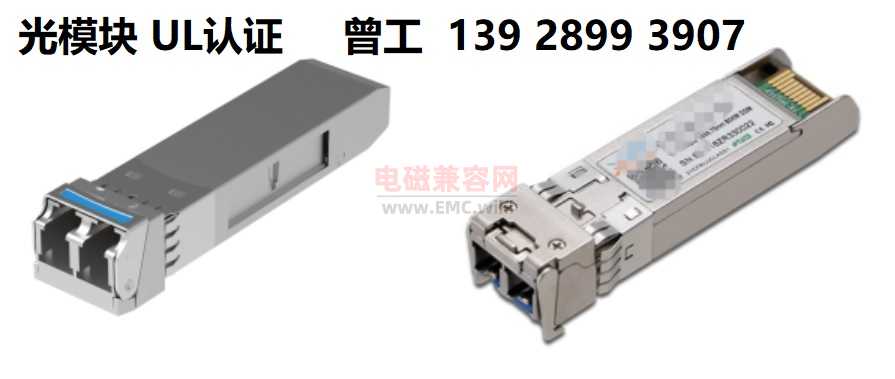
Optical module UL certification

Optical module UL certification

The optical module is composed of optoelectronic devices, functional circuits and optical interfaces. The optoelectronic devices include two parts: transmitting and receiving. In short, the function of the optical module is photoelectric conversion. The sending end converts the electrical signal into an optical signal. After transmission through the optical fiber, the receiving end converts the optical signal into an electrical signal. If the optical module is exported to the United States, it needs to be certified according to UL62368-1. Now we will introduce the test items, data preparation and process steps of the optical module UL62368-1:

1、 Test items of optical module UL62368-1

  1. Input/output test
  2. Leakage current from enclosure measurement
  3. Risk of Electric Shock
  4. Normal&Abnormal Temperature Test
  5. Class P – Default Condition Tests – Electronic Ballasts (Class P)
  6. Dielectric Voltage Withstand Test
  7. Drop Test
  8. Strain Relief Test
  9. Mold Stress Test
  10. Humidity Test

2、 The data to be prepared are as follows

  1. Product application form;
  2. Product Specification
  3. Circuit schematic diagram
  4. PCB Layout
  5. Bill of Materials
  6. Product structure dimension drawing
  7. FDA CDRH report

3、 Certification process introduction and cooperation steps are as follows

  1. Fill in the application form;
  2. Start quotation;
  3. Confirm the quotation and sign the contract;
  4. Pay, open a case, and cooperate with our ITLCBTL laboratory to sign back the agreement when opening a case;
  5. Provide samples and data;
  6. Start the test and coordinate with the customer to sort out the product data;
  7. Close the case and issue the certificate;

Advantage
UL-CBTL Laboratory Zeng Gong – 139-2899-3907

Contact us

Tel: + 86 139 2899 3907

Email: xiangwei.zeng@gmail.com

Wechat

Harmonised Standards

Formal objections

This page contains a list of European Commission decisions taken on the basis of formal objections raised against publication of the references of harmonised standards in the Official Journal of the European Union (OJEU).

A harmonised standard is a European standard developed by a recognised European Standards Organisation: CEN, CENELEC, or ETSI. It is created following a request from the European Commission to one of these organisations. Manufacturers, other economic operators, or conformity assessment bodies can use harmonised standards to demonstrate that products, services, or processes comply with relevant EU legislation.

The references of harmonised standards must be published in the Official Journal of the European Union. The purpose of this website is to provide access to the latest lists of references of harmonised standards and other European standards published in the Official Journal of the European Union (OJEU).

References of harmonised standards and of other European standards published in the OJEU

Accessibility

  • Websites and mobile applications of public sector bodiesSearch for available translations of the preceding

Chemicals

  • Chemical substances (REACH)Search for available translations of the preceding
  • Explosives for civil usesSearch for available translations of the preceding
  • Pyrotechnic articlesSearch for available translations of the preceding

Conformity assessment and management systems

  • New Legislative Framework (NLF) and Eco-Management and Audit Scheme (EMAS)Search for available translations of the preceding

Construction

  • Construction products (CPD/CPR)Search for available translations of the preceding

Consumers and workers protection

  • Cosmetics productsSearch for available translations of the preceding
  • General product safetySearch for available translations of the preceding
  • Personal protective equipment (PPE)Search for available translations of the preceding
  • Toys safetySearch for available translations of the preceding

Energy efficiency

  • Ecodesign and energy labellingSearch for available translations of the preceding

Electric and electronic engineering

  • Electromagnetic compatibility (EMC)Search for available translations of the preceding
  • Equipment for explosive atmospheres (ATEX)Search for available translations of the preceding
  • Low Voltage (LVD)Search for available translations of the preceding
  • Radio Equipment (RED)Search for available translations of the preceding
  • Restriction of the use of certain hazardous substances (RoHS)Search for available translations of the preceding

Healthcare engineering

  • In vitro diagnostic medical devices (Regulation 2017/746)Search for available translations of the preceding
  • Medical devices (Regulation 2017/745)Search for available translations of the preceding
  • Active implantable medical devices (Directive 90/385/EEC)Search for available translations of the preceding
  • In vitro diagnostic medical devices (Directive 98/79/EC)Search for available translations of the preceding
  • Medical devices (Directive 93/42/EEC)Search for available translations of the preceding

Measuring technology

  • Measuring instruments (MID)Search for available translations of the preceding
  • Non-automatic weighing instruments (NAWI)Search for available translations of the preceding

Mechanical engineering and means of transport

  • Cableway installations designed to carry personsSearch for available translations of the preceding
  • Equipment for explosive atmospheres (ATEX)Search for available translations of the preceding
  • Gas appliances (GAR)Search for available translations of the preceding
  • Inspection of pesticide application equipmentSearch for available translations of the preceding
  • LiftsSearch for available translations of the preceding
  • Machinery (MD)Search for available translations of the preceding
  • Pressure equipment (PED)Search for available translations of the preceding
  • Rail system: interoperabilitySearch for available translations of the preceding
  • Recreational craft and personal watercraftSearch for available translations of the preceding
  • Simple Pressure Vessels (SPVD)Search for available translations of the preceding
  • Unmanned aircraft systems (UAS)Search for available translations of the preceding

Services

  • Community postal servicesSearch for available translations of the preceding

Sustainability

  • Packaging and packaging wasteSearch for available translations of the preceding

Use of harmonised standards

The use of these standards remains voluntary. Manufacturers, other economic operators, or conformity assessment bodiesSearch for available translations of the preceding linkEN••• are free to choose another technical solution to demonstrate compliance with the mandatory legal requirements.

Within the context of some directives or regulations, voluntary European standards supporting the implementation of legal requirements are not called “harmonised standards”. This legislation is also included in this information service if:

  • legislation foresees a need for a Commission standardisation request to European Standards Organisations;
  • publication of references in the Official Journal of the European Union is foreseen as a precondition for presumption of conformity or for other legal effect.

Official website : https://ec.europa.eu/growth/single-market/european-standards/harmonised-standards_en

Energy labels

Energy labels:

  • rank appliances on a scale from A to G according to how much energy they consume
  • help consumers save money by choosing products that consume less energy
  • can encourage companies to design products that consume less energy

Class A (green) appliances consume the least energy – making them the most energy‑efficient. Class G (red) appliances consume the most energy.

EU rules on energy labelling also apply to some ‘energy‑related products’: goods or systems with an impact on energy consumption during use. The rules do not apply to second-hand products or to means of transport for persons or goods.

Label rating system without the plus sign

Since March 2021, the energy label rating system uses A to G rankings only, instead of A+++ to D ratings as before. This new rating system applies to the following product groups:

  • refrigerators
  • dishwashers
  • washing machines
  • televisions
  • light bulbs and lamps

The first 4 product groups must feature the rescaled labels from 1 March 2021. Light bulbs and lamps must feature the rescaled label from 1 September 2021.

Products that require labels

For certain product groups, an energy label must be clearly displayed on each product at the point of sale.

Product categories that require energy labels

  • Light bulbs and lamps
  • Heaters
  • Fridges and freezers
  • Washing machines and driers
  • Air conditioners and fans
  • Electronic displays, including televisions
  • Kitchen appliances
  • Tyres

Energy efficient products

  • Lighting
  • Heaters
  • Refrigeration
  • Vacuum cleaners
  • Washing machines and driers
  • Air conditioners and fans
  • Electronic displays and TV boxes
  • Kitchen appliances
  • Pumps
  • Transformers and converters
  • Computers and servers
  • Imaging equipment
  • Game consoles
  • Electric motors
  • Tyres
  • Off mode, standby and networked standby
  • Welding equipment

Europa(Europe)- Ecodesign and Energy Labelling

Directive 2009/125/EC and Regulation (EU) 2017/1369

Short name:Ecodesign and Energy Labelling – Framework Directives
Base:Directive 2009/125/EC of the European Parliament and of the Council of 21 October 2009 establishing a framework for the setting of ecodesign requirements for energy-related products
OJ L 285, 31 October 2009Search for available translations of the preceding linkEN•••Regulation (EU) 2017/1369 of the European Parliament and of the Council of 4 July 2017 setting a framework for energy labelling and repealing Directive 2010/30/EU
OJ L 198, 28 July 2017, p. 1–23Search for available translations of the preceding linkEN•••
Modification:[-]
Directives repealed:Directive 2010/30/EU of the European Parliament and of the Council of 19 May 2010 on the indication by labelling and standard product information of the consumption of energy and other resources by energy-related products – OJ L 153, 18 June 2010Search for available translations of the preceding linkEN•••Directive 2005/32/EC of the European Parliament and of the Council of 6 July 2005 establishing a framework for the setting of ecodesign requirements for energy-using products and amending Council Directive 92/42/EEC and Directives 96/57/EC and 2000/55/EC of the European Parliament and of the Council – OJ L 191, 22 July 2005Search for available translations of the preceding linkEN•••Directive 2008/28/EC of the European Parliament and of the Council of 11 March 2008 amending Directive 2005/32/EC establishing a framework for the setting of ecodesign requirements for energy-using products, as well as Council Directive 92/42/EEC and Directives 96/57/EC and 2000/55/EC, as regards the implementing powers conferred on the Commission – OJ L 81, 20 March 2008Search for available translations of the preceding linkEN••• – Amendment Partial RepealCouncil Directive 92/75/EEC of 22 September 1992 on the indication by labelling and standard product information of the consumption of energy and other resources by household appliances – OJ L 297, 13 October 1992Search for available translations of the preceding linkEN•••
Guide for application:Guidance on CE marking for professionalsSearch for available translations of the preceding linkEN•••
Commission contact points:Directorate-General (DG) for Energy – Energy Efficiency Unit
Contact DG EnergySearch for available translations of the preceding linkEN•••
Energy label and ecodesignSearch for available translations of the preceding linkEN••• webpageDG for Internal Market, Industry, Entrepreneurship and SMEs, Clean Technologies and Products Unit
Email
EcodesignSearch for available translations of the preceding linkEN••• webpage
For information about the content and availability of European standards, please contact the European Standardisation OrganisationsSearch for available translations of the preceding linkEN•••.

Harmonised standards

There are no references of harmonised standards which have been published in the Official Journal of the European Union under the ecodesign and energy labelling framework directives.

To view the references of harmonised standards which have been published in the Official Journal under the ecodesign and energy labelling implementing measures, please select the short names below.

Implementing measures – Ecodesign and Energy labelling

Directives/ Regulations

  EcodesignEnergy Labelling
CirculatorsSearch for available translations of the preceding linkEN•••Circulators and glandless circulators integrated in products(EC) No 641/2009 
ComputersSearch for available translations of the preceding linkEN•••Computers and computer servers(EU) No 617/2013Search for available translations of the preceding linkEN••• 
Computers and small serversEnterprise servers and data storage products(EU) 2019/424Search for available translations of the preceding linkEN••• 
DishwashersSearch for available translations of the preceding linkEN•••Household dishwashers(EU) No 2019/2022(EU) No 2019/2017
Domestic ovens, hobs and range hoodsSearch for available translations of the preceding linkEN•••Domestic ovens, hobs and range hoods(EU) No 66/2014(EU) No 65/2014
Electric motorsSearch for available translations of the preceding linkEN•••Electric motors(EU) 2019/1781 
FansSearch for available translations of the preceding linkEN•••Industrial fans driven by motors(EU) No 327/2011 
Heating and cooling appliancesAir conditioners and comfort fansSearch for available translations of the preceding linkEN•••(EU) No 206/2012(EU) No 626/2011
Hot-water boilersSearch for available translations of the preceding linkEN•••92/42/EEC 
Water heaters and hot water storage tanksSearch for available translations of the preceding linkEN•••(EU) No 814/2013Search for available translations of the preceding linkEN•••(EU) No 812/2013Search for available translations of the preceding linkEN•••
Space heatersSearch for available translations of the preceding linkEN•••(EU) No 813/2013Search for available translations of the preceding linkEN•••(EU) No 811/2013Search for available translations of the preceding linkEN•••
Local space heaters, Solid fuel local space heatersSearch for available translations of the preceding linkEN•••(EU) 2015/1188Search for available translations of the preceding linkEN•••
(EU) 2015/1185Search for available translations of the preceding linkEN•••
(EU) 2015/1186Search for available translations of the preceding linkEN•••
Solid fuel boilersSearch for available translations of the preceding linkEN•••(EU) 2015/1189Search for available translations of the preceding linkEN•••(EU) 2015/1187Search for available translations of the preceding linkEN•••
Air heating products, cooling products, high temperature process chillers and fan coil unitsSearch for available translations of the preceding linkEN•••(EU) No 2016/2281Search for available translations of the preceding linkEN••• 
Power suppliesSearch for available translations of the preceding linkEN•••External power supplies(EU) 2019/1782Search for available translations of the preceding linkEN••• 
Refrigerated storage cabinetsSearch for available translations of the preceding linkEN•••Professional refrigerated storage cabinets, blast cabinets, condensing units and process chillers(EU) 2015/1095Search for available translations of the preceding linkEN•••(EU) 2015/1094Search for available translations of the preceding linkEN•••
Refrigerating appliancesSearch for available translations of the preceding linkEN•••Household refrigerating appliances(EU) 2019/2019Search for available translations of the preceding linkEN•••(EU) 2019/2016Search for available translations of the preceding linkEN•••
Set-top boxesSearch for available translations of the preceding linkEN•••Simple set-top boxes(EC) No 107/2009 
Standby and off modeSearch for available translations of the preceding linkEN•••Electric power consumption standby and off mode of electrical and electronic household and office equipment(EC) No 1275/2008
(EC) No 801/2013
 
TelevisionSearch for available translations of the preceding linkEN•••Television(EU) 2019/2021Search for available translations of the preceding linkEN•••(EU) 2019/2013Search for available translations of the preceding linkEN•••
TransformersSearch for available translations of the preceding linkEN•••Small, medium and large power transformers(EU) No 548/2014 
Tumble driersSearch for available translations of the preceding linkEN•••Household tumble driers(EU) No 932/2012(EU) No 392/2012
Vacuum cleanersSearch for available translations of the preceding linkEN•••Vacuum cleaners(EU) No 666/2013 
VentilationSearch for available translations of the preceding linkEN•••Ventilation units(EU) No 1253/2014Search for available translations of the preceding linkEN•••(EU) No 1254/2014Search for available translations of the preceding linkEN•••
Washing machines and washer-dryersSearch for available translations of the preceding linkEN•••Household washing machines and washer-dryers(EU) No 2019/2023(EU) No 2019/2014
Water pumpsSearch for available translations of the preceding linkEN•••Water pumps(EU) No 547/2012 
Welding equipmentWelding equipment(EU) 2019/1784 

Europa(Europe)- Product compliance – Ecodesign requirements

Before you can begin selling a product in an EU country, it must comply with the rules that apply in that country and throughout the EU. Once the product has been approved for sale in one country, it can then in principle be sold anywhere in the EU. In practice, individual EU countries do retain the right, in certain cases, to restrict the access to their market of products already sold in another EU country.

Different rules must be followed at each step of the process of bringing a product to market: planning, manufacturing, importing (for products manufactured outside the EU), distribution and the final sale to consumers or end-users. Many potential actors are involved.

Explore the interactive content below to find out what each actor does and what their EU‑related obligations are.

Manufacturers or the authorised representatives

Ecodesign requirements

There are certain products that must comply with minimum requirements related to energy efficiency. These are called ecodesign requirements and the aim is to reduce the negative environmental impact throughout the product’s lifecycle.

Before you place this type of product on the EU market you must ensure that they comply with these rules.

The product types currently covered by these rules are those that use energy (boilers, computers, household appliances etc.). You can see the full list below:

Products that must meet ecodesign requirements

Domestic and service industry lighting products:

  • Directional and non-directional lamps (including ultraviolet radiation)
  • Fluorescent lamps (without integrated ballast)
  • High-intensity discharge lamps
  • Ballasts and luminaires able to operate such lamps

Electrical devices:

  • Computers and servers
  • Game consoles
  • Simple/complex set-top boxes
  • Standby for networked equipment
  • Televisions

Household appliances:

  • Cookers
  • Dishwashers
  • Freezers
  • Refrigerators
  • Tumble dryers
  • Washing machines
  • Vacuum cleaners

Heating and cooling devices:

  • Air conditioners
  • Heaters
  • Comfort fans
  • Heaters
  • Industrial fans
  • Local space heaters
  • Solid fuel local space heaters
  • Solid fuel boilers
  • Ventilation units
  • Water heaters

Other products:

  • Circulators
  • Electric motors
  • Electric power consumption standby and off mode
  • External power supplies
  • Imagining equipment
  • Power transformers
  • Professional refrigeration
  • Water pumps

If you want to read about product-specific ecodesign regulations you can see the links in the references section at the bottom of the page.

Types of requirements

There are two types of requirements foreseen in the Ecodesign Directive.

Specific requirements

Specific requirements are when exact values are measured and a limit is given. For example, maximum energy consumption, or minimum quantities of recycled material to be used in production.

Generic requirements

Generic requirements do not set limit values, but may require that:

  • the product is ‘energy-efficient’ or ‘recyclable’
  • you provide information on how to use and maintain the product, to minimise its environmental impact
  • you perform a lifecycle analysis of the product to identify alternative design options and solutions for improvement

The introduction of new minimum requirements can result in a ban of all non-compliant products from being sold in EU countries. An example of this is incandescent lamps, which were gradually phased out from 2009.

Harmonised standards

Harmonised standards are rules that have been adopted by the European standardisation bodies (CENELEC and CEN).

The use of harmonised standards helps provide a presumption of conformity. This means that the products are presumed to comply with the requirements covered by implementing measures when tested using a harmonised standard.
 

Additional harmonised EU standards are gradually being produced to support the ecodesign measures adopted so far.

CE certification

We can provide customers with CE certification for various electronic and electrical products.

Not limited to Electromagnetic compatibility (EMC) DIRECTIVE 2014/30/EU, Radio Equipment (RED) Directive 2014/53/EU,Low Voltage (LVD) Directive 2014/35/EU,Restriction of the use of certain hazardous substances (RoHS) Directive 2011/65/EU.

CE-certification
CE-certification

EMC – Electromagnetic compatibility – DIRECTIVE 2014/30/EU

Multimedia EMC standards

EN IEC 61000-3-2:2019
EN 61000-3-3:2013/A1:2019
EN 55032:2015/A11:2020
EN 55035:2017 or EN 55024:2010/A1:2015

Home appliances EMC standards

EN IEC 61000-3-2:2019
EN 61000-3-3:2013/A1:2019
EN 55014-1:2017
EN 55014-2-2015

Lamps EMC standard

EN IEC 61000-3-2:2019
EN 61000-3-3:2013/A1:2019
EN 55015:2013+A1:2015
EN 61547:2009

RED – Radio Equipment – Directive 2014/53/EU

For Bluetooth wireless products, what standards are required for European wireless RED certification?

RF (intentionally radiated radio frequency part)

  • EN 300328 V2.2.2
  • EN 301489-1 V2.2.3
  • EN 301489-17 V3.2.2

EMC (Unintentional emission part, according to different products, different product standards are used, the following is an example of Bluetooth speakers)

  • EN IEC 61000-3-2:2019
  • EN 61000-3-3:2013/A1:2019
  • EN 55032:2015/A11:2020
  • EN 55035:2017 or EN 55024:2010/A1:2015

LVD (Low Voltage Directive, choose one of the following two)

  • EN 62368-1:2014+A11:2017
  • or
  • EN 60950

EMF

  • EN 62479:2010

European WIFI test standard

RED Radio Frequency RF Standard

  • EN 300328 V2.2.2(For 2.4GHz)
  • ETSI EN 301 893 V2.1.1(For 5GHz)
  • EN 301489-1 V2.2.3
  • EN 301489-17 V3.2.2

If it is embedded in a certain type of product, it needs to meet the corresponding product standards. For example, multimedia products need to meet:

EMC standards

  • EN IEC 61000-3-2:2019
  • EN 61000-3-3:2013/A1:2019
  • EN 55032:2015/A11:2020
  • EN 55035:2017 or EN 55024:2010/A1:2015

There are also safety standards corresponding to the LVD directive. For example, multimedia products need to meet: EN 62368-1

LVD (Low Voltage Directive, choose one of the following two)

  • EN 62368-1:2014+A11:2017
  • EN 60950

EMF

  • EN IEC 62311:2020

You are welcome to consult us, please contact David Zeng info@emc.wiki or 1513888718@qq.com , We can provide one-stop testing, rectification and certification services.

Introduction of common safety standards for lithium batteries in the North American market

Commonly used standards and applicable product ranges for lithium batteries:

  1. UL1642:

Lithium-ion battery cell (cell) standard, applicable to rechargeable lithium battery and non-rechargeable lithium battery.

  1. UL2054:

Batteries for household and commercial products (battery) have a wide range of applications, suitable for rechargeable lithium batteries and non-rechargeable lithium batteries.

  1. UL62133:

Introduced by the IEC62133 standard, it is suitable for rechargeable lithium batteries and lithium batteries.

  1. UL2056:

Suitable for mobile power (power bank) products.

  1. UL62368-1:

Applicable to IT/AV product standards, and can also be used to evaluate mobile power (power bank) products.

  1. UL2595:

Suitable for battery-driven equipment products, such as: lamps, hand-held power tools, sweeping robots, garden tools, etc.

  1. UL2743:

It is suitable for car emergency starting power lithium battery.

  1. UL2271 & UL2272:

It is suitable for lithium batteries for electric vehicles (including balance vehicles and twisted vehicles).

  1. IEEE1625 & IEEE1725:

CTIA (American Wireless Communications and Internet Association) certification of lithium battery standards, suitable for mobile phone lithium batteries, laptop computers and IPAD lithium batteries.

  1. UL1973:

The safety standards for energy storage battery systems mainly cover all types of energy storage batteries used for photovoltaics, wind energy, backup power sources, and communication base stations.

  1. UL2580:

Batteries for electric vehicles, battery packs for driving electric vehicles, capacitive systems, hybrid systems, and subsystems or modules. For example: electric car battery pack, electric forklift battery pack, etc.

Low Voltage Directive (LVD)

The low voltage directive (LVD) (2014/35/EU) ensures that electrical equipment within certain voltage limits provides a high level of protection for European citizens, and benefits fully from the single market. It has been applicable since 20 April 2016.

About the low voltage directive (LVD)

The low voltage directive (LVD) covers health and safety risks on electrical equipment operating with an input or output voltage of between

  • 50 and 1000 V for alternating current
  • 75 and 1500 V for direct current

It applies to a wide range of electrical equipment for both consumer and professional usage, such as

  • household appliances
  • cables
  • power supply units
  • laser equipment
  • certain components, e.g. fuses

EU legislation in the electrical sector is important to ensure that health and safety requirements are the same across Europe for products placed on the market.

The general product safety directive (2001/95/EC) covers consumer goods with a voltage below 50 V for alternating current, or below 75 V for direct current. It aims to ensure that only safe consumer products are sold in the EU.