The CE RED (Radio Equipment Directive) certification is a mandatory process for wireless devices seeking to be sold and used within the European Economic Area (EEA). It ensures that radio equipment complies with the harmonized standards and safety requirements set by the European Union.
The CE RED certification is based on the Radio Equipment Directive (RED), which aims to harmonize the spectrum usage, improve its efficiency, and avoid harmful interference while protecting the health and safety of individuals as well as property. The directive covers a wide range of wireless devices including mobile phones, Wi-Fi equipment, bluetooth devices, radio frequency remote control equipment, and broadcast equipment.
To obtain CE RED certification, manufacturers must demonstrate that their radio equipment meets the essential requirements outlined in the directive. This involves submitting technical documentation, undergoing conformity assessment procedures, and ensuring that the product carries the CE marking.
The CE marking is a declaration of conformity, indicating that the product meets all the relevant European Union directives and regulations. It serves as a passport for the product to enter the European market, ensuring free movement within the EEA.
The CE RED wireless certification process ensures consumer safety, protects against harmful radio emissions, and maintains the integrity of the radio spectrum in the European Union. It is an essential requirement for manufacturers looking to market and sell their wireless devices in the European Union, as it provides a level playing field and ensures compatibility with other devices operating within the region.
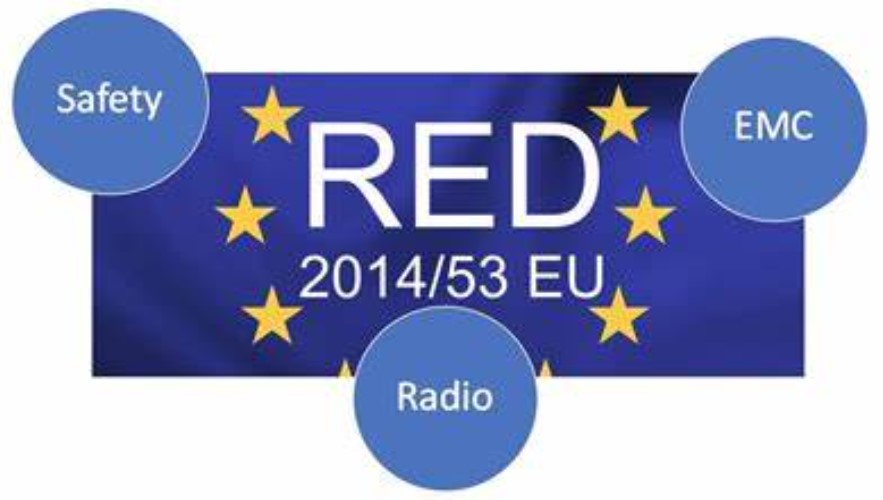
We provide various European wireless products with CE RED Certificates (The Radio Equipment Directive (RED) 2014/53/EU ). If you have any relevant needs, feel free to contact us.
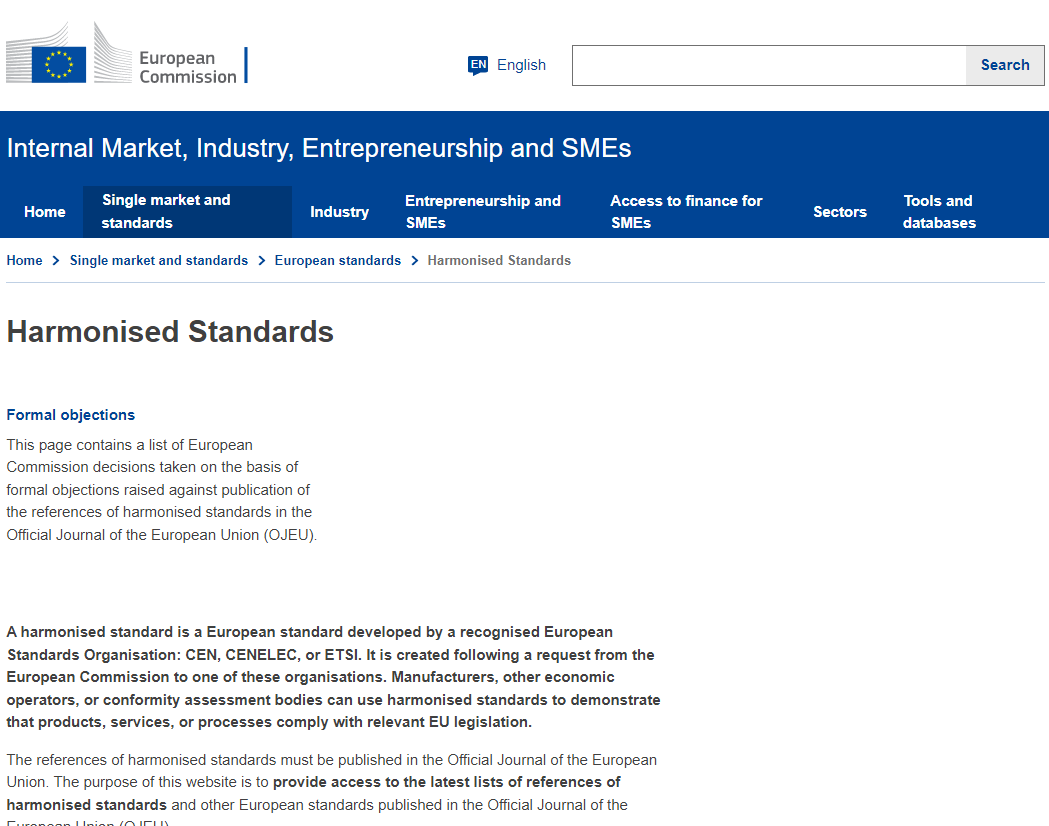
This page contains a list of European Commission decisions taken on the basis of formal objections raised against publication of the references of harmonised standards in the Official Journal of the European Union (OJEU).
A harmonised standard is a European standard developed by a recognised European Standards Organisation: CEN, CENELEC, or ETSI. It is created following a request from the European Commission to one of these organisations. Manufacturers, other economic operators, or conformity assessment bodies can use harmonised standards to demonstrate that products, services, or processes comply with relevant EU legislation.
The references of harmonised standards must be published in the Official Journal of the European Union. The purpose of this website is to provide access to the latest lists of references of harmonised standards and other European standards published in the Official Journal of the European Union (OJEU).
References of harmonised standards and of other European standards published in the OJEU
Accessibility
Websites and mobile applications of public sector bodiesSearch for available translations of the preceding
Chemicals
Chemical substances (REACH)Search for available translations of the preceding
Explosives for civil usesSearch for available translations of the preceding
Pyrotechnic articlesSearch for available translations of the preceding
Conformity assessment and management systems
New Legislative Framework (NLF) and Eco-Management and Audit Scheme (EMAS)Search for available translations of the preceding
Construction
Construction products (CPD/CPR)Search for available translations of the preceding
Consumers and workers protection
Cosmetics productsSearch for available translations of the preceding
General product safetySearch for available translations of the preceding
Personal protective equipment (PPE)Search for available translations of the preceding
Toys safetySearch for available translations of the preceding
Energy efficiency
Ecodesign and energy labellingSearch for available translations of the preceding
Electric and electronic engineering
Electromagnetic compatibility (EMC)Search for available translations of the preceding
Equipment for explosive atmospheres (ATEX)Search for available translations of the preceding
Low Voltage (LVD)Search for available translations of the preceding
Radio Equipment (RED)Search for available translations of the preceding
Restriction of the use of certain hazardous substances (RoHS)Search for available translations of the preceding
Healthcare engineering
In vitro diagnostic medical devices (Regulation 2017/746)Search for available translations of the preceding
Medical devices (Regulation 2017/745)Search for available translations of the preceding
Active implantable medical devices (Directive 90/385/EEC)Search for available translations of the preceding
In vitro diagnostic medical devices (Directive 98/79/EC)Search for available translations of the preceding
Medical devices (Directive 93/42/EEC)Search for available translations of the preceding
Measuring technology
Measuring instruments (MID)Search for available translations of the preceding
Non-automatic weighing instruments (NAWI)Search for available translations of the preceding
Mechanical engineering and means of transport
Cableway installations designed to carry personsSearch for available translations of the preceding
Equipment for explosive atmospheres (ATEX)Search for available translations of the preceding
Gas appliances (GAR)Search for available translations of the preceding
Inspection of pesticide application equipmentSearch for available translations of the preceding
LiftsSearch for available translations of the preceding
Machinery (MD)Search for available translations of the preceding
Pressure equipment (PED)Search for available translations of the preceding
Rail system: interoperabilitySearch for available translations of the preceding
Recreational craft and personal watercraftSearch for available translations of the preceding
Simple Pressure Vessels (SPVD)Search for available translations of the preceding
Unmanned aircraft systems (UAS)Search for available translations of the preceding
Services
Community postal servicesSearch for available translations of the preceding
Sustainability
Packaging and packaging wasteSearch for available translations of the preceding
Use of harmonised standards
The use of these standards remains voluntary. Manufacturers, other economic operators, or conformity assessment bodiesSearch for available translations of the preceding linkEN••• are free to choose another technical solution to demonstrate compliance with the mandatory legal requirements.
Within the context of some directives or regulations, voluntary European standards supporting the implementation of legal requirements are not called “harmonised standards”. This legislation is also included in this information service if:
legislation foresees a need for a Commission standardisation request to European Standards Organisations;
publication of references in the Official Journal of the European Union is foreseen as a precondition for presumption of conformity or for other legal effect.
Official website : https://ec.europa.eu/growth/single-market/european-standards/harmonised-standards_en
How to confirm whether FCC ID certification has been done in FCC certification?
You can check the FRN number and Grantee Code number. If there is, then you may have done FCC ID certification.
Query through the complete FCC ID number = Grantee Code number + product code
Query the company’s FRN number
Applicant’s FCC Registration Number (FRN), which is an identification number given to the enterprise by the government. It can be applied for free on the FCC official website. After application, the website will automatically generate it to the enterprise.
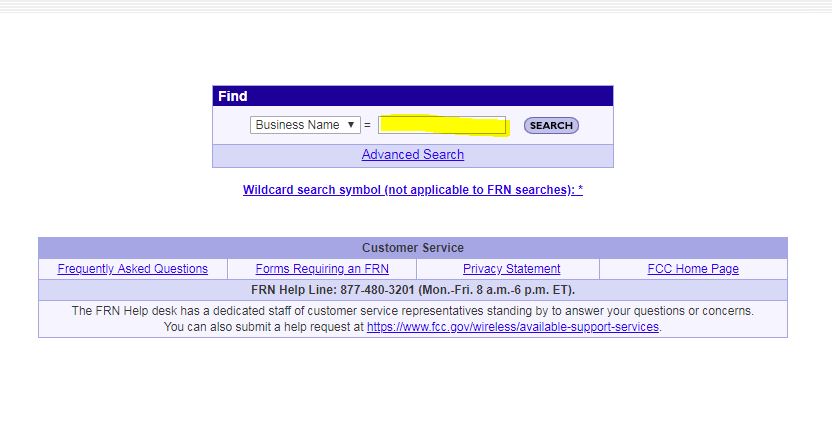
Open the website https://apps.fcc.gov/coresWeb/simpleSearch.do and enter the full name of the company in the yellow box in the picture below.
If you can’t find the FRN number here, then this company must not have done FCC ID certification. At least this company name is here. If didn’t search even your company name on the FCC website, then you must have not successfully applied for FCC ID.
For example, take Fotorama (Hong Kong) Limited as an example to make a query. As shown in the figure below, this company has been registered on the FCC official website on 06/10/2011, then this company is likely to have FCC certification, but it cannot Sure, after completing this step, it is not certain that the customer has actually done FCC ID certification, and then proceed to the next step.
Query the company’s Grantee Code number (authorization code)
For customers who apply for an FCC ID for the first time, they can apply for Grantee Code after applying for an FRN number (a fee of about tens of dollars is required, and the details are subject to the FCC official), and they only need to apply once. Grantee Code (3 or 5 letters or numbers). Each Grantee Code only represents a company. The 3 or 5 digit number is randomly provided by the FCC and is not determined by the customer.
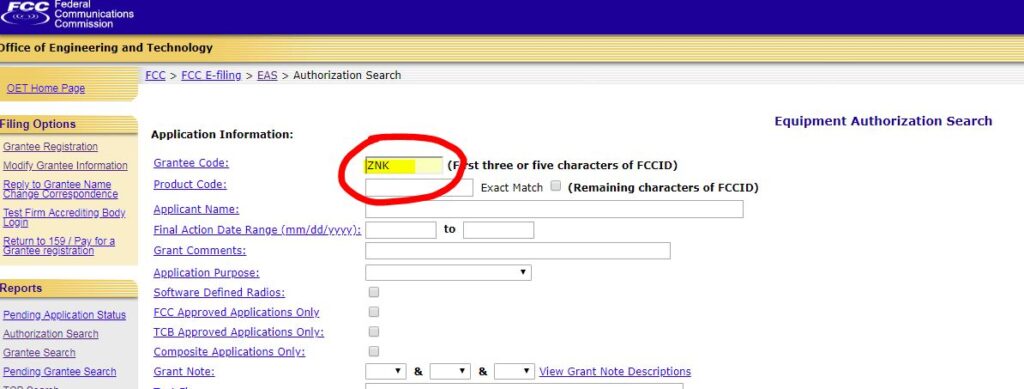
Open the page on the website https://apps.fcc.gov/oetcf/eas/reports/GenericSearch.cfm and enter the first 3 digits or the first 5 letters or horizontal bar code of the FCC ID number. For example, take Fotorama (Hong Kong) Limited as an example for query. As shown in the figure below, the manufacturer’s Grantee Code is ZNK.
Check the FCC ID certification that the company has done before
Query by Grantee Code number
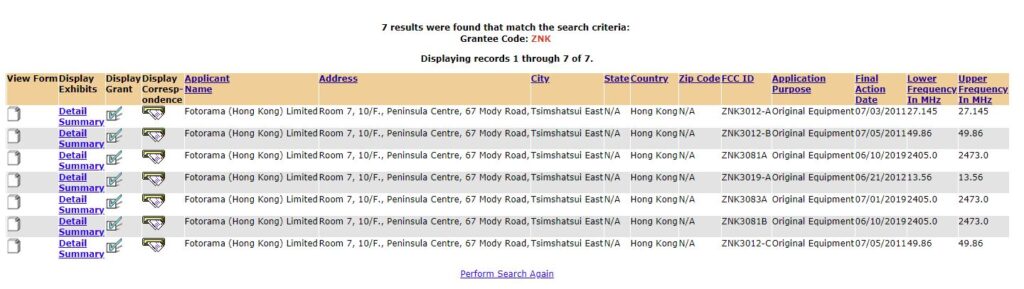
For example, in Grantee Code: query, the premise is that the client’s Grantee Code number (the first 3 digits or the first 5 digits of the FCC ID) is ZNK, then the last step is to query. Open the website https://apps.fcc.gov/oetcf/eas/reports/GenericSearch.cfm page, enter ZNK in the red box, and then click Start Search at the bottom of the page.
Then the search shows that the customer has made 7 reports. Three products were FCC ID certified in 2011, two products were FCC ID certified in 2012, and three product certifications were made on 06/10 and 07/01 respectively in 2019. The details are shown in the figure below.
Search by company name
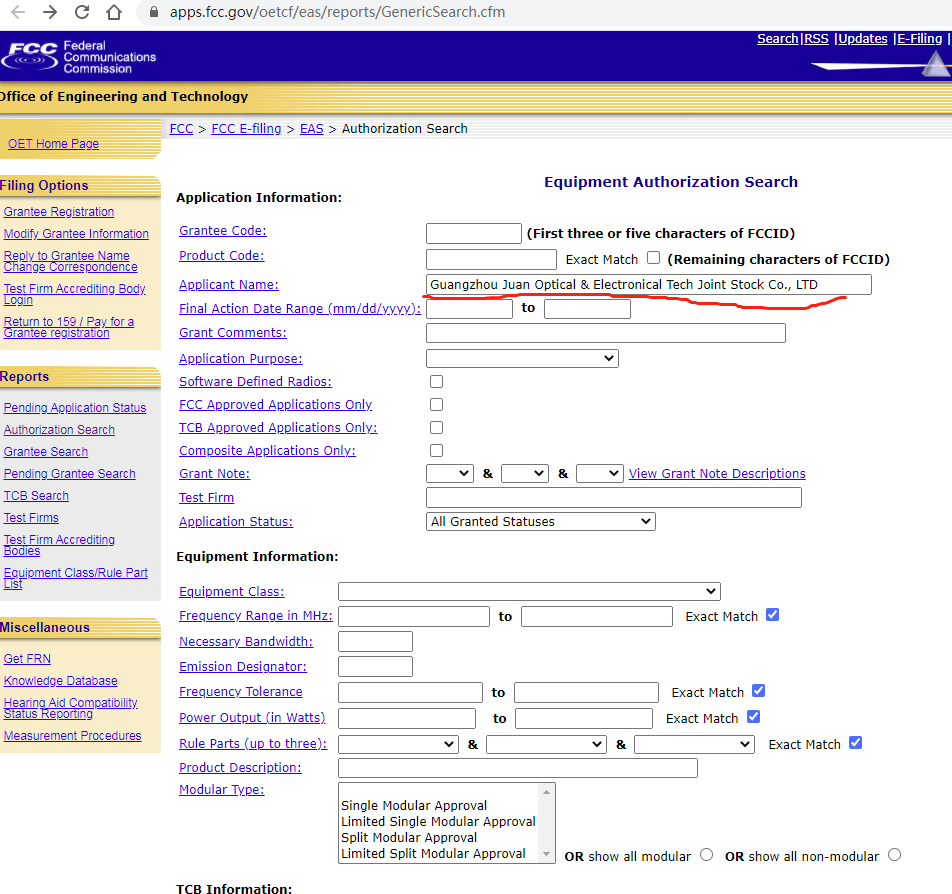
For example, open the website https://apps.fcc.gov/oetcf/eas/reports/GenericSearch.cfm, enter Guangzhou Juan Optical & Electronic Tech Joint Stock Co., LTD in Applicant Name: and click Start Search at the bottom of the page.
FCC ID rules
The FCC ID includes the Grantee Code company code (3 or 5 letters or numbers), and each Grantee Code only represents one company. The 3-digit or 5-digit number is randomly provided by the FCC and is not determined by the customer. Once the application is successful, it will become a fixed number, as the first 3 or 5 digits of the company’s application for FCC ID numbers. And the product code (10-12 letters or numbers) of the product. Therefore, the product ID number, the first three or five digits are Grantee Code, and the latter is self-edited by the applicant (up to 10-12 digits). Usually the product model is used for self-encoding. The complete FCC ID cannot be more than 15 at most. Of course, It can be less than 15.
The three-character Grantee Code always starts with an alphabetic character and does not contain the numbers 1 and/or 0.
The five-character Grantee Code always starts with a numeric character and does not contain the number 1 and/or 0.
The product code may include a hyphen (-).
The maximum number of digits of FCC ID cannot be greater than 15 digits.
You are welcome to consult us, please contact David Zeng info@emc.wiki or 1513888718@qq.com , We can provide one-stop testing, EMC debug and certification services.
FCC ID refers to the FCC wireless certification in the United States. After passing the certification, a string of numbers will appear, commonly known as FCC ID certification.
FCC ID products include
Wireless radio frequency products, such as BT, Wifi, Zigbee, 2.4GHz, 5GHz, mobile phone products, various remote controls and other intentional launch products, all need to comply with the US FCC PART 15C standard limit.
Verification method
The product needs to pass the FCC approved test lab with the test is completed and the test report is obtained.
Organize product technical information, including: product details photos, block diagrams, circuit schematics, operational description, user manuals, etc.
Then the NVLAP & A2LA test laboratory approved by the FCC will submit it to the FCC TCB test room to confirm that all the information is correct (or directly find the TCB), and issue a certificate.
FCC ID standard
FCC ID 47 CFR PART 15 Subpart C: 2019 section 15.247 (not 5g wifi)
ANSI C63.10: 2013
Coverage frequency
FCC Rules and Regulations Part 15 Subpart C Section 15.247-2.4G WIFI / BT
FCC Rules and Regulations Part 15 Subpart C Section 15.407-5.2G WiFi
FCC Rules and Regulations Part 15 Subpart C Section 15.407-5.8G WiFi
For MIMO system of 802.11n/ac, total power is calculated by combining the output power of each antenna according to KDB662911
North America 2.4G BT
2402-2480 MHz
GFSK, π/4-DQPSK, 8DPSK for Bluetooth (DSS)
GFSK for Bluetooth (DTS)
79 channels for Bluetooth (DSS)
40 channels for Bluetooth (DTS)
North America2.4G WIFI
2412MHz ~ 2462MHz
802.11b: DSSS; 802.11g/n: OFDM
11 Channel for 20MHz bandwidth(2412~2462MHz)
7 channels for 40MHz bandwidth(2422~2452MHz)
North America 5G WIFI frequency band
5150 MHz ~ 5250 MHz
5725 MHz ~ 5850MHz
FCC Part 15.407: Unlicensed National Information Infrastructure (U-NII)
North America 5.2G WIFI
FCC Rules and Regulations Part 15 Subpart C Section 15.407
ANSI C63.10: 2013
4 channels for 5180 MHz ~ 5240 MHz (802.11a/n/ac-HT20);
2 channels for 5190 MHz ~ 5230 MHz (802.11n/ac-HT40);
1 channel for 5210 MHz (802.11ac-HT80);
North America 5.8G WIFI
FCC Rules and Regulations Part 15 Subpart C Section 15.407 ANSI C63.10: 2013
5 channels for 5745 MHz ~ 5825 MHz (802.11a/n/ac-HT20);
2 channels for 5755 MHz ~ 5795 MHz (802.11n/ac-HT40);
1 channel for 5775 MHz (802.11ac-HT80);
North American DFS Band
If you have a device that supports WIFI 802.11a, you need to evaluate DFS, which includes Master active such as a router, and Slave passive such as a mobile phone.
5.250–5.350 GHz, whether it is used indoors or outdoors, should be operated according to dynamic frequency selection (DFS or avoid radar). The regulations allow users to install antennas with a power limit of 250 mW.
5.470-5.725 GHz, whether it is used indoors or outdoors, should be operated according to dynamic frequency selection (DFS or avoid radar).
FCC ID certification sample preparation
Provide at least 1~2 prototypes required to apply for FCC ID, one complete and ordinary similar shipment sample, and one RF fixed-frequency prototype.
You are welcome to consult us, please contact David Zeng info@emc.wiki or 1513888718@qq.com , We can provide one-stop testing, rectification and certification services.
We can provide customers with CE certification for various electronic and electrical products.
Not limited to Electromagnetic compatibility (EMC) DIRECTIVE 2014/30/EU, Radio Equipment (RED) Directive 2014/53/EU,Low Voltage (LVD) Directive 2014/35/EU,Restriction of the use of certain hazardous substances (RoHS) Directive 2011/65/EU.
EN IEC 61000-3-2:2019 EN 61000-3-3:2013/A1:2019 EN 55032:2015/A11:2020 EN 55035:2017 or EN 55024:2010/A1:2015
Home appliances EMC standards
EN IEC 61000-3-2:2019 EN 61000-3-3:2013/A1:2019 EN 55014-1:2017 EN 55014-2-2015
Lamps EMC standard
EN IEC 61000-3-2:2019 EN 61000-3-3:2013/A1:2019 EN 55015:2013+A1:2015 EN 61547:2009
RED – Radio Equipment – Directive 2014/53/EU
For Bluetooth wireless products, what standards are required for European wireless RED certification?
RF (intentionally radiated radio frequency part)
EN 300328 V2.2.2
EN 301489-1 V2.2.3
EN 301489-17 V3.2.2
EMC (Unintentional emission part, according to different products, different product standards are used, the following is an example of Bluetooth speakers)
EN IEC 61000-3-2:2019
EN 61000-3-3:2013/A1:2019
EN 55032:2015/A11:2020
EN 55035:2017 or EN 55024:2010/A1:2015
LVD (Low Voltage Directive, choose one of the following two)
EN 62368-1:2014+A11:2017
or
EN 60950
EMF
EN 62479:2010
European WIFI test standard
RED Radio Frequency RF Standard
EN 300328 V2.2.2(For 2.4GHz)
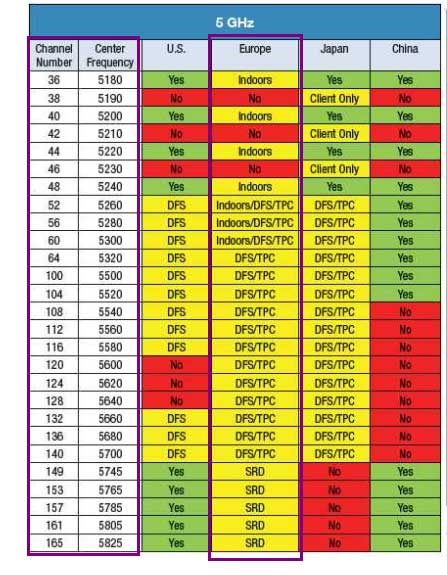
ETSI EN 301 893 V2.1.1(For 5GHz)
EN 301489-1 V2.2.3
EN 301489-17 V3.2.2
If it is embedded in a certain type of product, it needs to meet the corresponding product standards. For example, multimedia products need to meet:
EMC standards
EN IEC 61000-3-2:2019
EN 61000-3-3:2013/A1:2019
EN 55032:2015/A11:2020
EN 55035:2017 or EN 55024:2010/A1:2015
There are also safety standards corresponding to the LVD directive. For example, multimedia products need to meet: EN 62368-1
LVD (Low Voltage Directive, choose one of the following two)
EN 62368-1:2014+A11:2017
EN 60950
EMF
EN IEC 62311:2020
You are welcome to consult us, please contact David Zeng info@emc.wiki or 1513888718@qq.com , We can provide one-stop testing, rectification and certification services.
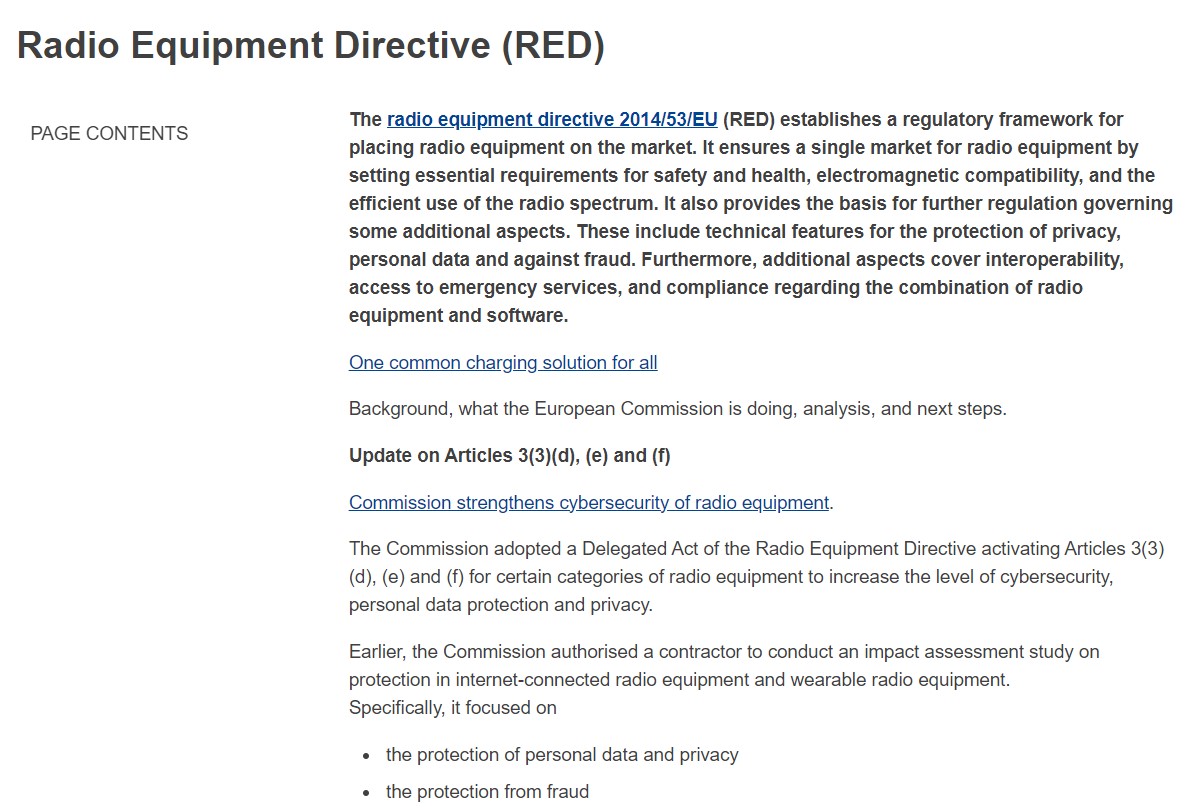
The radio equipment directive 2014/53/EU(RED) establishes a regulatory framework for placing radio equipment on the market. It ensures a single market for radio equipment by setting essential requirements for safety and health, electromagnetic compatibility, and the efficient use of the radio spectrum. It also provides the basis for further regulation governing some additional aspects. These include technical features for the protection of privacy, personal data and against fraud. Furthermore, additional aspects cover interoperability, access to emergency services, and compliance regarding the combination of radio equipment and software.
The Commission adopted a Delegated Act of the Radio Equipment Directive activating Articles 3(3)(d), (e) and (f) for certain categories of radio equipment to increase the level of cybersecurity, personal data protection and privacy.
Earlier, the Commission authorised a contractor to conduct an impact assessment study on protection in internet-connected radio equipment and wearable radio equipment. Specifically, it focused on
We ask the public and stakeholders to contribute to a data collection exercise. Based on this, we will perform an impact assessment of options that ensure that reconfigurable radio systems approved for Europe’s single market stay compliant with the Radio Equipment Directive after the installation of new or modified software.
*Experts are national public administrations, manufacturers and economic operators, consumer organisations, academia, think tanks, compliance assessment bodies, etc.
The RED aligned the previous directive, the radio and telecommunication terminal equipment directive (1999/5/EC(R&TTED), with the new legislative framework
for the marketing of products.
The revision also took account of the need for improved market surveillance. In particular, for the traceability obligations of manufacturers, importers and distributors. It has improved market surveillance instruments. One example is the possibility for required preregistration of radio equipment in categories with low compliance levels.
The RED was published in the OJEU on 22 May 2014, entered into force on 11 June 2014 and is applicable as of 13 June 2016. It included a one-year transitional period, which ended on 12 June 2017 (Article 48). During the transitional phase, manufacturers were allowed to place on the market radio equipment compliant with either the RED or the EU legislation applicable before 13 June 2016 (e.g. R&TTED).
For more details on the application of the RED, see the RED guide under the guidance section below.