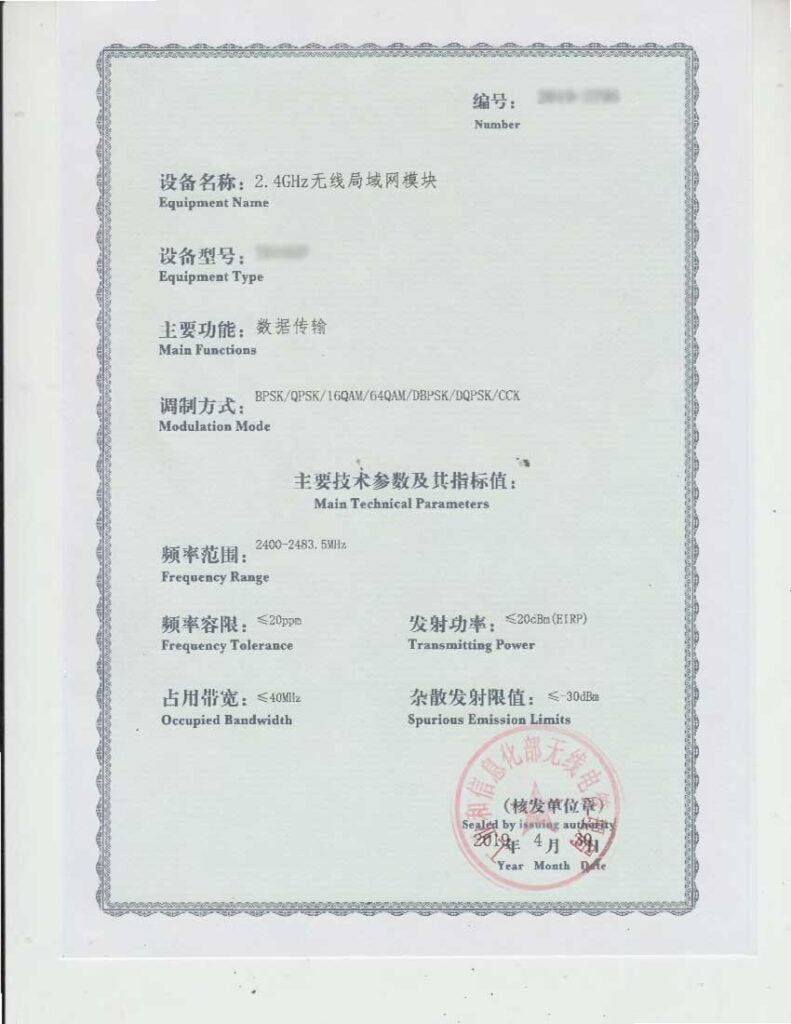
1.If the built-in module without certification, please provide fixed frequency prototype 5 units (lead RF line), fixed frequency tools 5, fixed frequency software and operating instructions.
2.If the built-in module has been certified and meets the requirements of the Ministry of Industry and Information Technology (MIIT) Document No. 1 of 2014, please provide a complete fixed-frequency prototype and the built-in module certificate, one fixed-frequency tool, fixed-frequency software and operating instructions.Please note: Each sample must have a label (nameplate) and a unique identification code (serial number or number).
Data Request
A:Have you registered an account in the “National Integrated Online Government Service Platform” or “Ministry of Industry and Information Technology Government Service Platform”, if not, please provide the following information, we will help you to register
1.Proof of organization and Chinese translation, with signature stamp
2.Scanned copy of legal person’s passport
B:All files need to be in Chinese and the file size should not exceed 5M: (Each model)
1.Application form, commitment letter (Annex)
2.Scanned copy of business license and Chinese translation of the business license
3.Scanned copy and signature of the passport of the manager.
4.If the product is produced by the applicant, provide the applicant’s ISO quality system certificate (the scope of the certificate needs to include the product category of this application), if not need to provide a description of technical capabilities, production capacity and quality assurance system (can refer to the annex).
5.If the applicant commissions the production on behalf of the factory, it is necessary to provide the applicant and the factory’s commissioning contract and the factory’s ISO quality system certificate or system status statement.
6.Whole machine schematic diagram, block diagram, product manual, product technical manual, RF part BOM (fill in the attachment), RF module/chip specification, antenna specification, antenna gain and line loss description (see attachment), product six-sided photo + internal photo (attachment).
How to confirm whether FCC ID certification has been done in FCC certification?
You can check the FRN number and Grantee Code number. If there is, then you may have done FCC ID certification.
Query through the complete FCC ID number = Grantee Code number + product code
Query the company’s FRN number
Applicant’s FCC Registration Number (FRN), which is an identification number given to the enterprise by the government. It can be applied for free on the FCC official website. After application, the website will automatically generate it to the enterprise.
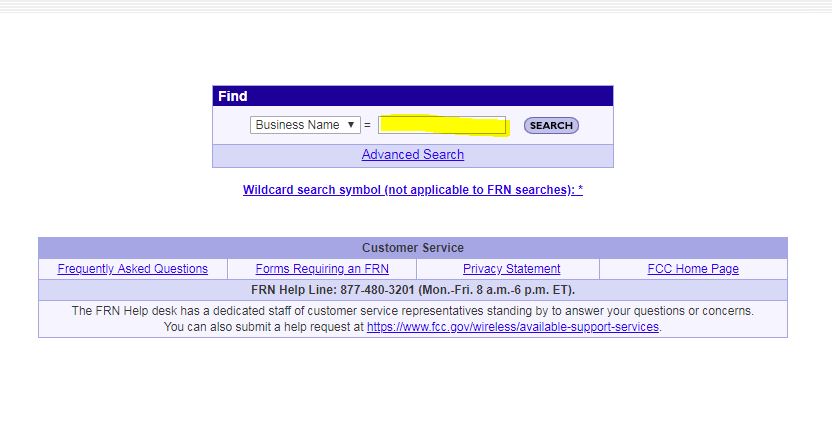
Open the website https://apps.fcc.gov/coresWeb/simpleSearch.do and enter the full name of the company in the yellow box in the picture below.
If you can’t find the FRN number here, then this company must not have done FCC ID certification. At least this company name is here. If didn’t search even your company name on the FCC website, then you must have not successfully applied for FCC ID.
For example, take Fotorama (Hong Kong) Limited as an example to make a query. As shown in the figure below, this company has been registered on the FCC official website on 06/10/2011, then this company is likely to have FCC certification, but it cannot Sure, after completing this step, it is not certain that the customer has actually done FCC ID certification, and then proceed to the next step.
Query the company’s Grantee Code number (authorization code)
For customers who apply for an FCC ID for the first time, they can apply for Grantee Code after applying for an FRN number (a fee of about tens of dollars is required, and the details are subject to the FCC official), and they only need to apply once. Grantee Code (3 or 5 letters or numbers). Each Grantee Code only represents a company. The 3 or 5 digit number is randomly provided by the FCC and is not determined by the customer.
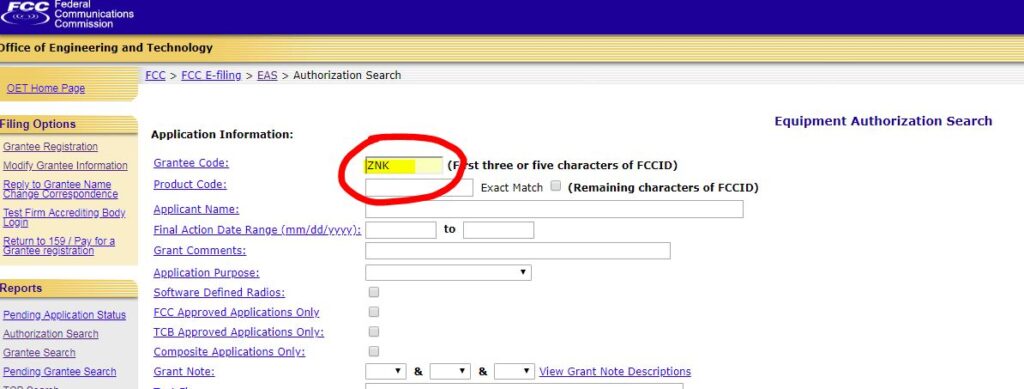
Open the page on the website https://apps.fcc.gov/oetcf/eas/reports/GenericSearch.cfm and enter the first 3 digits or the first 5 letters or horizontal bar code of the FCC ID number. For example, take Fotorama (Hong Kong) Limited as an example for query. As shown in the figure below, the manufacturer’s Grantee Code is ZNK.
Check the FCC ID certification that the company has done before
Query by Grantee Code number
For example, in Grantee Code: query, the premise is that the client’s Grantee Code number (the first 3 digits or the first 5 digits of the FCC ID) is ZNK, then the last step is to query. Open the website https://apps.fcc.gov/oetcf/eas/reports/GenericSearch.cfm page, enter ZNK in the red box, and then click Start Search at the bottom of the page.
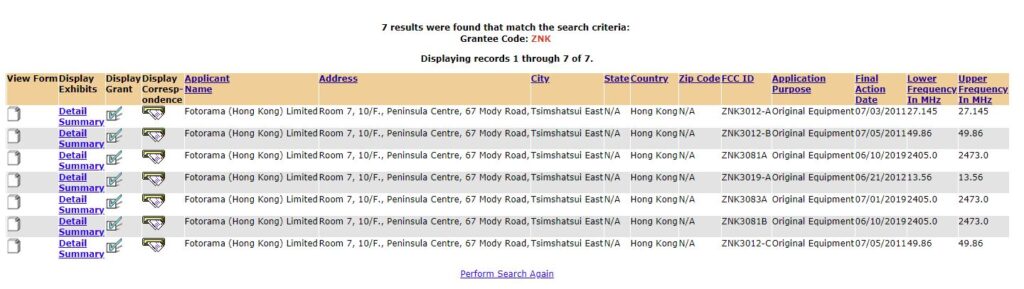
Then the search shows that the customer has made 7 reports. Three products were FCC ID certified in 2011, two products were FCC ID certified in 2012, and three product certifications were made on 06/10 and 07/01 respectively in 2019. The details are shown in the figure below.
Search by company name
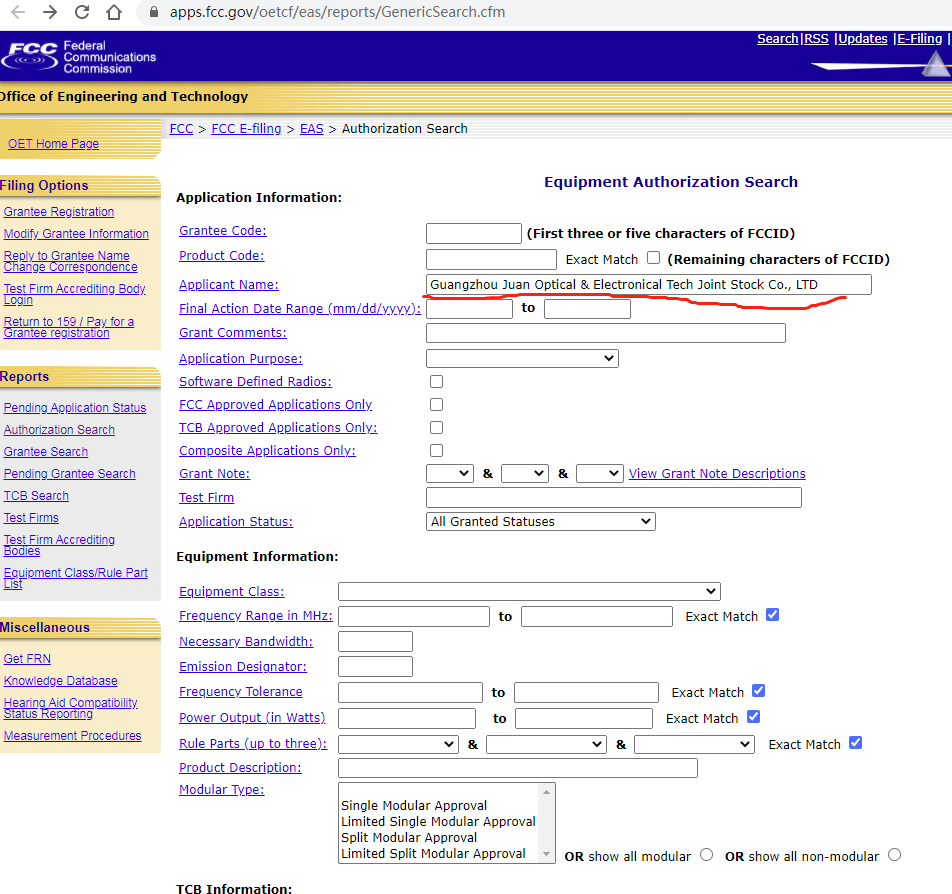
For example, open the website https://apps.fcc.gov/oetcf/eas/reports/GenericSearch.cfm, enter Guangzhou Juan Optical & Electronic Tech Joint Stock Co., LTD in Applicant Name: and click Start Search at the bottom of the page.
FCC ID rules
The FCC ID includes the Grantee Code company code (3 or 5 letters or numbers), and each Grantee Code only represents one company. The 3-digit or 5-digit number is randomly provided by the FCC and is not determined by the customer. Once the application is successful, it will become a fixed number, as the first 3 or 5 digits of the company’s application for FCC ID numbers. And the product code (10-12 letters or numbers) of the product. Therefore, the product ID number, the first three or five digits are Grantee Code, and the latter is self-edited by the applicant (up to 10-12 digits). Usually the product model is used for self-encoding. The complete FCC ID cannot be more than 15 at most. Of course, It can be less than 15.
The three-character Grantee Code always starts with an alphabetic character and does not contain the numbers 1 and/or 0.
The five-character Grantee Code always starts with a numeric character and does not contain the number 1 and/or 0.
The product code may include a hyphen (-).
The maximum number of digits of FCC ID cannot be greater than 15 digits.
You are welcome to consult us, please contact David Zeng info@emc.wiki or 1513888718@qq.com , We can provide one-stop testing, EMC debug and certification services.
We can provide customers with CE certification for various electronic and electrical products.
Not limited to Electromagnetic compatibility (EMC) DIRECTIVE 2014/30/EU, Radio Equipment (RED) Directive 2014/53/EU,Low Voltage (LVD) Directive 2014/35/EU,Restriction of the use of certain hazardous substances (RoHS) Directive 2011/65/EU.
EN IEC 61000-3-2:2019 EN 61000-3-3:2013/A1:2019 EN 55032:2015/A11:2020 EN 55035:2017 or EN 55024:2010/A1:2015
Home appliances EMC standards
EN IEC 61000-3-2:2019 EN 61000-3-3:2013/A1:2019 EN 55014-1:2017 EN 55014-2-2015
Lamps EMC standard
EN IEC 61000-3-2:2019 EN 61000-3-3:2013/A1:2019 EN 55015:2013+A1:2015 EN 61547:2009
RED – Radio Equipment – Directive 2014/53/EU
For Bluetooth wireless products, what standards are required for European wireless RED certification?
RF (intentionally radiated radio frequency part)
EN 300328 V2.2.2
EN 301489-1 V2.2.3
EN 301489-17 V3.2.2
EMC (Unintentional emission part, according to different products, different product standards are used, the following is an example of Bluetooth speakers)
EN IEC 61000-3-2:2019
EN 61000-3-3:2013/A1:2019
EN 55032:2015/A11:2020
EN 55035:2017 or EN 55024:2010/A1:2015
LVD (Low Voltage Directive, choose one of the following two)
EN 62368-1:2014+A11:2017
or
EN 60950
EMF
EN 62479:2010
European WIFI test standard
RED Radio Frequency RF Standard
EN 300328 V2.2.2(For 2.4GHz)
ETSI EN 301 893 V2.1.1(For 5GHz)
EN 301489-1 V2.2.3
EN 301489-17 V3.2.2
If it is embedded in a certain type of product, it needs to meet the corresponding product standards. For example, multimedia products need to meet:
EMC standards
EN IEC 61000-3-2:2019
EN 61000-3-3:2013/A1:2019
EN 55032:2015/A11:2020
EN 55035:2017 or EN 55024:2010/A1:2015
There are also safety standards corresponding to the LVD directive. For example, multimedia products need to meet: EN 62368-1
LVD (Low Voltage Directive, choose one of the following two)
EN 62368-1:2014+A11:2017
EN 60950
EMF
EN IEC 62311:2020
You are welcome to consult us, please contact David Zeng info@emc.wiki or 1513888718@qq.com , We can provide one-stop testing, rectification and certification services.
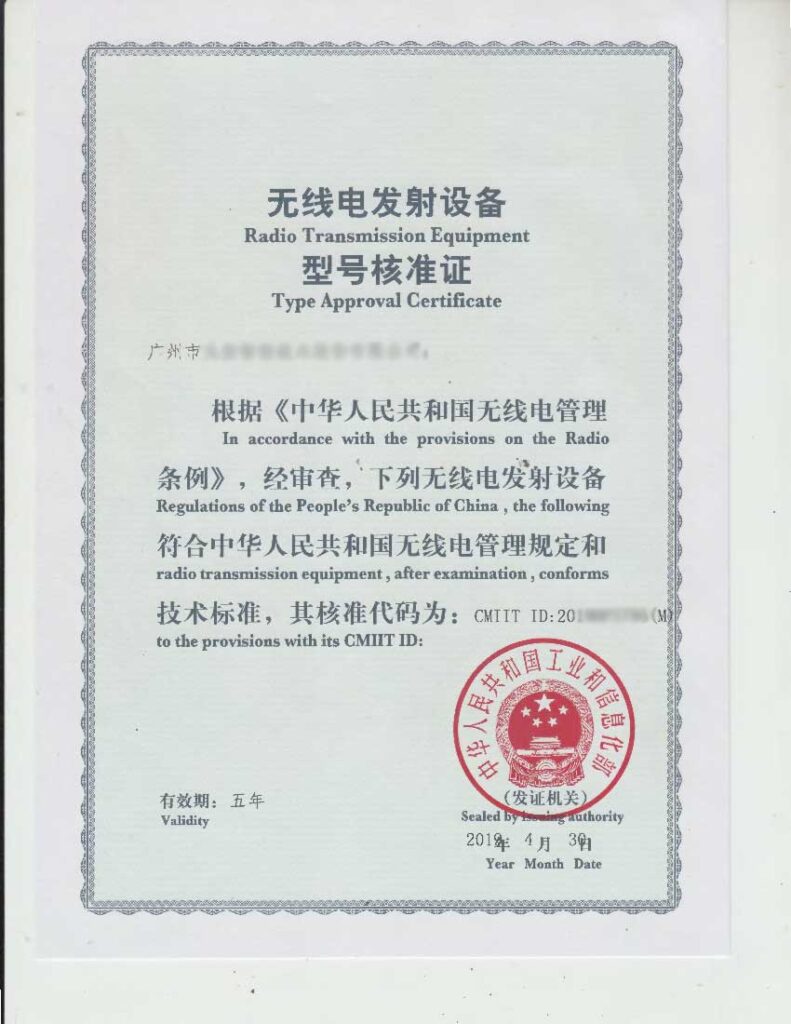
State Radio Regulatory Commission of the People’s Republic of China
SRRC is a mandatory certification requirement of the National Radio Regulatory Commission. Since June 1, 1999, the Ministry of Information Industry (MII) of China has mandated that all radio component products sold and used in China must obtain a radio model Radio Type Approval Certification (Radio Type Approval Certification).
At present, China’s SRRC certification is all managed and issued by the Ministry of Industry and Information Technology of the People’s Republic of China.
Wireless products sold in the Chinese market must apply for SRRC certification as long as they are in the SRRC product catalog. For example, Bluetooth, wifi, zigbee, 2g, 3g, 4g, 5g products are typical SRRC compulsory certification products.
We have an RF testing laboratory in Guangzhou, which can provide customers with pre-testing, data sorting, registration with the Ministry of Industry and Information Technology of China, and one-stop SRRC testing and certification services.
You are welcome to consult us, please contact David Zeng info@emc.wiki or 1513888718@qq.com , We can provide one-stop testing, EMC debug and certification services.
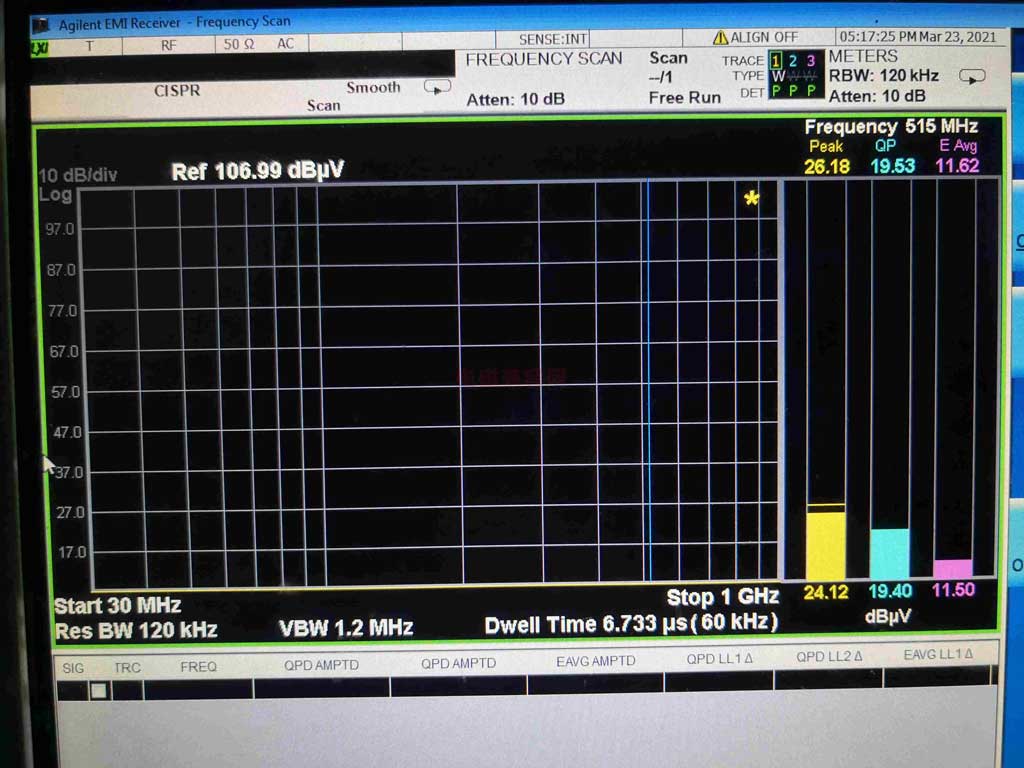
PK, QP, and AV in emc test refer to three different detectors in EMI test receiver or spectrum analyzer.
From the three column diagrams in the above figure, it can be seen that from left to right, the PK detector reading value, the QP detector reading value, and the AV detector reading value are respectively decremented. The reading of the same frequency point is detected by different detectors, in which the PK value is the largest and the AV value is the smallest.
PK> QP> AV
Detector for EMI measurement — PK peak detector, QP quasi-peak detector, AV average detector
The use of quasi-peak detection is a characteristic of civil electromagnetic disturbance emission testing. Since civil electromagnetic compatibility product family standards are all converted from CISPR standards, these standards are compiled to ensure the smooth flow of communication and broadcasting. Therefore, harassment has an impact on communication and broadcasting. The influence of is ultimately judged by human subjective auditory effects. Average detection and peak detection are not enough to describe the impact of pulse amplitude, width and frequency on vision. Quasi-peak detection must be used. Only quasi-peak detection is more consistent. The human ear responds to sounds regularly.
The respective characteristics of several detection methods:
PK peak detection: Its charging time constant is very small, even a very narrow pulse can be quickly charged to a stable value. After the intermediate frequency signal disappears, due to the large discharge time constant of the circuit, the output voltage of the detection can be Stay at the peak for a long time. The feature of peak detection is first used in the harassment emission test of military equipment, because many military equipment can cause explosions or malfunctions of digital equipment as long as a single pulse is stimulated, and there is no need to pay attention to the accumulation of time like audio equipment. The PK value mainly considers the pulse amplitude or the larger peak-to-peak pulse measurement value!
QP quasi-peak detector: The time constant of the impulse and discharge point of this detector is between the average value and the peak value. The output of the detector during the measurement period is not only related to the pulse amplitude, but also related to the pulse repetition frequency, and its output is related to Interference has the same effect on hearing. The magnitude of the QP value will be considered for the pulse amplitude and pulse repetition rate. For example, the PK amplitude of the motor characteristic is often very high, but the radiation is still qualified. That is because the pulse repetition rate of the same frequency of the disturbance signal of the motor is relatively high. Low, so QP is often qualified under certain circumstances. Therefore, if the PK value exceeds the standard, the reading point QP may not necessarily exceed the standard.
AV average detector: Its biggest feature is that the detector has the same charge and discharge time constant, which is especially suitable for continuous wave measurement. The main consideration of the AV value is that the measured value of the pulse with a high repetition rate is relatively large!
The main problems and improvement measures of quasi-peak test The main problem with the quasi-peak detection method for testing is the long measurement time.
Because the quasi-peak measurement takes a long time and the efficiency of the test is relatively low, as an improvement, the peak detector is commonly used for the first round of testing in practice, because among the three types of detection, the measured value obtained by the peak detector should be the highest. If the first round of measurement If the value is lower than the quasi-peak value and the average value given by the standard, then the subsequent test does not need to be performed, and it can be determined that the test has passed. If part of the measured value in the peak test is higher than the standard quasi-peak value and average value, then take the excess frequency band to do the quasi-peak value and average value test. Even so, the entire test time is shorter than all the quasi-peak value and average value. Value detection test.
PK peak detector For EMI measurement, a peak detector is used for preliminary measurement. The measurement speed of peak detection mode is faster than other modes. The signal is usually displayed in peak mode on a spectrum analyzer or EMC analyzer. Since the amplitude of the signal measured in the peak mode is always greater than or equal to the value measured in the quasi-peak or average mode, it is very easy to scan once and compare the result with the limit line. If all signals are below the limit line, the product has already complied with the regulations and no further testing is required.
Characteristics of peak detector The IF circuit part of the EMC analyzer has an envelope or peak detector whose time constant can ensure that the output voltage of the detector always tracks the peak change of the IF signal. In other words, the detector tracks the changes in the envelope of the IF signal, rather than the instantaneous value of the IF sine wave.
QP quasi-peak detector Most of the measurement limit lines for radiation and conduction are based on the quasi-peak detection mode. The quasi-peak detector gives different weight values according to the repetition frequency of the signal, which is also a method of measuring its interference factor. As the signal repetition frequency increases, the quasi-peak detector does not have time to discharge completely, resulting in an increase in output voltage. For continuous wave signals, the measurements of peak detection and quasi-peak detection are the same. Since the reading of the quasi-peak detector is always less than or equal to the peak detector, why not use the quasi-peak detector? Isn’t it easier to pass the EMI test? It is indeed easier to pass the test by doing this, but the quasi-peak detector measurement is faster than the peak detector measurement It was 2 to 3 orders of magnitude slower.
Characteristics of quasi-peak detector The charging speed of the quasi-peak detector is much faster than the discharge speed. Therefore, the higher the signal repetition rate, the higher the output voltage of the quasi-peak detector. The quasi-peak detector can linearly respond to signals of different amplitudes. A signal with high amplitude and low repetition rate may have the same output as a signal with low amplitude and high repetition rate.
AV average detector Certain conducted emission measurements require the use of an average detector with a quasi-peak detector. In addition, the measurement of radiated emissions above 1 GHz is also carried out using an average detector. The output of the average detector is always less than or equal to the output of the peak detector. Characteristics of average detector Average detection is similar to peak detection in many respects. The output of the envelope detector is the modulation envelope. When the post-detection bandwidth is greater than the resolution bandwidth, peak detection is performed. If average detection is to be performed, the detected signal must pass through a filter with a bandwidth much smaller than the resolution bandwidth. This filter averages the high frequency components (such as noise) of the signal output by the envelope detector.
RMS average detector The weight detector used by the RMS average weight receiver is a root mean square detector (applicable to pulse repetition frequencies higher than the corner frequency fc) and an average detector (applicable to pulse repetition frequencies lower than the corner frequency fc). In combination, the following characteristics of the impulse response curve are obtained: 10 dB/decade when higher than the corner frequency, and 20 dB/decade when lower than the corner frequency. See CISPR 16-1-1 2010 for specific response characteristics.
The reading law of several detection methods: PK> QP> AV If the PK value readings are lower than the QP and AV limits, then the standard defaults that there is no need to read the QP value, and it is directly qualified. Therefore, most of the time everyone has to directly qualify for the PK margin. Because QP and AV cannot be higher than PK. If the PK value is higher than the QP value limit, then a QP reading point is required. If the QP reading point can be qualified, then the product is still judged to be qualified. For conduction testing, for example, in the frequency band of 150kHz~30MHz, the standard requires both QP and AV values to be qualified. If one of the frequency points is unqualified, then the entire conduction is unqualified. Why do you want to read QP? That is because the limit required by the standard is the QP value, and the PK value is the read value of the pre-scan.
SRRC requirements are as follows: Samples: 6 units are provided(1 set as a backup), of which 4 prototypes need to lead out radio frequency cables. Different RF product samples may have different requirements, but basic BT and WIFI need to provide 6 prototypes.
document: A. Has the applicant registered an account in the SRRC reporting system? If not, please provide the following information, and our company will help you register; if you have already registered, please provide your account and password.
Color scanned copy of the applicant’s business license (the copy is affixed with the official seal, and the foreign company provides organization certification materials and Chinese translation, and the official seal is added)
A copy of the legal person ID card with official seal
Contact phone number of the handler
B. Application materials (all documents must be in Chinese, and the file size should not exceed 5M):
Application form, letter of commitment, (attached, please fill out and confirm with our company)
Color scanned copy of the applicant’s business license (can be ignored if provided),
Power of attorney with official seal and scanned copy of ID card (see attachment)
If the product is produced by the applicant, provide the applicant’s ISO quality system certificate, if it is not necessary to provide technical capabilities, production capacity and quality assurance system description (including at least the main production equipment model, number or quantity) production line, production plan, Corresponding testing equipment, etc.);
If the applicant entrusts factory production, the contract between the applicant and the factory and the factory’s ISO quality system certificate or system description (including at least the main production equipment model, number of sets or production line, production plan, corresponding testing equipment, etc.);
Block diagram, circuit diagram, product technical manual, RF part BOM (fill in the attachment form), RF module specification, antenna specification;
There are often customer inquiries as to how many samples are required for SRRC certification, the type of radio transmission equipment approved, the type of equipment and the number of samples, as detailed below: In principle, the samples mentioned below refer to the complete prototype that has been applied for certification, or the module that has been applied for certification, etc. If the prototype is very large, you can provide a complete prototype according to the requirements of different laboratories, or provide other modules in the form of modules. For details, please contact David Zeng info@emc.wiki or 1513888718@qq.com
Equipment type
Quantity of samples submitted
Quantity of test samples
Accessories and sample requirements
2.4GHz spread spectrum communication equipment
5
3
The sample can transmit modulation and carrier signals continuously at a fixed frequency; Provide detailed frequency list and rate list; Provide equipment testing software and methods, which can set parameters such as transmit power and frequency; Provide radio frequency test interface; Provide the RF test cable and the attenuation value of the applied frequency band, and the antenna gain value; If there is no serial number on the test sample, it needs to be provided separately.
5.8GHz spread spectrum communication equipment
5
3
The sample can transmit modulation and carrier signals continuously at a fixed frequency; Provide detailed frequency list and rate list; Provide equipment testing software and methods, which can set parameters such as transmit power and frequency; Provide radio frequency test interface; Provide the RF test cable and the attenuation value of the applied frequency band, and the antenna gain value;
2.4GHz band wireless LAN equipment
5
3
The sample can transmit modulation and carrier signals continuously at a fixed frequency; Provide the bandwidth, transmission rate, and transmission channel supported by the device; Provide RF test interface, number of RF cables and antennas, antenna gain and RF cable attenuation instructions for the applied frequency band; 4. Provide equipment test software, test methods and necessary test tools; If there is no serial number on the sample sent, the customer needs to provide it separately. If the type of sample submitted for inspection is a module, a statement of whether the module is restrictive or complete shall be provided; If the sample submitted for inspection is a complete device made of a module that has been model-approved, in addition to the above information, the device must also meet the conditions for radiation testing, and provide a differentiation statement and the original device and the original module model approval certificate. For Bluetooth devices, it should clearly support the version (such as 2.0, 4.0, 5.0), mode (such as BR, EDR, LE) and rate. For Bluetooth devices that use the signaling test mode, the tested sample should be adjusted to the signaling test mode. Integrated with Bluetooth The tester establishes a test connection.
5.8GHz band wireless LAN equipment
5
3
The sample can transmit modulation and carrier signals continuously at a fixed frequency; Provide the bandwidth, transmission rate, and transmission channel supported by the device Provide radio frequency test interface, radio frequency Description of the number of cables and antennas, antenna gain, and RF cable attenuation of the applied frequency band; Provide equipment test software, test methods and necessary test tools, and can set parameters such as transmit power and frequency; If there is no serial number on the sample sent, the customer needs to provide it separately. If the type of sample submitted for inspection is a module, a statement of whether the module is restrictive or complete shall be provided; If the sample submitted for inspection is a complete device made of a module that has been model-approved, in addition to the above information, the device must also meet the conditions for radiation testing, and provide a differentiation statement and the original device and the original module model approval certificate.
GSM terminal
5
3
Provide sample radio frequency test interfaces, including schematic diagrams of the positions of the radio frequency test interfaces of each standard of 2G/3G/4G; Provide RF test cable and attenuation value of the applied frequency band; The sample can establish a communication connection with the integrated tester through the radio frequency cable, and the integrated tester is controllable Prepare samples to change radio frequency parameters such as transmit power and working frequency; At least one sample can establish a communication connection with the comprehensive tester through radiation; The IMEI number read out via the dial keypad “*#06#” or related software should be consistent with the IMEI number posted on the back of the sample; Non-mobile phone devices need to provide test accessories needed to ensure the normal operation of the sample (such as setting the operation of opening the mobile network, the command code of the AT command and its software, the schematic diagram of the device serial line connection, the positive and negative poles of the power supply, and the set voltage Value or current value, etc.); If the device supports the authentication and security function (WAPI), a list of key components related to WAPI should be provided.
Public walkie talkie
5
3
The sample can transmit modulation and carrier signals at a fixed frequency; Provide equipment test software and methods, which can set parameters such as transmit power and frequency; 3. Provide RF test interface; Provide the attenuation value of the RF test cable and the applied frequency band; If there is no serial number on the test sample, it needs to be provided separately.
800/900MHz band radio frequency identification (RFID) equipment
5
3
The sample can transmit modulation, carrier signal and frequency hopping working signal at a fixed frequency; Provide equipment testing software and methods, which can set parameters such as transmit power and frequency; Provide radio frequency test interface; Provide the attenuation value of the RF test cable and the applied frequency band, and the antenna gain value; If there is no serial number on the test sample, it needs to be provided separately; If the type of sample to be inspected is a module, it is necessary to provide a statement whether the module is restrictive or complete.
Internet of Vehicles (Intelligent Connected Cars) Directly Connected Communication Radio Equipment
5
3
Provide sample RF test interface, including 2G/3G/4G radio frequency test interface location diagram of each standard; Provide RF test cable and attenuation value of the applied frequency band; The sample can establish a communication connection with the integrated tester through the radio frequency cable, and the integrated tester can control the sample to change the transmission power and working frequency.
Everyone knows that SRRC model approval is required in China. So, do you know which frequencies can be used? Does it mean that I can use which frequency to do SRRC? Below are related products regulated by the country, and the frequencies that can be used must not be used casually. Yes, different products use different frequencies, so as to ensure that they do not interfere with each other, to ensure the full use of the spectrum, and to ensure the quality of communication without interference.
Everyone knows that SRRC is needed in China, so, do you know which products need to be SRRC certification?
Public network mobile communication equipment 01 Cellular public network mobile communication base station and auxiliary equipment 02 Cellular public network mobile communication terminal equipment
Dedicated communication equipment 01 FM equipment (Ultrashort wave radio for maritime services) 02 Digital walkie-talkie equipment 03 public walkie-talkie 04 Simulate cluster equipment 05 Digital Trunking Equipment 06 Police Digital Trunking Equipment 07 Simulate non-central equipment 08 Digital non-central equipment 09 Data Transmission Equipment 10 Fixed wireless video transmission equipment 11 Dedicated mobile wireless video transmission equipment 12 Shortwave single sideband equipment 13 GSM-R railway special equipment 14 Paging device 15 800/900MHz band radio frequency identification (RFID) equipment 16 5.8GHz electronic toll collection system 17 230MHz band wireless data transmission equipment 18 Ultra-wideband (UWB) equipment 19 Internet of Vehicles (Intelligent Connected Cars) Directly Connected Communication Radio Equipment
Wireless access equipment 01 400MHz wireless access equipment 02 1785-1805MHz frequency band wireless access system 03 3.5GHz band fixed wireless access equipment 04 26GHz band wireless access equipment (LMDS) 05 40-50GHz frequency band point-to-point wireless access system 06 Broadband wireless access system in 40-50GHz frequency band 07 Digital microwave equipment 08 2.4GHz spread spectrum communication equipment 09 5.8GHz spread spectrum communication equipment 10 2.4GHz band wireless LAN equipment 11 5150-5350MHz band wireless access equipment 12 5.8GHz band wireless LAN equipment 13 60GHz band wireless access equipment
Broadcast transmission equipment 01 Broadcasting equipment 02 TV equipment