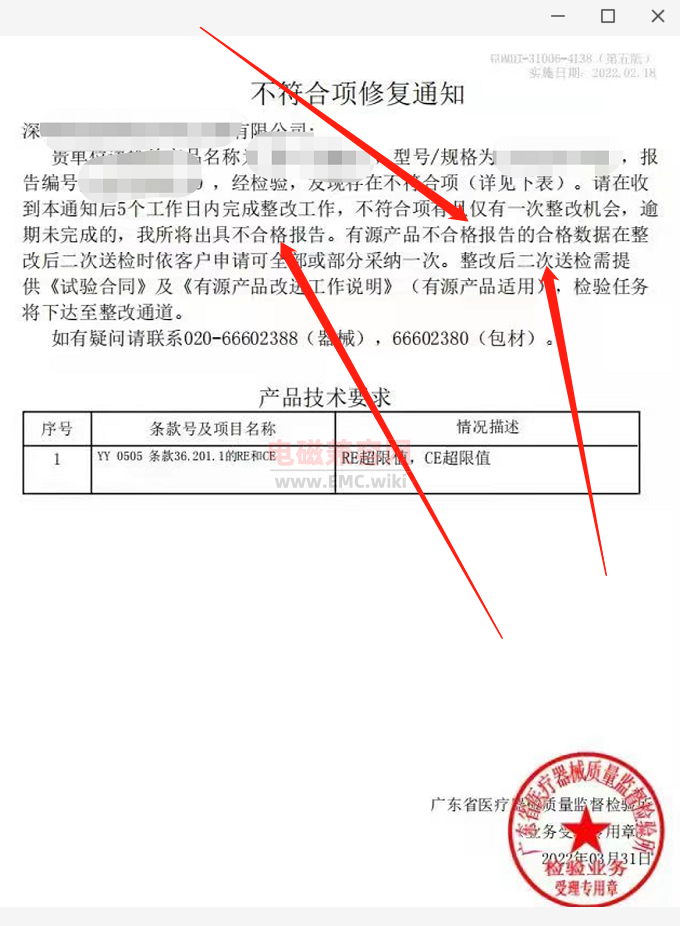
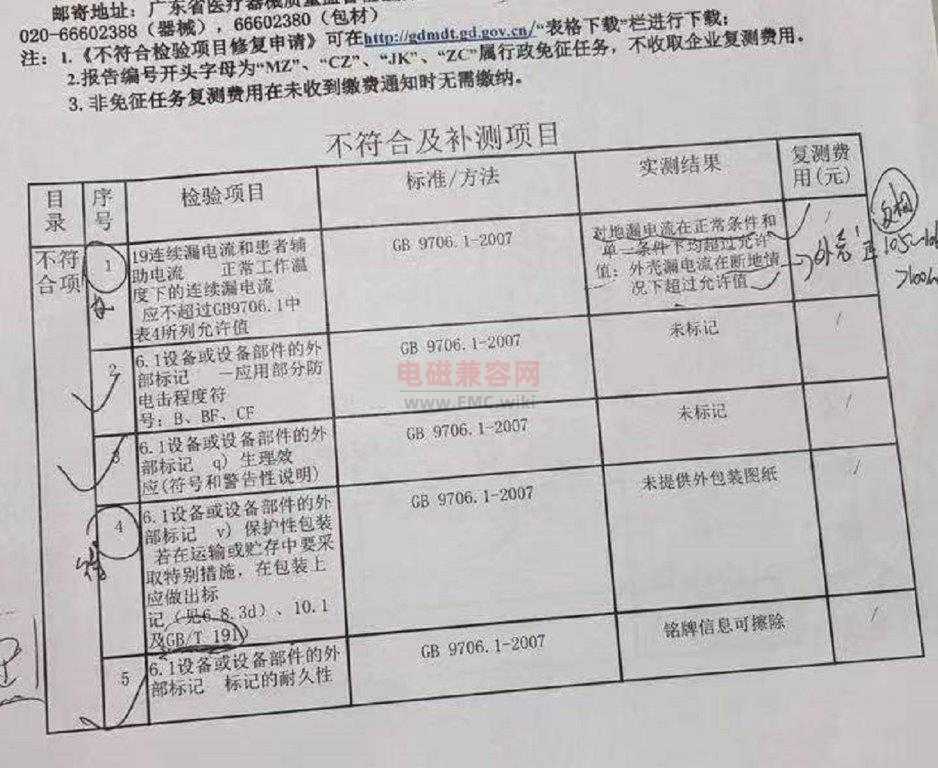
Provide emc test, EMC debug, safety leakage current test, safety withstand voltage test, safety grounding resistance test of medical device products, provide full project forecast service of medical device products, commissioned inspection report service, CNAS report, CMA report, high Low temperature, reliability test, data discrepancy investigation between medical device product laboratories, product EMC and safety regulation instability investigation. Provide EMC electromagnetic compatibility YY 0505-2012 / YY 9706.102-2021 standard training services, provide SAFETY safety regulations GB 9706.1-2007 / GB 9706.1-2020 standard training services, provide on-site training, on-site rectification services.
On April 18, 2022, ITL Testing was authorized by the CQC entrusted testing laboratory of China Quality Certification Center. Since then, it has won another important honor on behalf of ITL Hongnuo Testing Laboratory in the field of quality technology. As well as a good cooperative relationship with CQC, it can provide enterprises with the well-known CQC certification in China, so that the product quality of the enterprise can be improved, the recognition degree and the reputation of the enterprise can be enhanced.
ITL Testing has successively obtained national CNAS accreditation, CMA accreditation, NVLAP accreditation, and CB laboratory authorization, and has large laboratories in Guangzhou and Dongguan. It can provide professional one-stop testing and certification services for electronic and electrical products of enterprises.
CQC laboratory product category
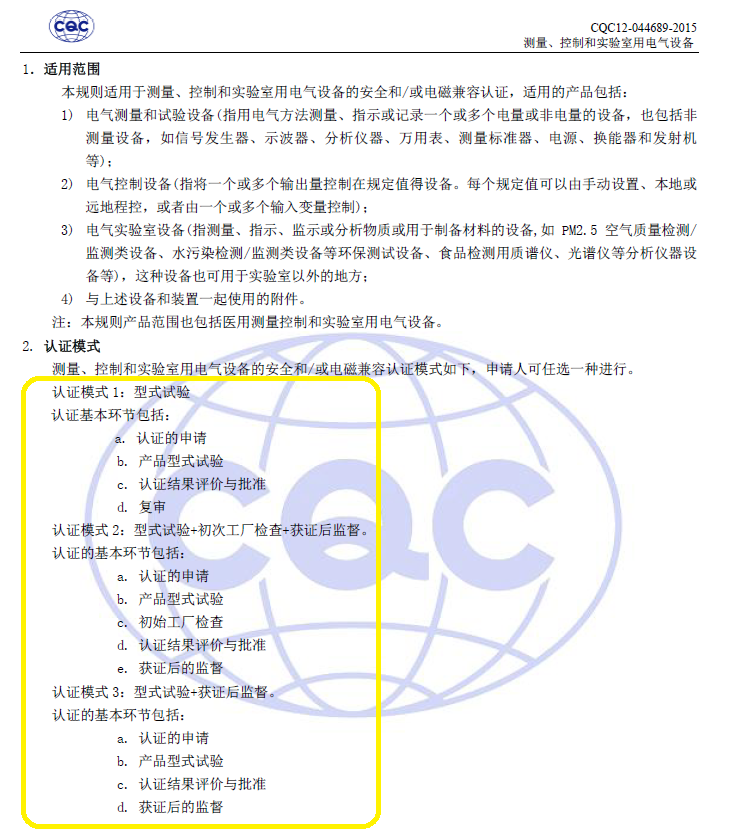
ITL Testing has obtained the safety and/or electromagnetic compatibility certification laboratory license of CQC-approved electrical equipment for measurement, control and laboratory use (ITL Hongnuo can issue a test report, and then ask CQC to apply for a CQC certificate). Applicable products include :
1) Electrical measurement and test equipment (referring to equipment that measures, indicates or records one or more electrical quantities or non-electrical quantities by electrical means, and also includes non-measurement equipment, such as signal generators, oscilloscopes, analytical instruments, multimeters, measurement standards, power supplies, transducers and transmitters, etc.);
2) Electrical control equipment (referring to equipment that controls one or more output quantities at specified values. Each specified value can be manually set, locally or remotely programmed, or controlled by one or more input variables);
3) Electrical laboratory equipment (referring to equipment for measuring, indicating, monitoring or analyzing substances or for preparing materials, such as PM2.5 air quality testing/monitoring equipment, water pollution testing/monitoring equipment and other environmental testing equipment, food Mass spectrometers, spectrometers and other analytical instruments and equipment for detection, etc.), which can also be used outside the laboratory;
4) Accessories for use with the above equipment and devices. Note: The product scope of this rule also includes medical measurement control and laboratory electrical equipment.
Charges for testing electrical equipment and accessories for CQC measurement, control and laboratory use
Total reference testing fee: 16840-30000 (different testing fees will be charged according to the structure, function or testing standard of the product)
Application fee certificate fee 1600
The factory inspection fee for the first application is about 6000
3 authentication modes
For more information about CQC certification, you can contact Mr Zeng xiangweizeng@gmail.com
UN ECE publishes the list of countries (contracting parties) for Regulation 10 (Uniform provisions concerning the approval of vehicles with regard to electromagnetic compatibility). They are updating the list depending on the version of ECE R10. They updated the list on 24 February 2021 according to revision 06.
Each country is represented with a unique ECE R10 symbol and has a designated type approval authority. For instance, Ireland’s ECE R10 symbol is E24 and its designated type approval authority is NSAI.
ECE R10 symbols, together with unique type-specific numbers, are used on type approval certificates of the products. Type approval certificates are issued by designated type approval authorities which are mostly governmental organizations.
ECE R10 Symbols
Contracting Parties
Designated Type Approval Authority(ies)
E1
Germany
Kraftfahrt-Bundesamt (KBA)PRO EMV Labor
E2
France
Ministère de la Transition Ecologique et Solidaire CNRV
E3
Italy
Ministero delle Infrastrutture e dei Trasporti Dipartimento
E4
Netherlands
RDW
E5
Sweden
Transportstyrelsen (Swedish Transport Agency)
E6
Belgium
Service Public fédéral (SPF) Mobilité et Transports
E7
Hungary
Innovációs és Technológiai Minisztérium
E8
Czech Republic
Ministry of Transport
E9
Spain
Ministerio de Industria
E10
Serbia
Road Traffic Safety Agency
E11
United Kingdom
Vehicle Certification Agency (VCA)
E12
Austria
Bundesministerium für Verkehr
E13
Luxembourg
Ministère de la Mobilité et des Travaux publicsSociété Nationale de Certification et d’Homologation (SNCH)
E14
Switzerland
OFROU
E16
Norway
Vegdirektoratet
E17
Finland
Finnish Transport and Communications Agency
E18
Denmark
Danish Road Traffic Authority
E19
Romania
Ministerul Transporturilor si Infrastructurii
E20
Poland
Transportowy Dozor Techniczny (TDT)
E21
Portugal
Instituto da Mobilidade e dos Transportes (IMT)
E22
Russian Federation
Federal Agency on Technical Regulating and Metrology (NAMI)
E23
Greece
Ministry of Transport and Communications
E24
Ireland
National Standards Authority of Ireland (NSAI)
E25
Crotia
State Office for Metrology Independent Service for Type Approval of Motor Vehicles
E26
Slovenia
Slovenia Traffic Safety Agency – Vehicle Department
E27
Slovakia
Ministry of Transport and Construction
E28
Belarus
State Committee for Standardization (Gosstandart)
E29
Estonia
Estonian Road Administration
E30
Republic of Moldova
not announced yet
E31
Bosnia and Herzegovina
not announced yet
E32
Latvia
Road Traffic Safety Directorate
E34
Bulgaria
Ministry of Transport, Executive Agency Road Transport Administration
E35
Kazakhstan
Committee of Technical Regulation and Metrology of the Ministry of Investment and Development (CTRM)
E36
Lithuania
Lithuanian Transport Safety Administration
E37
Turkey
Ministry of Industry and Technology
E39
Azerbaijan
not announced yet
E40
North Macedonia
Ministry of Economy
E42
European Union
not assigned
E43
Japan
Ministry of Land, Infrastructure, Transport and Tourism
E45
Australia
not announced yet
E46
Ukraine
Ministry of Infrastructure
E47
South Africa
National Regulator for Compulsory Specifications (NRCS)
E48
New Zealand
not announced yet
E49
Cyprus
Road Transport Department
E50
Malta
Malta Standards Authority
E51
Republic of Korea
not announced yet
E52
Malaysia
Road Transport Department (JPJ)
E53
Thailand
not announced yet
E54
Albania
not announced yet
E55
Armenia
National Body for Standards and Metrology (CJSC)
E56
Montenegro
not announced yet
E57
San Marino
Autorità per l’Omologazione
E58
Tunisia
Agence Techique des Transports Terrestres
E60
Georgia
not announced yet
E62
Egypt
Ministry of Trade and Industry
E63
Nigeria
not announced yet
E64
Pakistan
not announced yet
Above list shows the countries which are contracting parties for UN ECE Regulation 10. List is derived from official publication which is named as ECE/TRANS/WP.29/343/Rev.29/Add.1 and published on 24 February 2021 by ECE.
Frequently Asked Questions about ECE R10 countries and country codes
1. Are ECE R10 symbols identical in each country?
Yes, within UN ECE member states, Regulation 10 certifications are identical. For instance if designated type approval authority of Ireland has issued your product’s type approval, you will have ECE R10 symbol of E24 and this is valid within all UN ECE member states. Thus, single E marking cover all countries listed on the list.
2. What Designated Type Approval Authorities do?
They issue type approval certificates. They mostly issue certificates with their Designated Technical Service(s).
3. What Designated Technical Services do?
They receive type approval application documents, check and review them. When the documents submitted by the applicant (manufacturer, exporter or importer) are ready for certification they sent them to Designated Type Approval Authority.
4. What GZSAdoes?
We collaborate with Designated Technical Services and help manufacturers, exporters or importers to certify their products according to recent version of UN ECE R10. We are both offering EMC testing and type approval services according to UN ECE Regulation Revision 6.
5. Which country codes GZSA offers?
Currently, we are offering E1(Germany) and E24(Ireland) marking services.
ECE R10 is one of the regulations published by The United Nations Economic Commission for Europe (UNECE) for automotive industry. UNECE has 56 member states as of 18 February 2020. ECE R10 is defining Electromagnetic Compatibility requirements of the vehicles and electronic sub assemblies (ESAs) used in automotive. It explains both EMC tests and type approval of the product.
WHICH PRODUCTS ARE UNDER THE SCOPE OF ECE R10?
As given on the scope of ECE R10, the regulation applies to:
1.1. Vehicles of categories L, M, N O, T, R and S1 with regard to electromagnetic compatibility;
1.2. Components and separate technical units intended to be fitted in these vehicles with the limitation given in paragraph 3.2.1. with regard to electromagnetic compatibility.
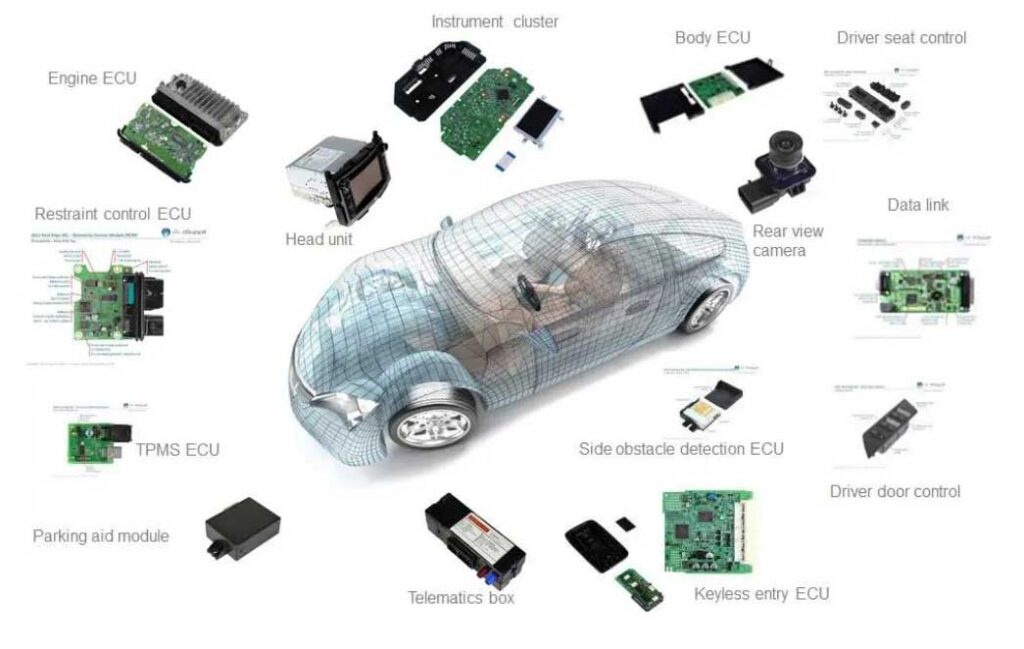
1.3. It covers: (a) Requirements regarding the immunity to radiated and conducted disturbances for functions related to direct control of the vehicle, related to driver, passenger and other road users’ protection, related to disturbances, which would cause confusion to the driver or other road users, related to vehicle data bus functionality, related to disturbances, which would affect vehicle statutory data; (b) Requirements regarding the control of unwanted radiated and conducted emissions to protect the intended use of electrical or electronic equipment at own or adjacent vehicles or nearby, and the control of disturbances from accessories that may be retrofitted to the vehicle; (c) Additional requirements for vehicles and ESAs providing coupling systems for charging the REESS regarding the control of emissions and immunity from this connection between vehicle and power grid.
WHICH VERSIONS OF ECE R10 ARE PUBLISHED?
Version of ECE R10 is mentioned as ECE R10Rev.6, ECE R10Rev.5 or ECE R10Rev.4. The latest version is Revision 6 and it has been officially published by UN ECE. On 30 October 2020, United Nations published an amendment for ECE R10 Rev.6. ECE R10 regulations and its amendments are free documents, you can download them by visiting official website of UN ECE. However, you can not reach test standards mentioned in the regulation since most of the test standards are not free of charge. If you need to check the details of standards you have to purchase them from web store of the standard publisher. Alternatively, you can ask Testups any technical questions about the tests.
WHAT ARE THE OTHER REGULATIONS PUBLISHED BY UN ECE?
ECE R10 is not the only regulation published by UN ECE. There are 160 regulations published by UN ECE. Each regulation specify requirements of the different types of vehicles or components that will be used on that vehicles.
DIFFERENT LANGUAGE VERSIONS OF ECE R10
There are three language options for ECE R10 regulation published by The United Nations Economic Commission for Europe (UNECE). You can click below links to reach English, French or Russian.
ECE R10 Rev 6 English
ECE R10 Rev 6 French
ECE R10 Rev 6 Russian
ECE R10 Rev 6 Deutsch is not available. However, you can get some general information about ECE regulations in German by clicking here.
ECE R10 TESTING
UN ECE R10 explains how to perform EMC tests and there are various test standards that are applied. Each test and test setup is explained in detail. UN ECE R10 EMC Tests can be categorized into two groups: emission and immunity. Emission and immunity tests are performed according to referred test standards. The standards referred to UN ECE R10 Revision 6 are listed below:
CISPR 12, CISPR 16-1-4, CISPR 25, ISO 7637-2, ISO-EN 17025, ISO 11451, ISO 11451-1, ISO 11451-2, ISO 11451-4, ISO 11452, ISO 11452-1, ISO 11452-2, ISO 11452-3, ISO 11452-4, ISO 11452-5, ITU Radio Regulations, edition 2008, IEC 61000-3-2, IEC 61000-3-3, IEC 61000-3-11, IEC 61000-3-12, IEC 61000-4-4, IEC 61000-4-5, IEC 61000-6-3, CISPR 16–2–1, CISPR 22, CISPR 16-1-2, IEC 61851-1 and CISPR 32.
What are immunity related functions?
ECE R10 mentions immunity related functions of the vehicle. This defines the test plan since products with immunity related functions need much more testing. “Immunity related functions” are listed as six function categories. This list is not exhaustive and shall be adapted to the technical evolution of vehicle or technology.
1) Functions related to the direct control of the vehicle:
By degradation or change in: e.g. engine, gear, brake, suspension, active steering, speed limitation devices;
By affecting drivers position: e.g. seat or steering wheel positioning;
By affecting driver’s visibility: e.g. dipped beam, windscreen wiper, indirect vision systems, blind spot systems.
2) Functions related to driver, passenger and other road user protection:
E.g. airbag and safety restraint systems, emergency calling systems;
3) Functions which, when disturbed, cause confusion to the driver or other road users:
Optical disturbances: incorrect operation of e.g. direction indicators, stop lamps, end outline marker lamps, rear position lamp, light bars for emergency system, wrong information from warning indicators, lamps or displays related to functions in subparagraphs (a) or (b) which might be observed in the direct view of the driver;
Acoustical disturbances: incorrect operation of e.g. anti-theft alarm, horn.
4) Functions related to vehicle data bus functionality:
By blocking data transmission on vehicle data bus-systems, which are used to transmit data, required to ensure the correct functioning of other immunity related functions.
5) Functions which when disturbed affect vehicle statutory data: e.g. tachograph, odometer;
6) Function related to charging mode when coupled to the power grid:
For vehicle test: by leading to unexpected vehicle motion;
For ESA test: by leading to an incorrect charging condition (e.g. over-current, over-voltage).
How to apply ECE R10 tests?
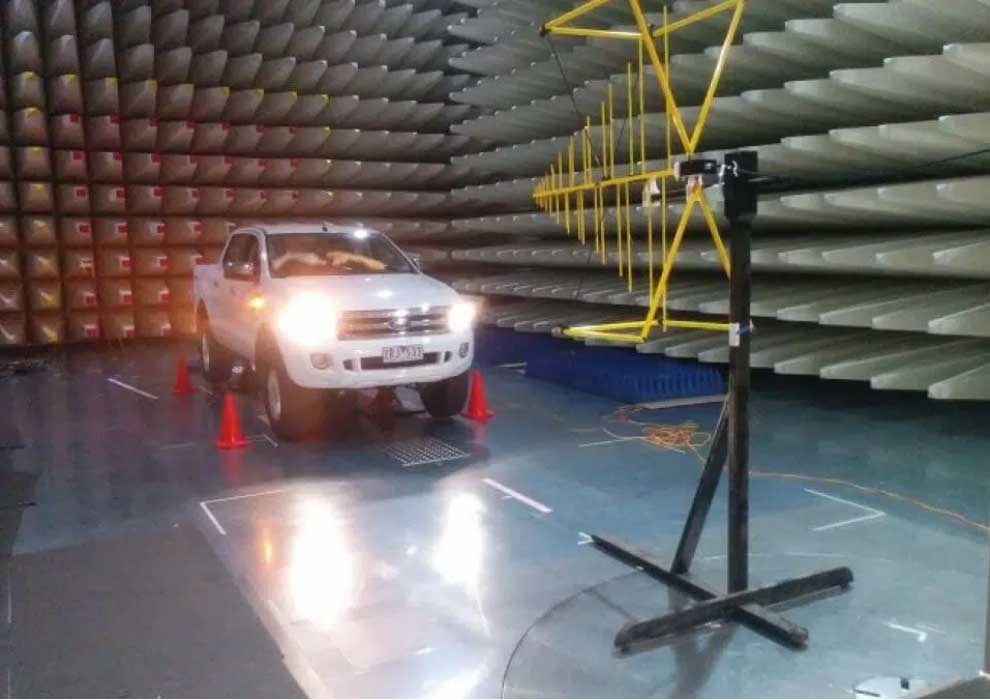
EMC tests are performed according to relevant clauses of ECE R10 regulation at EMC testing laboratories. EMC testing laboratories which are able to perform ECE R10 tests, are equipped with IEC, ISO or CISPR compliant EMC test chambers and equipments. Test experts check the product features and functions and make a test plan according to applicable ECE R10 EMC tests. Emission and immunity tests are performed. As Testups offers, ECE R10 tests can be finished in 4 weeks, if the product passes all product-specific EMC tests listed on the regulation and referred standards. After passing all applicable ECE R10 tests, test report is issued for the product (vehicle or ESA). This test report shows the ECE R10 test results of the product and it is required if the product also needs ”E-mark” or type approval according to UN ECE R10.
ECE R10 TYPE APPROVAL OR HOMOLOGATION
After ECE R10 tests are done and PASS test report issued, Type Approval or Homologation (E-marking) can be also issued for the product. In this step, ECE R10 test report, technical documents of the product and quality documents (like valid ISO 9001 certificate) of the manufacturing or/and distributor company are checked by a third party and authorized agency. They are also called designated technical service. If all product and company documents are submitted properly, E mark including a unique number can be affixed or labeled on the product.
Examples of approval marks
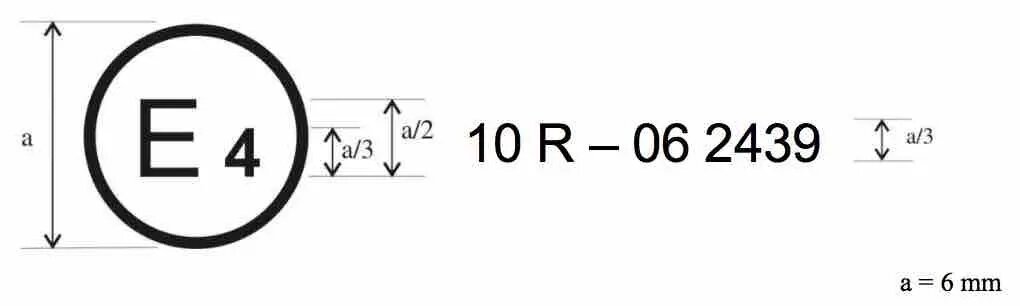
The below approval mark affixed to a vehicle or ESA shows that the vehicle type concerned has, with regard to electromagnetic compatibility, been approved in the Netherlands (E 4) pursuant to Regulation No. 10 under approval No. 05 2439. The approval number indicates that the approval was granted according to the requirements of Regulation No. 10 as amended by the 06 series of amendments.
Which countries are covered by ECE R10?
There are 57 countries which are under the scope of UN ECE Regulation 10. Each country has a ECE symbol and designated type approval authority. For instance for Ireland, ECE symbol is E24 and designated type approval authority is NSAI. For whole list of ECE R10 countries visit this page: ECE R10 Countries
COSTS FOR EMC TESTING AND TYPE APPROVAL
There are two cost item for ECE R10 compliance: testing and type approval.
What are the costs for ECE R10 EMC testing?
EMC testing costs depend on the features of the product, test plan, and location of test laboratory. If your product is a simple electronic sub assembly which has no immunity related function, reduced EMC tests are allowed. This will make costs lower. For such a simple product operating at a single voltage and with a single operation mode, ECE R10 testing costs will change in this range: 2.500 – 3.000 EUR.
What are the costs for ECE R10 Type Approval?
Type approval costs depend on the agency or country issuing the type approval. Although E1(Germany) and E24(Ireland) marks are technically identical, E1 marking takes some much more time and a bit expensive than E24 due to authorized agency costs. ECE R10 type approval (E marking) costs will change in this range: 1.500 – 2.000 EUR.
How to reduce ECE R10 testing costs ?
If you are suffering from the costs for ECE R10 testing and type approval, take into account suggestions listed below:
Check ECE R10 EMC tests during the design stage of your products. Early testing would save you time and money since you would have opportunity to get test results before serial production.
Use same or similar electronic components when designing your products. Using similar electronic components would increase the probability of the PASS ratio of test results. If you use various types of electronic components, ensure that they have been EMC tested or certified.
Group similar products in terms of electromagnetic compatibility and reduce number of model names with product family names. ECE R10 allows product grouping if technically applicable. When defining your product model names, try to group them under a product family model names.
Start testing with pre-compliance EMC tests during design validation stage of your products, this would save time and cost during ECE R10 certification. If an electronic product or vehicle never tested before, it would probably fail at one of ECE R10 tests. Pre-compliance testing would save you time and money even it seems causing extra costs.
Try to perform some EMC tests in house by having EMC test equipments (if you regularly need ECE R10 testing or type approval service). Work on investing on some of the EMC test instruments and prepare test setups which are most essential for your product. By in house testing, you would get opportunity to design your product more comfortable and to check your product’s EMC performance during its pilot or serial production.
Build a UN ECE R10 compliant EMC test laboratory (if you have various products that need ECE R10 testing or type approval service). UN ECE R10 compliant test laborotory needs some expert staff like test engineers and technicians. If your team can handle these laboratory operations, building a new test laboratory would make you much more comfortable in terms of electromagnetic compatibility of your products. If you would like go further, have accreditation or authorisation for your laboratory to show your lab’s independency and satisfy your customers.
Regulation No 10 of the Economic Commission for Europe of the United Nations (UN/ECE) — Uniform provisions concerning the approval of vehicles with regard to electromagnetic compatibility
ECE Regulation R10 of the Economic Commission for Europe of the United Nations (UN/ECE), the body responsible for implementing global trade agreements within Europe, addresses electromagnetic compatibility (EMC) issues and applying to vehicles of categories L, M, N O, T, R and S. The regulation requires manufacturers to gain type approval for all vehicles, electronic sub-assemblies, components and separate technical units.
ECE Regulation R10 covers the requirements regarding the immunity to radiated and conducted disturbances related to direct control of the vehicle, the driver, passenger and other road users’ protection. The regulation addresses disturbances which would cause confusion to the driver or other road users, related to vehicle data bus functionality. ECE Regulation R10 also addresses requirements regarding the control of unwanted radiated and conducted emissions to protect the intended use of electrical or electronic equipment from nearby or adjacent vehicles and the control of disturbances from accessories that may be retrofitted to the vehicle.
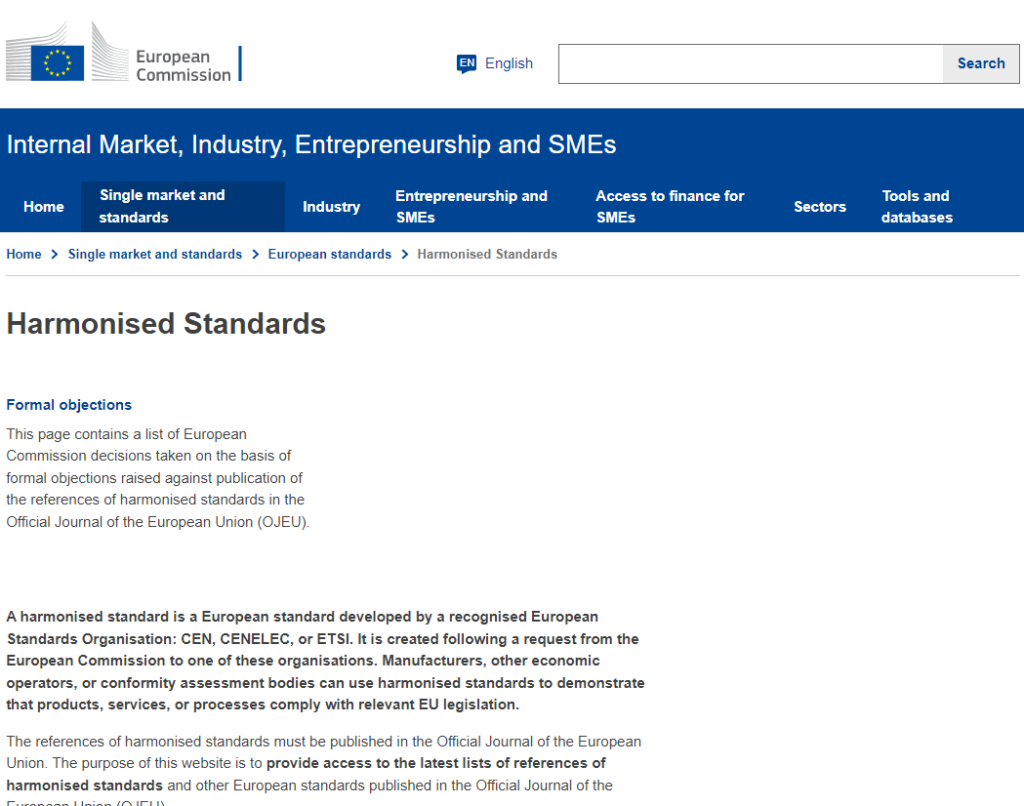
This page contains a list of European Commission decisions taken on the basis of formal objections raised against publication of the references of harmonised standards in the Official Journal of the European Union (OJEU).
A harmonised standard is a European standard developed by a recognised European Standards Organisation: CEN, CENELEC, or ETSI. It is created following a request from the European Commission to one of these organisations. Manufacturers, other economic operators, or conformity assessment bodies can use harmonised standards to demonstrate that products, services, or processes comply with relevant EU legislation.
The references of harmonised standards must be published in the Official Journal of the European Union. The purpose of this website is to provide access to the latest lists of references of harmonised standards and other European standards published in the Official Journal of the European Union (OJEU).
References of harmonised standards and of other European standards published in the OJEU
Accessibility
Websites and mobile applications of public sector bodiesSearch for available translations of the preceding
Chemicals
Chemical substances (REACH)Search for available translations of the preceding
Explosives for civil usesSearch for available translations of the preceding
Pyrotechnic articlesSearch for available translations of the preceding
Conformity assessment and management systems
New Legislative Framework (NLF) and Eco-Management and Audit Scheme (EMAS)Search for available translations of the preceding
Construction
Construction products (CPD/CPR)Search for available translations of the preceding
Consumers and workers protection
Cosmetics productsSearch for available translations of the preceding
General product safetySearch for available translations of the preceding
Personal protective equipment (PPE)Search for available translations of the preceding
Toys safetySearch for available translations of the preceding
Energy efficiency
Ecodesign and energy labellingSearch for available translations of the preceding
Electric and electronic engineering
Electromagnetic compatibility (EMC)Search for available translations of the preceding
Equipment for explosive atmospheres (ATEX)Search for available translations of the preceding
Low Voltage (LVD)Search for available translations of the preceding
Radio Equipment (RED)Search for available translations of the preceding
Restriction of the use of certain hazardous substances (RoHS)Search for available translations of the preceding
Healthcare engineering
In vitro diagnostic medical devices (Regulation 2017/746)Search for available translations of the preceding
Medical devices (Regulation 2017/745)Search for available translations of the preceding
Active implantable medical devices (Directive 90/385/EEC)Search for available translations of the preceding
In vitro diagnostic medical devices (Directive 98/79/EC)Search for available translations of the preceding
Medical devices (Directive 93/42/EEC)Search for available translations of the preceding
Measuring technology
Measuring instruments (MID)Search for available translations of the preceding
Non-automatic weighing instruments (NAWI)Search for available translations of the preceding
Mechanical engineering and means of transport
Cableway installations designed to carry personsSearch for available translations of the preceding
Equipment for explosive atmospheres (ATEX)Search for available translations of the preceding
Gas appliances (GAR)Search for available translations of the preceding
Inspection of pesticide application equipmentSearch for available translations of the preceding
LiftsSearch for available translations of the preceding
Machinery (MD)Search for available translations of the preceding
Pressure equipment (PED)Search for available translations of the preceding
Rail system: interoperabilitySearch for available translations of the preceding
Recreational craft and personal watercraftSearch for available translations of the preceding
Simple Pressure Vessels (SPVD)Search for available translations of the preceding
Unmanned aircraft systems (UAS)Search for available translations of the preceding
Services
Community postal servicesSearch for available translations of the preceding
Sustainability
Packaging and packaging wasteSearch for available translations of the preceding
Use of harmonised standards
The use of these standards remains voluntary. Manufacturers, other economic operators, or conformity assessment bodiesSearch for available translations of the preceding linkEN••• are free to choose another technical solution to demonstrate compliance with the mandatory legal requirements.
Within the context of some directives or regulations, voluntary European standards supporting the implementation of legal requirements are not called “harmonised standards”. This legislation is also included in this information service if:
legislation foresees a need for a Commission standardisation request to European Standards Organisations;
publication of references in the Official Journal of the European Union is foreseen as a precondition for presumption of conformity or for other legal effect.
Official website : https://ec.europa.eu/growth/single-market/european-standards/harmonised-standards_en
Prepackaged (or prepacked) products sold in any EU country must provide information on the package specifying the nominal quantity (weight or volume) of their contents. Examples of prepackaged products include:
food
drinks
cosmetics
cleaning products
The ℮-mark, placed next to the nominal quantity, shows that you have complied with the relevant European laws. You can add it to prepackaged products that you sell individually at a constant volume (for liquid products) or weight (for other products) which has been chosen in advance. ℮-mark can be placed on products whose weight or volume falls between the following values:
minimum 5 grams or 5 millilitres
maximum 10 kilograms or 10 litres
Is it mandatory?
The ℮-mark is not mandatory. However, having it affixed to your products enables you to sell them in all EU countries without having to check whether you have complied with individual national requirements. The ℮-mark shows that a product complies with EU rules on the indication of the volume or weight and the measuring methods that you must use as a seller of prepackaged products.
What are the requirements?
To ensure that the quantity displayed is correct, ℮-marked packages must fulfil the following requirements:
the average quantity of product in packages coming from the same batch must be equal to or greater than the quantity mentioned on the package.
the nominal quantity refers only to the product. It does not include packaging or any materials used to protect the product, handle it (example: the stick of a lollipop), preserve it (example: ice) or serve as an aid while using it (example: serving tray).
only a limited proportion of the prepackaged products from the same batch may have a smaller amount of product than indicated on the package. This is referred to as “tolerable negative error” and it is set in the annex 1 of the EU legislation.
The presence of the ℮-mark does NOT mean that the quantity of a product has been estimated. It means that the weight and volume have been measured according to EU rules, using instruments that meet the requirements of EU legislation
How do you affix it?
The ℮-mark should be printed on the package next to the indication of the weight or volume. The font height should be minimum 3 millimetres. The ℮-mark and indication of quantity should be displayed on the front of the pack. The quantity must be shown in figures and followed by the unit of measurement (grams, kilograms, millilitres, centilitres or litres) or its abbreviation (g, kg, ml, cl or l).
Quality checks and inspections
As a packer, you must ensure that the packages you fill meet the requirements. For this, you need to:
use officially recognised measuring equipment and procedures for packaging the products
keep records of checks you perform to ensure that the measuring is done correctly
As an importer, you need to provide proof that the prepackaged products you import meet the requirements. This proof can be the recorded checks mentioned above.
National authorities perform inspections to check if your ℮-marked products meet the requirements. They can do that at the packing facility or elsewhere in the distribution chain.
On specific requirements in a particular EU country and for more information on inspections, check with the national authorities.
If you manufacture products which you believe have outstanding environmental features, they might qualify to use the EU Ecolabel. Today, over 37 000 products sold on the EU market bear the EU Ecolabel, meaning that they comply with rigorous ecological criteria.
EU Ecolabel criteria are defined for a wide range of product groups. Check whether they exist for your product.
Benefits
The EU Ecolabel:
demonstrates to your customers and consumers that your product meets strict ecological criteria, making their choice in favour of your product easy.
is third-party verified and it is recognised in all EU countries;
enhances your reputation by showing environmental responsibility.
How to apply?
There is a 7-step application process. The label is awarded by the relevant national organisation (Competent Body) that checks your application.
Fees
A one-off application feeand an annual fee are payable to the Competent Body that processes the application.
Application for the EU Ecolabel demands the fee of:
EUR 200 – 350 for micro-enterprises;
EUR 200 – 600 for SMEs and companies from developing countries;
EUR 200 – 2000 for all other companies.
30% reduction for companies registered under EMAS or 15% reduction for companies certified under ISO 14001. Reductions are not cumulative and only the higher reduction applies where both systems are met.
A maximum annual fee for use of the Ecolabel has been capped at:
EUR 18 750 for micro-enterprises, SMEs and businesses, and applicants from developing countries;
EUR 25 000 for all other companies.
The annual fee can be a flat rate or based on the annual value of sales within the EU of the product awarded the EU Ecolabel. Where the annual fee is calculated as a percentage of the annual sales value, it will not be more than 0.15% of that value. In the case of SMEs, micro-enterprises or applicants from developing countries, the annual fee is reduced by at least 25%.
Official website: https://ec.europa.eu/environment/ecolabel/products-groups-and-criteria.html
If you intend to sell shoes or other footwear in one or more EU Countries, your products must comply with EU labelling requirements. As a manufacturer, you are responsible for supplying the label and for its accuracy. If the footwear is imported, the organisation that first places it on the EU market assumes this responsibility.
Are footwear labels mandatory?
Footwear labels are mandatory in the EU. According to EU rules, the term “footwear” refers to all articles with applied soles designed to protect or cover the foot. For example:
flat or high-heeled shoes
sandals
boots
slippers
espadrilles
sports shoes (including specialist sports shoes and those with skates attached)
There may be additional requirements, depending on the country where you plan to market the footwear.
What information should be displayed?
When you describe the materials and indicate the parts of the footwear, you should use the pictograms in the EU legislation, or a written indication in the languages of the EU country where you want to market your footwear. Your labelling must describe the materials of the 3 main parts of the footwear:
the upper
the lining and insole
the outer sole
In each case, the label should state whether the material is made of:
leather
coated leather
textile
other materials
If no single material accounts for at least 80% of the product, the label should indicate the 2 main materials used.
How do you affix the footwear label?
You must attach the labelling to at least one of the pair of shoes. You can do this by printing, sticking, embossing or tying the label to the shoe.
The labelling must be visible, securely attached and accessible, and the dimensions of the pictograms must be sufficiently large to make it easy to understand.
If you want to give your footwear a recognised sign of environmental excellence, check if you can also apply for an EU Ecolabel.
The symbol indicates that the product should not be discarded as unsorted waste but must be sent to separate collection facilities for recovery and recycling. The WEEE marking must appear on any electrical and electronic equipment placed on the EU market.
Is it mandatory?
With a few exceptions, most electrical and electronic equipment sold in the EU must bear a specific marking. WEEE labels are mandatory for the following product categories:
temperature exchange equipment, such as fridges and air-conditioning units
screens, monitors, and equipment containing screens having a surface greater than 100 cm²
lamps
large equipment (any external dimension more than 50 cm) such as washing machines, copy machines, rooftop solar panels
small equipment (external dimension less than 50 cm) such as vacuum cleaners, smoke detectors, clocks and watches
small IT and telecommunications equipment (no external dimension more than 50 cm)
A detailed list of the appliances that fall under each product category is provided in the annex of the EU directive.
How do you affix the label?
Your electrical and electronic equipment must bear:
the symbol of the crossed-out wheeled bin
your identification mark, such as brand name or trademark
If your product has been placed on the market after 13 August 2005, you can either:
add a bar underneath the crossed-our wheeled bin symbol, or
specify the date that the product was placed on the market
These inscriptions must be printed on the product itself and should be permanent, clearly visible and readable. The label could be printed on the packaging, the instructions or the warranty leaflet and not on the product itself only if the product’s size is too small or if its function is affected by the marking.
What are the costs related to the WEEE label?
Registration and reporting to the national register are free. However, there are financial obligations related to waste responsibilities, which may vary from one EU country to another.
Waste responsibilities
In addition to registering and affixing the WEEE label, your obligations also extend to the end-of-life phase of your products.
Read more about the registration process and your waste responsibilities for electrical and electronic equipment.
rank appliances on a scale from A to G according to how much energy they consume
help consumers save money by choosing products that consume less energy
can encourage companies to design products that consume less energy
Class A (green) appliances consume the least energy – making them the most energy‑efficient. Class G (red) appliances consume the most energy.
EU rules on energy labelling also apply to some ‘energy‑related products’: goods or systems with an impact on energy consumption during use. The rules do not apply to second-hand products or to means of transport for persons or goods.
Label rating system without the plus sign
Since March 2021, the energy label rating system uses A to G rankings only, instead of A+++ to D ratings as before. This new rating system applies to the following product groups:
refrigerators
dishwashers
washing machines
televisions
light bulbs and lamps
The first 4 product groups must feature the rescaled labels from 1 March 2021. Light bulbs and lamps must feature the rescaled label from 1 September 2021.
Products that require labels
For certain product groups, an energy label must be clearly displayed on each product at the point of sale.