Energy labels

Energy labels:

  • rank appliances on a scale from A to G according to how much energy they consume
  • help consumers save money by choosing products that consume less energy
  • can encourage companies to design products that consume less energy

Class A (green) appliances consume the least energy – making them the most energy‑efficient. Class G (red) appliances consume the most energy.

EU rules on energy labelling also apply to some ‘energy‑related products’: goods or systems with an impact on energy consumption during use. The rules do not apply to second-hand products or to means of transport for persons or goods.

Label rating system without the plus sign

Since March 2021, the energy label rating system uses A to G rankings only, instead of A+++ to D ratings as before. This new rating system applies to the following product groups:

  • refrigerators
  • dishwashers
  • washing machines
  • televisions
  • light bulbs and lamps

The first 4 product groups must feature the rescaled labels from 1 March 2021. Light bulbs and lamps must feature the rescaled label from 1 September 2021.

Products that require labels

For certain product groups, an energy label must be clearly displayed on each product at the point of sale.

Product categories that require energy labels

  • Light bulbs and lamps
  • Heaters
  • Fridges and freezers
  • Washing machines and driers
  • Air conditioners and fans
  • Electronic displays, including televisions
  • Kitchen appliances
  • Tyres

Energy efficient products

  • Lighting
  • Heaters
  • Refrigeration
  • Vacuum cleaners
  • Washing machines and driers
  • Air conditioners and fans
  • Electronic displays and TV boxes
  • Kitchen appliances
  • Pumps
  • Transformers and converters
  • Computers and servers
  • Imaging equipment
  • Game consoles
  • Electric motors
  • Tyres
  • Off mode, standby and networked standby
  • Welding equipment

Europa(Europe)- Ecodesign and Energy Labelling

Directive 2009/125/EC and Regulation (EU) 2017/1369

Short name:Ecodesign and Energy Labelling – Framework Directives
Base:Directive 2009/125/EC of the European Parliament and of the Council of 21 October 2009 establishing a framework for the setting of ecodesign requirements for energy-related products
OJ L 285, 31 October 2009Search for available translations of the preceding linkEN•••Regulation (EU) 2017/1369 of the European Parliament and of the Council of 4 July 2017 setting a framework for energy labelling and repealing Directive 2010/30/EU
OJ L 198, 28 July 2017, p. 1–23Search for available translations of the preceding linkEN•••
Modification:[-]
Directives repealed:Directive 2010/30/EU of the European Parliament and of the Council of 19 May 2010 on the indication by labelling and standard product information of the consumption of energy and other resources by energy-related products – OJ L 153, 18 June 2010Search for available translations of the preceding linkEN•••Directive 2005/32/EC of the European Parliament and of the Council of 6 July 2005 establishing a framework for the setting of ecodesign requirements for energy-using products and amending Council Directive 92/42/EEC and Directives 96/57/EC and 2000/55/EC of the European Parliament and of the Council – OJ L 191, 22 July 2005Search for available translations of the preceding linkEN•••Directive 2008/28/EC of the European Parliament and of the Council of 11 March 2008 amending Directive 2005/32/EC establishing a framework for the setting of ecodesign requirements for energy-using products, as well as Council Directive 92/42/EEC and Directives 96/57/EC and 2000/55/EC, as regards the implementing powers conferred on the Commission – OJ L 81, 20 March 2008Search for available translations of the preceding linkEN••• – Amendment Partial RepealCouncil Directive 92/75/EEC of 22 September 1992 on the indication by labelling and standard product information of the consumption of energy and other resources by household appliances – OJ L 297, 13 October 1992Search for available translations of the preceding linkEN•••
Guide for application:Guidance on CE marking for professionalsSearch for available translations of the preceding linkEN•••
Commission contact points:Directorate-General (DG) for Energy – Energy Efficiency Unit
Contact DG EnergySearch for available translations of the preceding linkEN•••
Energy label and ecodesignSearch for available translations of the preceding linkEN••• webpageDG for Internal Market, Industry, Entrepreneurship and SMEs, Clean Technologies and Products Unit
Email
EcodesignSearch for available translations of the preceding linkEN••• webpage
For information about the content and availability of European standards, please contact the European Standardisation OrganisationsSearch for available translations of the preceding linkEN•••.

Harmonised standards

There are no references of harmonised standards which have been published in the Official Journal of the European Union under the ecodesign and energy labelling framework directives.

To view the references of harmonised standards which have been published in the Official Journal under the ecodesign and energy labelling implementing measures, please select the short names below.

Implementing measures – Ecodesign and Energy labelling

Directives/ Regulations

  EcodesignEnergy Labelling
CirculatorsSearch for available translations of the preceding linkEN•••Circulators and glandless circulators integrated in products(EC) No 641/2009 
ComputersSearch for available translations of the preceding linkEN•••Computers and computer servers(EU) No 617/2013Search for available translations of the preceding linkEN••• 
Computers and small serversEnterprise servers and data storage products(EU) 2019/424Search for available translations of the preceding linkEN••• 
DishwashersSearch for available translations of the preceding linkEN•••Household dishwashers(EU) No 2019/2022(EU) No 2019/2017
Domestic ovens, hobs and range hoodsSearch for available translations of the preceding linkEN•••Domestic ovens, hobs and range hoods(EU) No 66/2014(EU) No 65/2014
Electric motorsSearch for available translations of the preceding linkEN•••Electric motors(EU) 2019/1781 
FansSearch for available translations of the preceding linkEN•••Industrial fans driven by motors(EU) No 327/2011 
Heating and cooling appliancesAir conditioners and comfort fansSearch for available translations of the preceding linkEN•••(EU) No 206/2012(EU) No 626/2011
Hot-water boilersSearch for available translations of the preceding linkEN•••92/42/EEC 
Water heaters and hot water storage tanksSearch for available translations of the preceding linkEN•••(EU) No 814/2013Search for available translations of the preceding linkEN•••(EU) No 812/2013Search for available translations of the preceding linkEN•••
Space heatersSearch for available translations of the preceding linkEN•••(EU) No 813/2013Search for available translations of the preceding linkEN•••(EU) No 811/2013Search for available translations of the preceding linkEN•••
Local space heaters, Solid fuel local space heatersSearch for available translations of the preceding linkEN•••(EU) 2015/1188Search for available translations of the preceding linkEN•••
(EU) 2015/1185Search for available translations of the preceding linkEN•••
(EU) 2015/1186Search for available translations of the preceding linkEN•••
Solid fuel boilersSearch for available translations of the preceding linkEN•••(EU) 2015/1189Search for available translations of the preceding linkEN•••(EU) 2015/1187Search for available translations of the preceding linkEN•••
Air heating products, cooling products, high temperature process chillers and fan coil unitsSearch for available translations of the preceding linkEN•••(EU) No 2016/2281Search for available translations of the preceding linkEN••• 
Power suppliesSearch for available translations of the preceding linkEN•••External power supplies(EU) 2019/1782Search for available translations of the preceding linkEN••• 
Refrigerated storage cabinetsSearch for available translations of the preceding linkEN•••Professional refrigerated storage cabinets, blast cabinets, condensing units and process chillers(EU) 2015/1095Search for available translations of the preceding linkEN•••(EU) 2015/1094Search for available translations of the preceding linkEN•••
Refrigerating appliancesSearch for available translations of the preceding linkEN•••Household refrigerating appliances(EU) 2019/2019Search for available translations of the preceding linkEN•••(EU) 2019/2016Search for available translations of the preceding linkEN•••
Set-top boxesSearch for available translations of the preceding linkEN•••Simple set-top boxes(EC) No 107/2009 
Standby and off modeSearch for available translations of the preceding linkEN•••Electric power consumption standby and off mode of electrical and electronic household and office equipment(EC) No 1275/2008
(EC) No 801/2013
 
TelevisionSearch for available translations of the preceding linkEN•••Television(EU) 2019/2021Search for available translations of the preceding linkEN•••(EU) 2019/2013Search for available translations of the preceding linkEN•••
TransformersSearch for available translations of the preceding linkEN•••Small, medium and large power transformers(EU) No 548/2014 
Tumble driersSearch for available translations of the preceding linkEN•••Household tumble driers(EU) No 932/2012(EU) No 392/2012
Vacuum cleanersSearch for available translations of the preceding linkEN•••Vacuum cleaners(EU) No 666/2013 
VentilationSearch for available translations of the preceding linkEN•••Ventilation units(EU) No 1253/2014Search for available translations of the preceding linkEN•••(EU) No 1254/2014Search for available translations of the preceding linkEN•••
Washing machines and washer-dryersSearch for available translations of the preceding linkEN•••Household washing machines and washer-dryers(EU) No 2019/2023(EU) No 2019/2014
Water pumpsSearch for available translations of the preceding linkEN•••Water pumps(EU) No 547/2012 
Welding equipmentWelding equipment(EU) 2019/1784 

Europa(Europe)- Product compliance – Ecodesign requirements

Before you can begin selling a product in an EU country, it must comply with the rules that apply in that country and throughout the EU. Once the product has been approved for sale in one country, it can then in principle be sold anywhere in the EU. In practice, individual EU countries do retain the right, in certain cases, to restrict the access to their market of products already sold in another EU country.

Different rules must be followed at each step of the process of bringing a product to market: planning, manufacturing, importing (for products manufactured outside the EU), distribution and the final sale to consumers or end-users. Many potential actors are involved.

Explore the interactive content below to find out what each actor does and what their EU‑related obligations are.

Manufacturers or the authorised representatives

Ecodesign requirements

There are certain products that must comply with minimum requirements related to energy efficiency. These are called ecodesign requirements and the aim is to reduce the negative environmental impact throughout the product’s lifecycle.

Before you place this type of product on the EU market you must ensure that they comply with these rules.

The product types currently covered by these rules are those that use energy (boilers, computers, household appliances etc.). You can see the full list below:

Products that must meet ecodesign requirements

Domestic and service industry lighting products:

  • Directional and non-directional lamps (including ultraviolet radiation)
  • Fluorescent lamps (without integrated ballast)
  • High-intensity discharge lamps
  • Ballasts and luminaires able to operate such lamps

Electrical devices:

  • Computers and servers
  • Game consoles
  • Simple/complex set-top boxes
  • Standby for networked equipment
  • Televisions

Household appliances:

  • Cookers
  • Dishwashers
  • Freezers
  • Refrigerators
  • Tumble dryers
  • Washing machines
  • Vacuum cleaners

Heating and cooling devices:

  • Air conditioners
  • Heaters
  • Comfort fans
  • Heaters
  • Industrial fans
  • Local space heaters
  • Solid fuel local space heaters
  • Solid fuel boilers
  • Ventilation units
  • Water heaters

Other products:

  • Circulators
  • Electric motors
  • Electric power consumption standby and off mode
  • External power supplies
  • Imagining equipment
  • Power transformers
  • Professional refrigeration
  • Water pumps

If you want to read about product-specific ecodesign regulations you can see the links in the references section at the bottom of the page.

Types of requirements

There are two types of requirements foreseen in the Ecodesign Directive.

Specific requirements

Specific requirements are when exact values are measured and a limit is given. For example, maximum energy consumption, or minimum quantities of recycled material to be used in production.

Generic requirements

Generic requirements do not set limit values, but may require that:

  • the product is ‘energy-efficient’ or ‘recyclable’
  • you provide information on how to use and maintain the product, to minimise its environmental impact
  • you perform a lifecycle analysis of the product to identify alternative design options and solutions for improvement

The introduction of new minimum requirements can result in a ban of all non-compliant products from being sold in EU countries. An example of this is incandescent lamps, which were gradually phased out from 2009.

Harmonised standards

Harmonised standards are rules that have been adopted by the European standardisation bodies (CENELEC and CEN).

The use of harmonised standards helps provide a presumption of conformity. This means that the products are presumed to comply with the requirements covered by implementing measures when tested using a harmonised standard.
 

Additional harmonised EU standards are gradually being produced to support the ecodesign measures adopted so far.

China Releases a National Standard -GB/T 17743-2021

The Chinese national standard GB/T 17743-2021 was released and officially implemented in July 2022

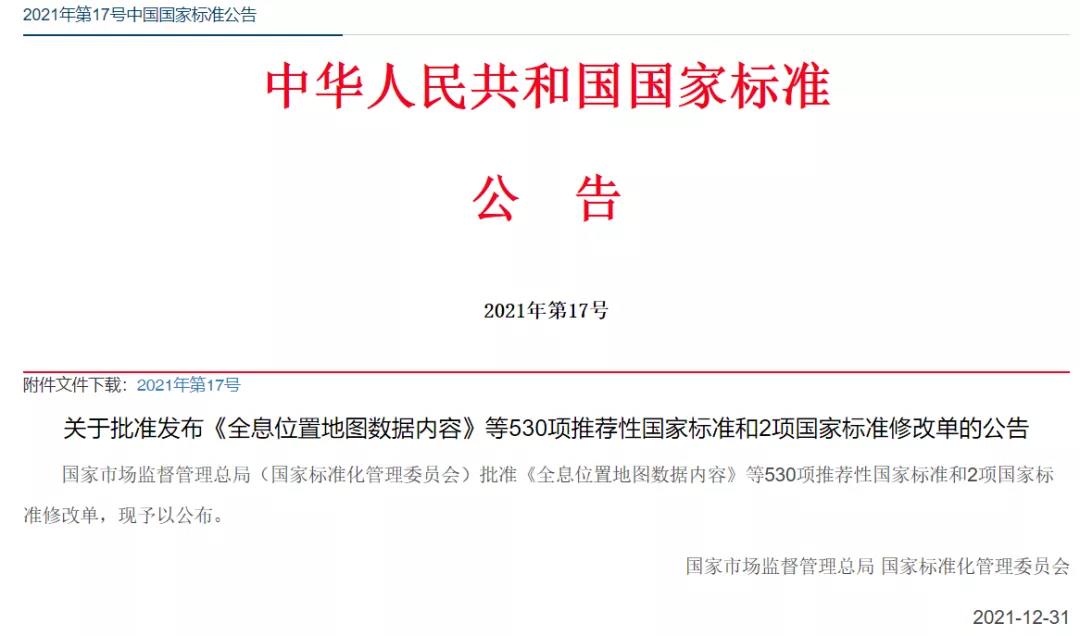
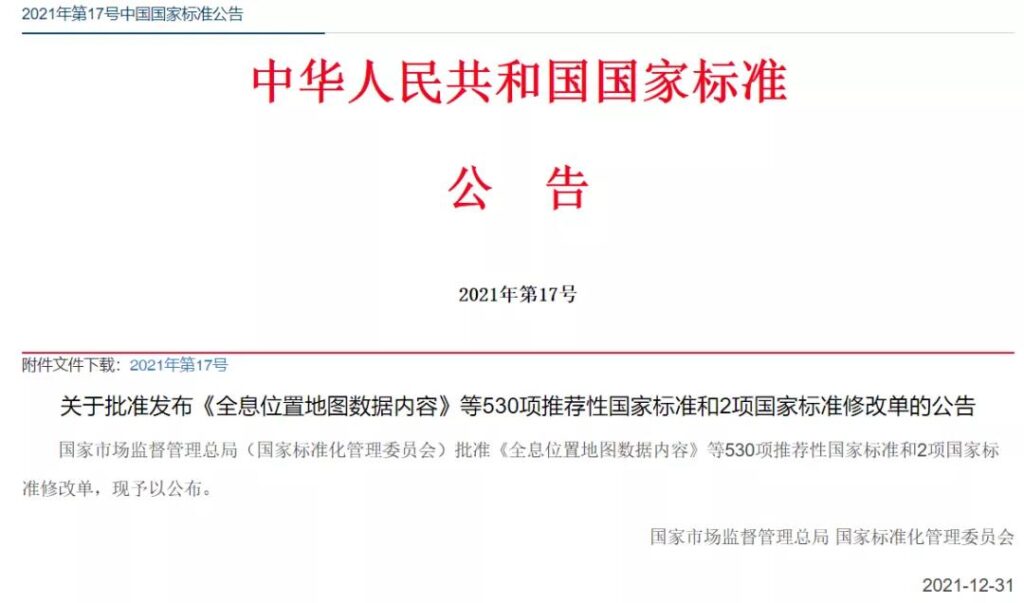
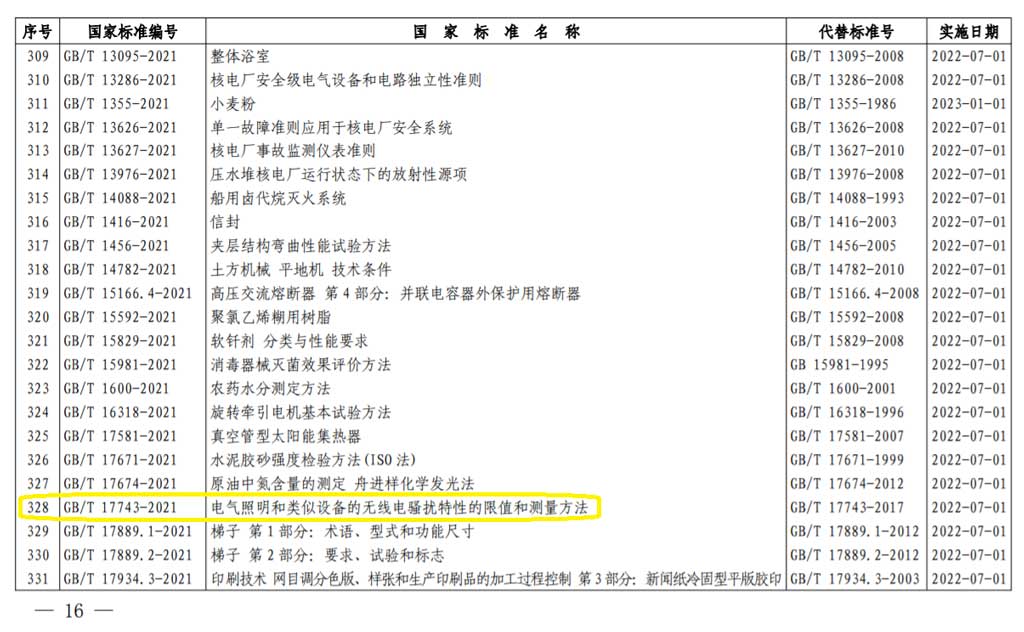
On December 31, 2021, the National Standards Administration of the State Administration for Market Regulation issued the 2021 China National Standards Announcement No. 17. This announcement contains the recommended national standard GB/T 17743-2021 “Limits and Measurement Methods of Radio Disturbance Characteristics of Electrical Lighting and Similar Equipment”, which will be formally implemented on July 1, 2022.

Electric lighting and similar equipment involve a wide range in life and develop very rapidly, affecting the daily lives of thousands of households, city night lighting, entertainment stage lighting, and so on. GB/T 17743-2021 is equivalent to the IEC international standard CISPR 15:2018, which is an important test basis for electrical lighting and similar equipment in terms of emission harassment. The release of this standard marks that my country’s standardization work in this field is further in line with international standards, reduces trade barriers caused by technological differences, and will help enhance the competitiveness of my country’s related products in the international market.

You are welcome to consult us, please contact David Zeng info@emc.wiki or 1513888718@qq.com , We can provide one-stop testing, EMC debug and certification services.

China Releases a National Standard -GB/T 9254.2-2021

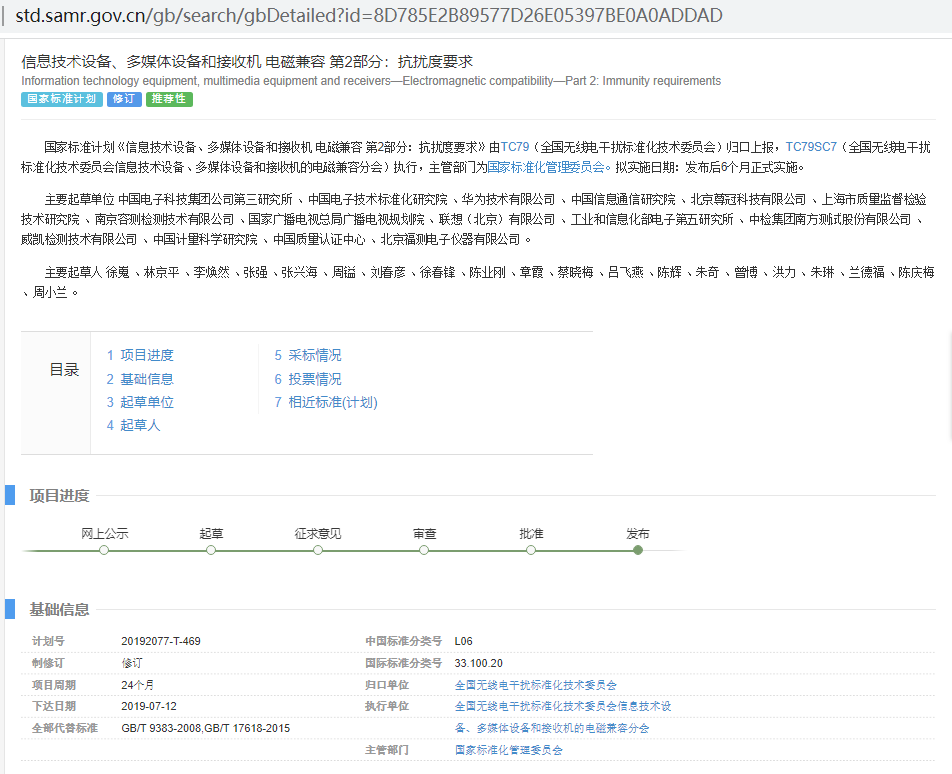
信息技术设备、多媒体设备和接收机 电磁兼容 第2部分:抗扰度要求
Information technology equipment, multimedia equipment and receivers—Electromagnetic compatibility—Part 2: Immunity requirements

The national standard plan “Electromagnetic Compatibility of Information Technology Equipment, Multimedia Equipment and Receivers Part 2: Immunity Requirements” is reported under the jurisdiction of TC79 (National Radio Interference Standardization Technical Committee), TC79SC7 (National Radio Interference Standardization Technical Committee Information Technology Equipment, Multimedia Equipment and Receiver Electromagnetic Compatibility Branch), the competent authority is the National Standardization Management Committee. Proposed implementation date: officially implemented 6 months after the release.

Standard number: GB/T 9254.2-2021
Release Date: 2019-07-12
Project cycle: 24 months, 2-year conversion cycle
Replace all standards: GB/T 9383-2008, GB/T 17618-2015

Standard adoption

The revision of this standard adopts the IEC international standard: CISPR 35:2016.
Adopting standard Chinese name: electromagnetic compatibility and immunity requirements for multimedia equipment.

2022-01-06 Chinese National Standard Announcement

You are welcome to consult us, please contact David Zeng info@emc.wiki or 1513888718@qq.com , We can provide one-stop testing, EMC debug and certification services.

FCC ID Search

How to confirm whether FCC ID certification has been done in FCC certification?

  • You can check the FRN number and Grantee Code number. If there is, then you may have done FCC ID certification.
  • Query through the complete FCC ID number = Grantee Code number + product code

Query the company’s FRN number

Applicant’s FCC Registration Number (FRN), which is an identification number given to the enterprise by the government. It can be applied for free on the FCC official website. After application, the website will automatically generate it to the enterprise.

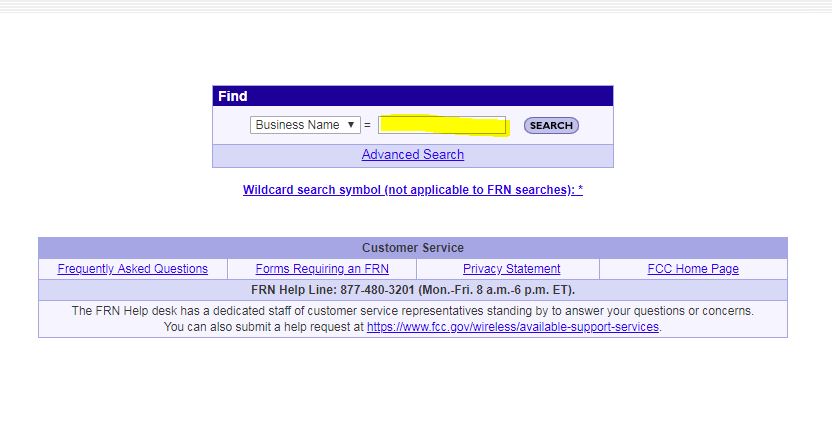
Open the website https://apps.fcc.gov/coresWeb/simpleSearch.do and enter the full name of the company in the yellow box in the picture below.

If you can’t find the FRN number here, then this company must not have done FCC ID certification. At least this company name is here. If didn’t search even your company name on the FCC website, then you must have not successfully applied for FCC ID.

For example, take Fotorama (Hong Kong) Limited as an example to make a query. As shown in the figure below, this company has been registered on the FCC official website on 06/10/2011, then this company is likely to have FCC certification, but it cannot Sure, after completing this step, it is not certain that the customer has actually done FCC ID certification, and then proceed to the next step.

Query the company’s Grantee Code number (authorization code)

For customers who apply for an FCC ID for the first time, they can apply for Grantee Code after applying for an FRN number (a fee of about tens of dollars is required, and the details are subject to the FCC official), and they only need to apply once. Grantee Code (3 or 5 letters or numbers). Each Grantee Code only represents a company. The 3 or 5 digit number is randomly provided by the FCC and is not determined by the customer.

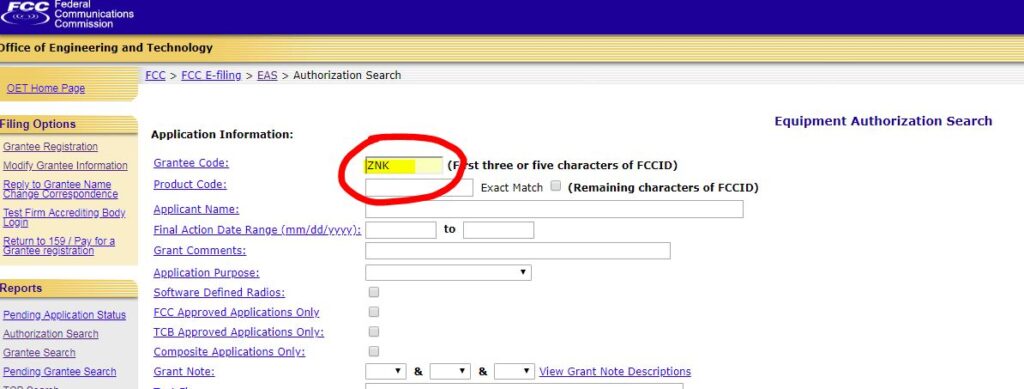
Open the page on the website https://apps.fcc.gov/oetcf/eas/reports/GenericSearch.cfm and enter the first 3 digits or the first 5 letters or horizontal bar code of the FCC ID number. For example, take Fotorama (Hong Kong) Limited as an example for query. As shown in the figure below, the manufacturer’s Grantee Code is ZNK.

Check the FCC ID certification that the company has done before

Query by Grantee Code number

For example, in Grantee Code: query, the premise is that the client’s Grantee Code number (the first 3 digits or the first 5 digits of the FCC ID) is ZNK, then the last step is to query. Open the website https://apps.fcc.gov/oetcf/eas/reports/GenericSearch.cfm page, enter ZNK in the red box, and then click Start Search at the bottom of the page.

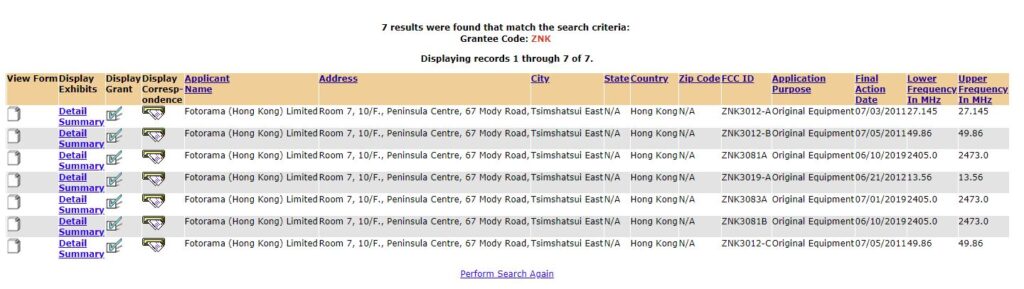
Then the search shows that the customer has made 7 reports. Three products were FCC ID certified in 2011, two products were FCC ID certified in 2012, and three product certifications were made on 06/10 and 07/01 respectively in 2019. The details are shown in the figure below.

Search by company name

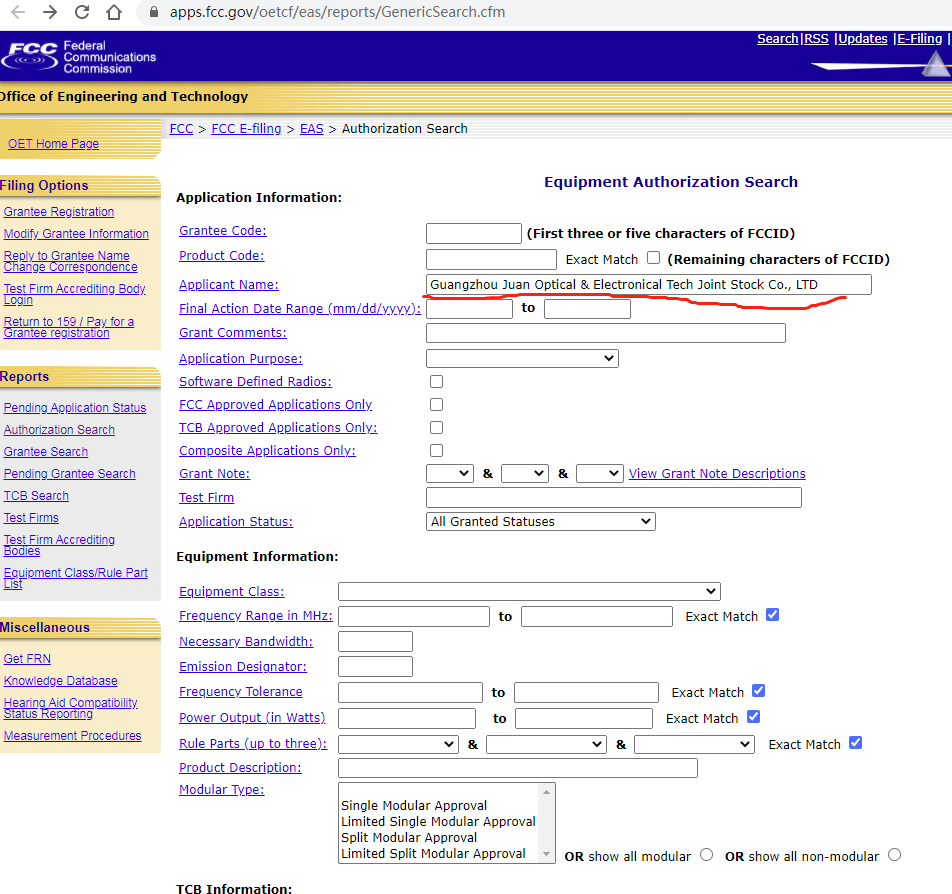
For example, open the website https://apps.fcc.gov/oetcf/eas/reports/GenericSearch.cfm, enter Guangzhou Juan Optical & Electronic Tech Joint Stock Co., LTD in Applicant Name: and click Start Search at the bottom of the page.

FCC ID rules

The FCC ID includes the Grantee Code company code (3 or 5 letters or numbers), and each Grantee Code only represents one company. The 3-digit or 5-digit number is randomly provided by the FCC and is not determined by the customer. Once the application is successful, it will become a fixed number, as the first 3 or 5 digits of the company’s application for FCC ID numbers. And the product code (10-12 letters or numbers) of the product. Therefore, the product ID number, the first three or five digits are Grantee Code, and the latter is self-edited by the applicant (up to 10-12 digits). Usually the product model is used for self-encoding. The complete FCC ID cannot be more than 15 at most. Of course, It can be less than 15.

  • The three-character Grantee Code always starts with an alphabetic character and does not contain the numbers 1 and/or 0.
  • The five-character Grantee Code always starts with a numeric character and does not contain the number 1 and/or 0.
  • The product code may include a hyphen (-).
  • The maximum number of digits of FCC ID cannot be greater than 15 digits.

You are welcome to consult us, please contact David Zeng info@emc.wiki or 1513888718@qq.com , We can provide one-stop testing, EMC debug and certification services.

China CCC

What is CCC?

The full name of 3C certification is “China Compulsory Product Certification”. It is a product conformity assessment system implemented by the Chinese government to protect consumers’ personal safety and national security, strengthen product quality management, and implement in accordance with laws and regulations. The so-called 3C certification is China’s compulsory product certification system, the English name is China Compulsory Certification, and the English abbreviation is CCC.

In December 2001, the General Administration of Quality Supervision, Inspection and Quarantine issued the “Management Regulations on Compulsory Product Certification”, which replaced the original imported product safety and quality licensing system and electrical product safety certification system with a compulsory product certification system. China Compulsory Product Certification is referred to as CCC certification or 3C certification. It is a statutory compulsory safety certification system, and it is also a basic practice widely adopted internationally to protect consumers’ rights and interests and safeguard consumers’ personal and property safety.

 The products listed in the “Product Catalog for Compulsory Product Certification”, including household appliances, automobiles, safety glass, wires and cables, toys and other products, require CCC compulsory certification. The products in the catalog are subject to changes at any time due to policies. For details, please consult David Zeng info@emc.wiki or 1513888718@qq.com .

CCC Certification Process

  • Provide information, online application, certification application and acceptance
  • Send sample test, issue type test report, product type test
  • Factory inspection, and then issue CCC certificate (there is still a certificate that can be issued first, av it (a cqc certification), you can issue the certificate first, and then audit the factory, the certificate must be completed within 3 months)
  • Evaluation and approval of certification results
  • Supervision after certification

CCC regular confirmation inspection

Safety regulations once a year, electromagnetic compatibility, once every 2 years

CCC certificate validity period

Valid for 5 years, can be renewed, each certificate must be reviewed annually

CCC annual review notes

More than 3,000 annual audits, a certificate

Hospitality expenses for meals, plus red envelopes, estimated to be 6000 yuan

For example, Guangzhou changed to Foshan, the applicant and the manufacturer wrote Panyu, and the factory wrote Foshan, and issued a new certificate. Where is the factory written on the certificate, it will be audited

If the factory crosses the city, the certificate number must be changed. If the factory is moved in the city, there is no need to change the certificate information. The certificate is valid for 5 years, renewal is very cheap.

Generally at least 30 units are audited, and at least 5 units can be certified samples.

Pure assembly, no environmental assessment is required.

Withstand voltage, grounding test equipment, multimeter, caliper, micrometer.

Withstand voltage: the first type of product national standard 1500v 60 seconds, the second type of 3500v 60 seconds

Work instructions are made for each station, and if assembled, a supply contract is provided.

CCC certificate query

http://cx.cnca.cn/CertECloud/index/index/page

You are welcome to consult us, please contact David Zeng info@emc.wiki or 1513888718@qq.com , We can provide one-stop testing, EMI debug and certification services.

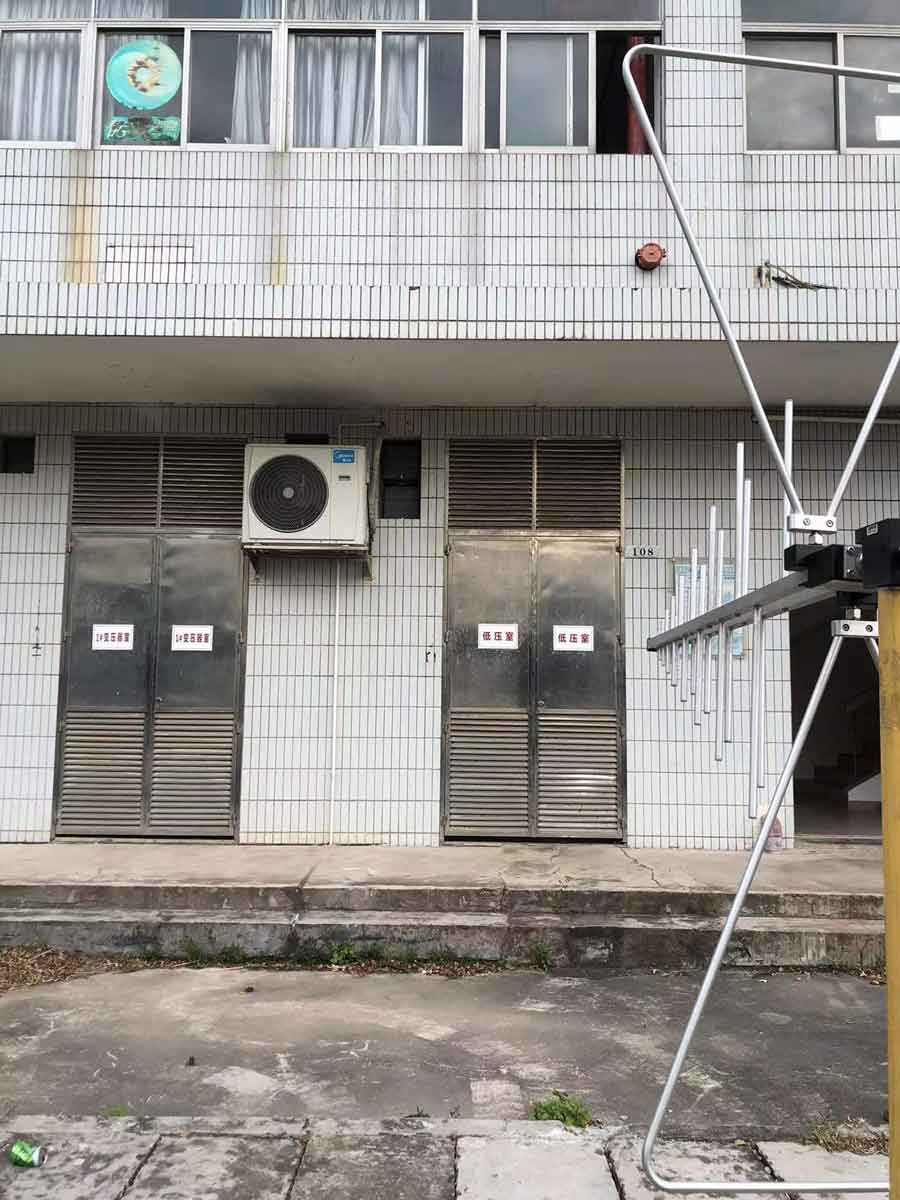
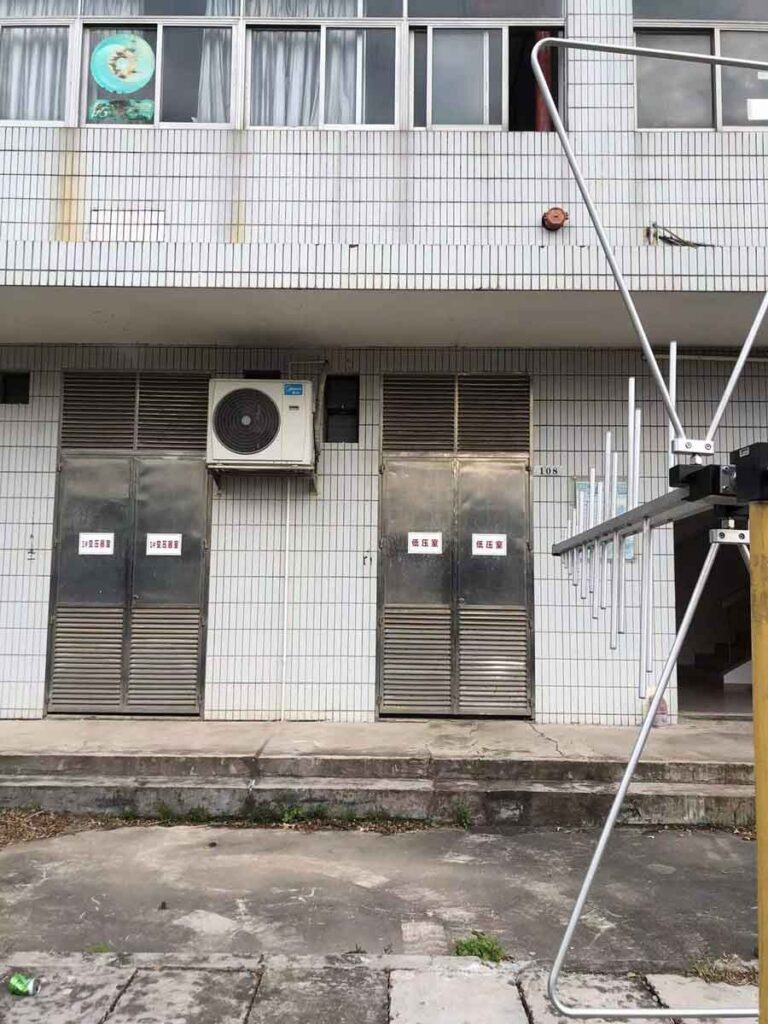
EMI investigation

On-site environmental electromagnetic interference investigation, according to different interference phenomena at the user site, investigation is carried out in different parts and areas to solve the electromagnetic interference problem of the customer environment.

Similarly, environmental electromagnetic interference monitoring can be carried out to prevent unknown electromagnetic wave interference and other harmful interference that affects environmental communications.

EMI investigation

You are welcome to consult us, please contact David Zeng info@emc.wiki or 1513888718@qq.com , We can provide one-stop testing, EMC debug and certification services.

Canada – ISED IC ID certification

All wireless electronic and electrical products sold to Canada must apply for the Canadian ISED IC ID certification.

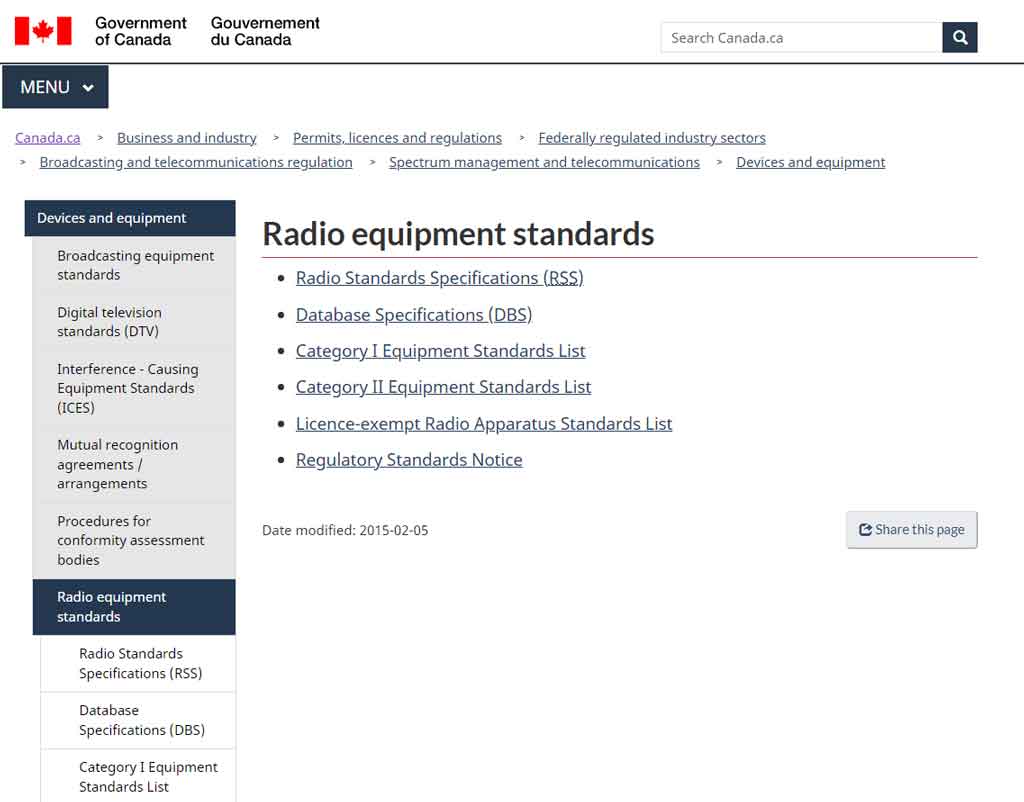
Radio equipment standards

  • Radio Standards Specifications (RSS)
  • Database Specifications (DBS)
  • Category I Equipment Standards List
  • Category II Equipment Standards List
  • Licence-exempt Radio Apparatus Standards List
  • Regulatory Standards Notice

Category I Equipment Standards List

  • RSS-Gen — General Requirements for Compliance of Radio Apparatus
  • RSS-HAC — Hearing Aid Compatibility and Volume Control
  • RSS-102 — Radio Frequency (RF) Exposure Compliance of Radiocommunication Apparatus (All Frequency Bands)
  • RSS-111 — Broadband Public Safety Equipment Operating in the Band 4940-4990 MHz
  • RSS-112 — Land Mobile and Fixed Equipment Operating in the Band 1670-1675 MHz
  • RSS-117 — Land and Coast Station Transmitters Using A1, A2, A3, A2H, or A3H Emissions Operating in the 200 – 535 kHz Band
  • RSS-119 — Land Mobile and Fixed Equipment Operating in the Frequency Range 27.41-960 MHz
  • RSS-123 — Licensed Low-Power Radio Apparatus
  • RSS-125 — Land Mobile and Fixed Radio Transmitters and Receivers, 1.705 to 50.0 MHz, Primarily Amplitude Modulated
  • RSS-127 — Air-Ground Equipment Operating in the Bands 849-851 MHz and 894-896 MHz
  • RSS-129 – 800 MHz Dual-Mode CDMA Cellular Telephones
    Withdrawn January 2013
  • RSS-130 — Mobile Broadband Services (MBS) Equipment Operating in the Frequency Bands 698-756 MHz and 777-787 MHz
  • RSS-131 — Zone Enhancers for the Land Mobile Service
  • RSS-132 — 800 MHz Cellular Telephones Employing New Technologies
  • RSS-133 – 2 GHz Personal Communication Services
  • RSS-134 — 900 MHz Narrowband Personal Communications Services
  • RSS-135 — Digital Scanner Receivers
  • RSS-136 — Land and Mobile Station Radiotelephone Transmitters and Receivers Operating in the 26.960 – 27.410 MHz General Radio Service Band
    Updated and renumbered to RSS-236 in November 2012
  • RSS-137 — Location and Monitoring Service (902-928 MHz)
  • RSS-138 — Commercial Shipborne Radar in the 2900-3100 MHz, 5470-5650 MHz and 9225-9500 MHz Bands
    Replaced in July 2013 by RSS-238
  • RSS-139 — Advanced Wireless Services (AWS) Equipment Operating in the Bands 1710-1780 MHz and 2110-2180 MHz
  • RSS-140 — Equipment Operating in the Public Safety Broadband Frequency Bands 758-768 MHz and 788-798 MHz
  • RSS-141 — Aeronautical Radiocommunication Equipment in the Frequency Band 117.975-137 MHz
  • RSS-142 — Narrowband Multipoint Communication Systems in the Bands 1429.5-1432 MHz
  • RSS-170 — Mobile Earth Stations (MESs) and Ancillary Terrestrial Component (ATC) Equipment Operating in the Mobile-Satellite Service (MSS) Bands
  • RSS-181 — Coast and Ship Station Equipment Operating in the Maritime Service in the Frequency Range 1605-28000 kHz
  • RSS-182 — Maritime Radio Transmitters and Receivers in the Band 156-162.5 MHz
  • RSS-187 — Emergency Position Indicating Radio Beacons, Emergency Locator Transmitters and Personal Locato Beaconsr
    Replaced by RSS-287
  • RSS-188 — Global Maritime Distress and Safety System (GMDSS)
    Updated and renumbered to RSS-288 in January 2012
  • RSS-191 — Local Multipoint Communication Systems in the Band 25.35-28.35 GHz; Point-to-Point and Point-to-Multipoint Broadband Communication Systems in the Bands 24.25-24.45 GHz and 25.05-25.25 GHz; and Point-to-Multipoint Broadband Communications in the Band 38.6-40.0 GHz
  • RSS-192 — Fixed Wireless Access Equipment Operating in the Band 3450 – 3650 MHz
  • RSS-193 — Multipoint and Point-to-Point Communication Systems (MCS) in the Fixed Service Operating in the 2150-2160 MHz, 2500-2596 MHz and 2686-2690 MHz Bands
    Rescinded in January 2012
  • RSS-194 — Fixed Wireless Access Equipment Operating in the Band 953-960 MHz
  • RSS-195 — Wireless Communications Service Equipment Operating in the Bands 2305-2320 MHz and 2345-2360 MHz
  • RSS-196 — Point-to-Multipoint Broadband Equipment Operating in the Bands 512-608 MHz and 614-698 MHz for Rural Remote Broadband Systems (RRBS) (TV Channels 21 to 51)
  • RSS-197 — Wireless Broadband Access Equipment Operating in the Band 3650-3700 MHz
  • RSS-199 — Broadband Radio Service (BRS) Equipment Operating in the Band 2500-2690 MHz
  • RSS-210 — Licence-Exempt Radio Apparatus
  • RSS-211 — Level Probing Radar Equipment
  • RSS-213 — 2 GHz Licence-exempt Personal Communications Service Devices (LE-PCS)
  • RSS-215 — Analogue Scanner Receivers
  • RSS-216 — Wireless Power Transfer Devices (Wireless Chargers)
  • RSS-220 — Devices Using Ultra-Wideband (UWB) Technology
  • RSS-222 — White Space Devices (WSDs)
  • RSS-236 — General Radio Service Equipment Operating in the Band 26.960 to 27.410 MHz (Citizens Band)
  • RSS-238 — Shipborne Radar in the 2900-3100 MHz and 9225-9500 MHz Bands
  • RSS-243 — Active Medical Implants Operating in the 401-406 MHz Band
  • RSS-244 — Medical Devices Operating in the Band 413-457 MHz
  • RSS-246 — Ultra-Low Power (ULP) Wireless Medical Capsule Endoscopy Devices Operating in the 430-440 MHz Band
  • RSS-247 — Digital Transmission Systems (DTSs), Frequency Hopping Systems (FHSs) and Licence-Exempt Local Area Network (LE-LAN) Devices
  • RSS-251 — Vehicular Radar and Airport Fixed or Mobile Radar in the 76-81 GHz Frequency Band
  • RSS-252 — Intelligent Transportation Systems — Dedicated Short Range Communications (DSRC) — On-Board Unit (OBU)
  • RSS-287 – Emergency Position Indicating Radio Beacons (EPIRB), Emergency Locator Transmitters (ELT), Personal Locator Beacons (PLB), and Maritime Survivor Locator Devices (MSLD)
  • RSS-288 — Global Maritime Distress and Safety System (GMDSS)
  • BETS-1 — Technical Standards and Requirements for Low Power Announce Transmitters in the Frequency Bands 525-1,705 kHz and 88-107.5 MHz
  • BETS-4 — Technical Standards and Requirements for Television Broadcasting Transmitters
  • BETS-5 — Technical Standards and Requirements for AM Broadcasting Transmitters
  • BETS-6 — Technical Standards and Requirements for FM Broadcasting Transmitters
  • BETS-8 — Technical Standards and Requirements for FM Transmitters Operating in Small Remote Communities
  • BETS-9 — Technical Standards and Requirements for Television Transmitters Operating in Small Remote Communities

Date modified: 2020-11-04

Category II Equipment Standards List

  • ICES-Gen — General Requirements for Compliance of Interference-Causing Equipment
  • ICES-001  Industrial, Scientific and Medical Radio Frequency Generators
  • ICES-002 — Vehicles, Boats and Other Devices Propelled by an Internal Combustion Engine, Electrical Means or Both
  • ICES-003 — Information Technology Equipment (ITE) – Limits and methods of measurement
  • ICES-004 — Alternating Current High Voltage Power Systems
  • ICES-005 — Lighting Equipment
  • ICES-006 — AC Wire Carrier Current Devices (Unintentional Radiators)
  • ICES-008  Cable Distribution Networks
  • RSS-Gen  General Requirements and Information for the Certification of Radiocommunication Equipment
  • RSS-102 — Radio Frequency Exposure Compliance of Radiocommunication Apparatus (All Frequency Bands)
  • RSS-216 — Wireless Power Transfer Devices (Wireless Chargers)
  • RSS-310 — Licence-Exempt Radio Apparatus
  • BETS-3  Technical Standards and Requirements for Radio Apparatus that Form Part of a Master Antenna Television (MATV) Broadcasting Undertaking
  • BETS-7  Technical Standards and Requirements for Radio Apparatus Capable of Receiving Television Broadcasting

Date modified: 2020-11-04

Official website – Canada – ISED

https://www.ic.gc.ca/eic/site/smt-gst.nsf/eng/h_sf06128.html

You are welcome to consult us, please contact David Zeng info@emc.wiki or 1513888718@qq.com , We can provide one-stop testing, EMC debug and certification services.

Canada – ISED IC certification

All electronic and electrical products sold to Canada other except wireless must apply for Canadian ISED IC certification.

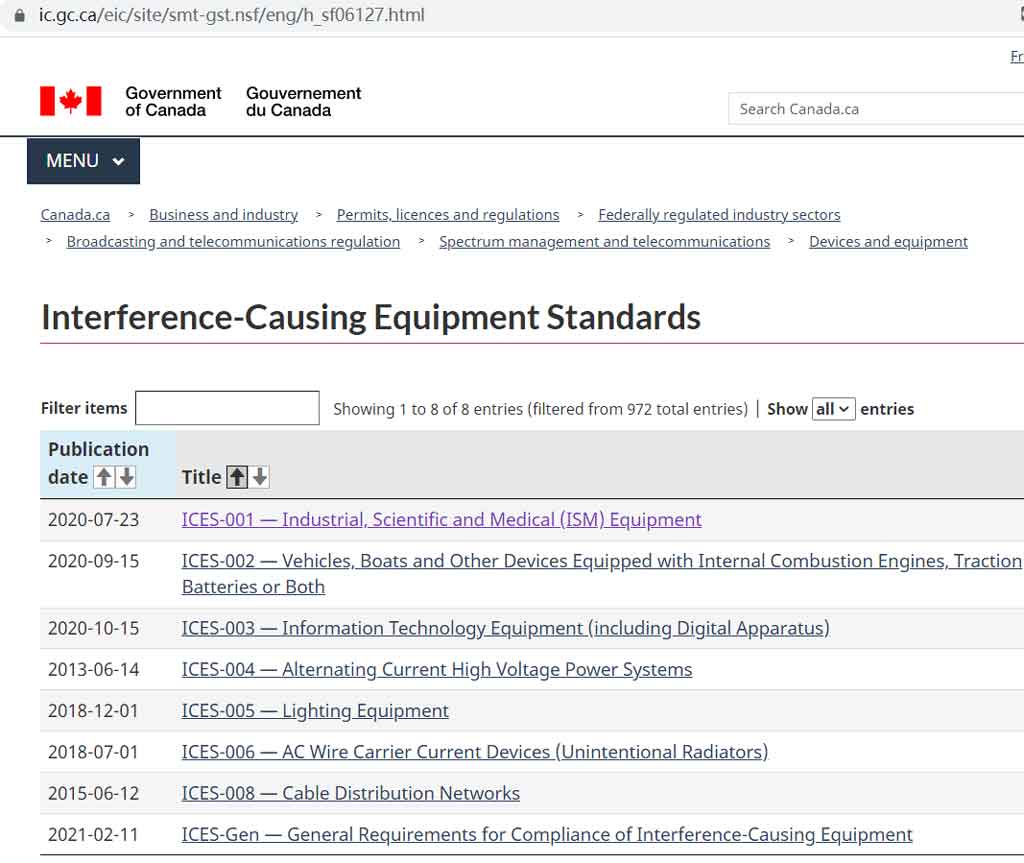
Canada ICES Standards

2020-07-23ICES-001 — Industrial, Scientific and Medical (ISM) Equipment
2020-09-15ICES-002 — Vehicles, Boats and Other Devices Equipped with Internal Combustion Engines, Traction Batteries or Both
2020-10-15ICES-003 — Information Technology Equipment (including Digital Apparatus)
2013-06-14ICES-004 — Alternating Current High Voltage Power Systems
2018-12-01ICES-005 — Lighting Equipment
2018-07-01ICES-006 — AC Wire Carrier Current Devices (Unintentional Radiators)
2015-06-12ICES-008 — Cable Distribution Networks
2021-02-11ICES-Gen — General Requirements for Compliance of Interference-Causing Equipment

Official website

https://www.ic.gc.ca/eic/site/smt-gst.nsf/eng/h_sf06127.html

You are welcome to consult us, please contact David Zeng info@emc.wiki or 1513888718@qq.com , We can provide one-stop testing, EMC debug and certification services.