Download the Radio Frequency Division Regulations of the People’s Republic of China

Everyone knows that SRRC model approval is required in China. So, do you know which frequencies can be used? Does it mean that I can use which frequency to do SRRC? Below are related products regulated by the country, and the frequencies that can be used must not be used casually. Yes, different products use different frequencies, so as to ensure that they do not interfere with each other, to ensure the full use of the spectrum, and to ensure the quality of communication without interference.

For more information about the availability of radio frequencies in China, please contact David Zeng  info@emc.wiki or 1513888718@qq.com

What product needs SRRC type approval?

Everyone knows that SRRC is needed in China, so, do you know which products need to be SRRC certification?

  1. Public network mobile communication equipment
    01 Cellular public network mobile communication base station and auxiliary equipment
    02 Cellular public network mobile communication terminal equipment
  2. Dedicated communication equipment
    01 FM equipment (Ultrashort wave radio for maritime services)
    02 Digital walkie-talkie equipment
    03 public walkie-talkie
    04 Simulate cluster equipment
    05 Digital Trunking Equipment
    06 Police Digital Trunking Equipment
    07 Simulate non-central equipment
    08 Digital non-central equipment
    09 Data Transmission Equipment
    10 Fixed wireless video transmission equipment
    11 Dedicated mobile wireless video transmission equipment
    12 Shortwave single sideband equipment
    13 GSM-R railway special equipment
    14 Paging device
    15 800/900MHz band radio frequency identification (RFID) equipment
    16 5.8GHz electronic toll collection system
    17 230MHz band wireless data transmission equipment
    18 Ultra-wideband (UWB) equipment
    19 Internet of Vehicles (Intelligent Connected Cars) Directly Connected Communication Radio Equipment
  3. Wireless access equipment
    01 400MHz wireless access equipment
    02 1785-1805MHz frequency band wireless access system
    03 3.5GHz band fixed wireless access equipment
    04 26GHz band wireless access equipment (LMDS)
    05 40-50GHz frequency band point-to-point wireless access system
    06 Broadband wireless access system in 40-50GHz frequency band
    07 Digital microwave equipment
    08 2.4GHz spread spectrum communication equipment
    09 5.8GHz spread spectrum communication equipment
    10 2.4GHz band wireless LAN equipment
    11 5150-5350MHz band wireless access equipment
    12 5.8GHz band wireless LAN equipment
    13 60GHz band wireless access equipment
  4. Broadcast transmission equipment
    01 Broadcasting equipment
    02 TV equipment
  5. Radar equipment
    01 Weather radar
    02 Aviation radar
    03 Marine radar
    04 Vehicle radar
    05 Surveillance radar
  6. Navigation equipment
    01 Aviation communication and navigation equipment
    02 Other navigation equipment
  7. Satellite communication equipment
    01 Satellite Earth Station
  8. Other equipment
    01 Amateur radio equipment
    02 Unmanned aircraft system equipment
    03 Radio control equipment
    04 Meteorological aids

Radio transmission equipment model approved equipment type, SRRC product range catalog, download as follows:

For more SRRC catalog information about China SRRC certification, please consult David Zeng info@emc.wiki or 1513888718@qq.com

 China NAL certification 

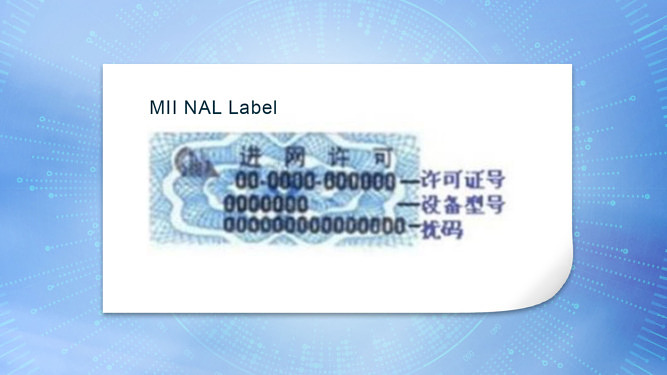
NAL certification, issued by the Ministry of Industry and Information Technology (MIIT), is essential for telecommunications products that are connected to the public telecommunications network. The NAL label is issued by the MII and consists of the certification number, the model number of the device and a random code on a blue background.

For foreign manufacturers, NAL certification for affected telecommunications products is mandatory before a product can be imported and marketed in China.

Relevant product categories for the NAL certifications

The first product categories for NAL approval were introduced in 2001 and there are now 28 categories from three different main groups:

  • Telecommunications terminal equipment
  • Radio communication equipment
  • Telecommunication equipment for inter-network connection.

Meanwhile more than 300 telecommunication products are defined in the categories. These include communication or network equipment with interfaces to public networks or Wide Area Network (WAN) services. Common communication interfaces include T1/E1, ISDN BRI, ISDN PRI, ADSL, serial and analogue PSTN.

China SRRC Certification

The SRRC certification is issued by the State Radio Monitoring and Testing Center (SRRC) – analogous to the CCC certification. The SRRC certification is relevant for all mandatory directory products that use a radio transmitter in any form.

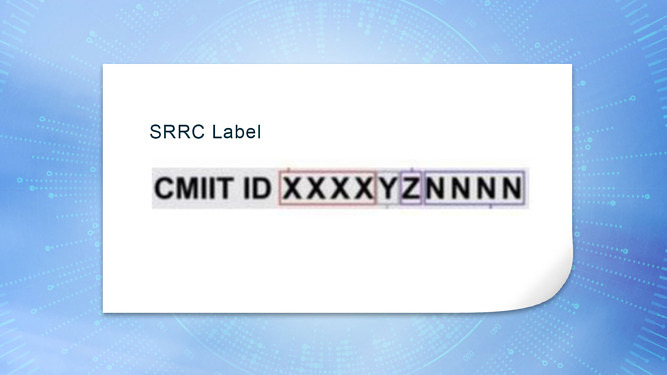
The SRRC label is primarily a word mark and represents the CMIIT ID, which the manufacturer receives from the authority during the approval process. Here it is important to note that without a CMIIT ID, no product may be imported into China and distributed there.

Core parameters for products with radio technologies

The necessary tests must be carried out in a test laboratory accredited by the Ministry of Industry and Information Technology (MIIT). The authority responsible for this is the State Radio Monitoring and Testing Center (SRTC). Part of the SRRC certification is the determination of core parameters of products with radio technologies. These include among others

  • Frequency
  • Frequency band
  • Transmission power
  • Frequency tolerance
  • occupied bandwidth
  • Parameters of the frequency spectrum (such as out-of-band emissions)

Only after a successful SRRC certification an application for a NAL certification can be made, because the test results of a SRRC certification are the basis for a NAL certification.

Products that require SRRC certification include mobile phones (GSM or CDMA), wireless LAN (WLAN) devices, and devices that use the following technologies

  • WLAN
  • Bluetooth
  • ZigbeeWiMAX
  • RFID

In the case of SRRC certification, it should be noted that the government body checks the frequencies selected for the product, so the manufacturer is obliged to correctly indicate the frequencies used by the device. Therefore, in order to obtain certification, the transmitting power, bandwidth and stray radiation must meet the requirements of the selected frequencies. In addition, some frequencies are not publicly available in China and manufacturers must also take this restriction into account.

Introduction of common safety standards for lithium batteries in the North American market

Commonly used standards and applicable product ranges for lithium batteries:

  1. UL1642:

Lithium-ion battery cell (cell) standard, applicable to rechargeable lithium battery and non-rechargeable lithium battery.

  1. UL2054:

Batteries for household and commercial products (battery) have a wide range of applications, suitable for rechargeable lithium batteries and non-rechargeable lithium batteries.

  1. UL62133:

Introduced by the IEC62133 standard, it is suitable for rechargeable lithium batteries and lithium batteries.

  1. UL2056:

Suitable for mobile power (power bank) products.

  1. UL62368-1:

Applicable to IT/AV product standards, and can also be used to evaluate mobile power (power bank) products.

  1. UL2595:

Suitable for battery-driven equipment products, such as: lamps, hand-held power tools, sweeping robots, garden tools, etc.

  1. UL2743:

It is suitable for car emergency starting power lithium battery.

  1. UL2271 & UL2272:

It is suitable for lithium batteries for electric vehicles (including balance vehicles and twisted vehicles).

  1. IEEE1625 & IEEE1725:

CTIA (American Wireless Communications and Internet Association) certification of lithium battery standards, suitable for mobile phone lithium batteries, laptop computers and IPAD lithium batteries.

  1. UL1973:

The safety standards for energy storage battery systems mainly cover all types of energy storage batteries used for photovoltaics, wind energy, backup power sources, and communication base stations.

  1. UL2580:

Batteries for electric vehicles, battery packs for driving electric vehicles, capacitive systems, hybrid systems, and subsystems or modules. For example: electric car battery pack, electric forklift battery pack, etc.

EU – New Security and Privacy Requirements for Wireless IoT Devices

On October 29, 2021, European Commission adopted the delegated act to the Radio Equipment Directive (RED) which aim to reinforce the safety of all wireless devices sold on the EU market. The delegated act requires compliance to privacy and cyber security requirements of internet-connected radio equipment by mid-2024.

Baseline requirements are defined in ETSI EN 303 645 however based on risk, type of device and its intended use additional requirements may be applicable. 

The essential requirement set out in Article 3(3), point (e), of Directive 2014/53/EU shall apply to any of the following radio equipment, if that radio equipment is capable of processing, within the meaning of Article 4(2) of Regulation (EU) 2016/679, personal data, as defined in Article 4(1) of Regulation (EU) 2016/679, or traffic data and location data, as defined in Article 2, points (b) and (c), of Directive 2002/58/EC: 

– (a) internet-connected radio equipment, other than the equipment referred to in points (b), (c) or (d);
– (b) radio equipment designed or intended exclusively for childcare; 
– (c) radio equipment covered by Directive 2009/48/EC; 
– (d) radio equipment designed or intended, whether exclusively or not exclusively, to be worn on, strapped to, or hung from any of the following:

– any part of the human body, including the head, neck, trunk, arms, hands, legs and feet; 
– any clothing, including headwear, hand wear and footwear, which is worn by human beings;

3. The essential requirement set out in Article 3(3), point (f), of Directive 2014/53/EU shall apply to any internet-connected radio equipment, if that equipment enables the holder or user to transfer money, monetary value or virtual currency as defined in Article 2, point (d), of Directive (EU) 2019/713.

Key exclusions: selected medical devices, IVD, mobililty, aviation


Source Link: https://ec.europa.eu/commission/presscorner/detail/en/ip_21_5634

CISPR 32:2015/AMD1:2019

Amendment 1 – Electromagnetic compatibility of multimedia equipment – Emission requirements

Abstract

CISPR 32:2015 is available as CISPR 32:2015 RLV which contains the International Standard and its Redline version, showing all changes of the technical content compared to the previous edition.

CISPR 32:2015 applies to multimedia equipment (MME) as defined in 3.1.24 and having a rated r.m.s. AC or DC supply voltage not exceeding 600 V. This publication covers two classes of MME (Class A and Class B). The MME classes are specified in Clause 4. The objectives of this publication are:
1) to establish requirements which provide an adequate level of protection of the radio spectrum, allowing radio services to operate as intended in the frequency range 9 kHz to 400 GHz;
2) to specify procedures to ensure the reproducibility of measurement and the repeatability of results.
This second edition cancels and replaces the first edition published in 2012. This edition constitutes a technical revision. The contents of the corrigendum of June 2016 have been included in this copy.

Radio Equipment Directive (RED)

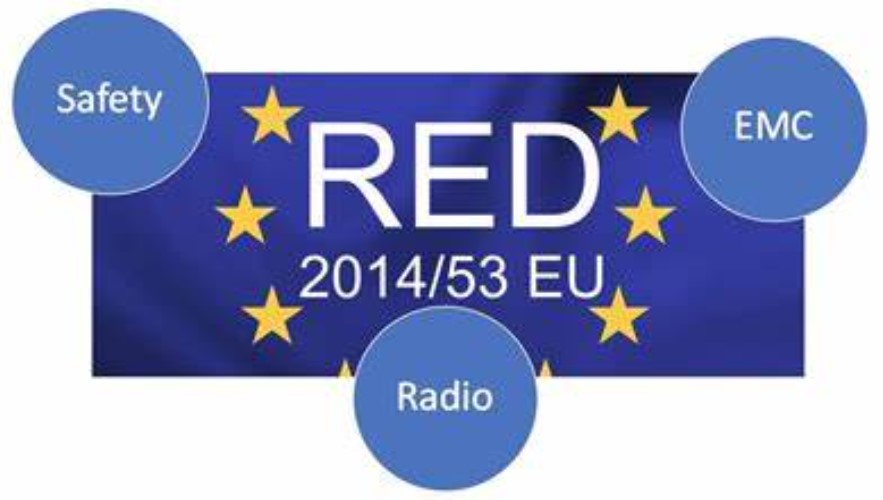
The radio equipment directive 2014/53/EU (RED) establishes a regulatory framework for placing radio equipment on the market. It ensures a single market for radio equipment by setting essential requirements for safety and health, electromagnetic compatibility, and the efficient use of the radio spectrum. It also provides the basis for further regulation governing some additional aspects. These include technical features for the protection of privacy, personal data and against fraud. Furthermore, additional aspects cover interoperability, access to emergency services, and compliance regarding the combination of radio equipment and software.

Update on Articles 3(3)(d), (e) and (f) 

Commission strengthens cybersecurity of radio equipment

The Commission adopted a Delegated Act of the Radio Equipment Directive activating Articles 3(3)(d), (e) and (f) for certain categories of radio equipment to increase the level of cybersecurity, personal data protection and privacy.

Earlier, the Commission authorised a contractor to conduct an impact assessment study on protection in internet-connected radio equipment and wearable radio equipment.
Specifically, it focused on

  • the protection of personal data and privacy
  • the protection from fraud

Different options were considered, in line with the inception impact assessment.
See the final report of the study.

Update on Articles 3(3)(i) and 4

We ask the public and stakeholders to contribute to a data collection exercise. Based on this, we will perform an impact assessment of options that ensure that reconfigurable radio systems approved for Europe’s single market stay compliant with the Radio Equipment Directive after the installation of new or modified software.

The RED aligned the previous directive, the radio and telecommunication terminal equipment directive (1999/5/EC(R&TTED), with the new legislative framework

for the marketing of products.

The revision also took account of the need for improved market surveillance. In particular, for the traceability obligations of manufacturers, importers and distributors. It has improved market surveillance instruments. One example is the possibility for required preregistration of radio equipment in categories with low compliance levels.

The RED was published in the OJEU on 22 May 2014, entered into force on 11 June 2014 and is applicable as of 13 June 2016. It included a one-year transitional period, which ended on 12 June 2017 (Article 48). During the transitional phase, manufacturers were allowed to place on the market radio equipment compliant with either the RED or the EU legislation applicable before 13 June 2016 (e.g. R&TTED).

For more details on the application of the RED, see the RED guide under the guidance section below.
Low Voltage Directive (LVD)

The low voltage directive (LVD) (2014/35/EU) ensures that electrical equipment within certain voltage limits provides a high level of protection for European citizens, and benefits fully from the single market. It has been applicable since 20 April 2016.

About the low voltage directive (LVD)

The low voltage directive (LVD) covers health and safety risks on electrical equipment operating with an input or output voltage of between

  • 50 and 1000 V for alternating current
  • 75 and 1500 V for direct current

It applies to a wide range of electrical equipment for both consumer and professional usage, such as

  • household appliances
  • cables
  • power supply units
  • laser equipment
  • certain components, e.g. fuses

EU legislation in the electrical sector is important to ensure that health and safety requirements are the same across Europe for products placed on the market.

The general product safety directive (2001/95/EC) covers consumer goods with a voltage below 50 V for alternating current, or below 75 V for direct current. It aims to ensure that only safe consumer products are sold in the EU.

ElectroMagnetic Compatibility Testing

WHAT IS ELECTROMAGNETIC COMPATIBILITY (EMC) TESTING?

Electromagnetic compatibility (EMC) testing measures the ability of equipment or systems to function satisfactorily in their electromagnetic environment without introducing intolerable electromagnetic disturbance to anything in that environment.

WHY IS EMC TESTING IMPORTANT?

EMC certifications are a mandatory requirement in most markets, including Europe, the US, China, Korea, Australia and New Zealand. EMC testing is necessary to help you meet regulatory requirements, improve product performance and reduce the risk of costly non-compliance. A third-party EMC test lab can conduct conformity assessments and also help to strengthen your competitive position in the market.

A ONE-STOP SERVICE FOR EMC TESTING AND CERTIFICATION

GZSA experts offer comprehensive testing and certification based on their complete knowledge of EMC legislation, guidelines, and standards. Our testing can cover all types of products, from small appliances to large defence industry machines.

We assist you to resolve any EMC regulatory issues, from design concept to final production. We provide a one-stop service that covers all your testing and certification needs. Our experts provide project management to ensure that your EMC tests run smoothly.

You can choose to have tests performed at our labs, on your premises or anywhere your product is installed.

EMC TESTING PROCEDURE

Our worldwide labs are capable of conducting a comprehensive range of EMC tests and providing you with EMC certifications. Depending on your product, this might include:

  • Antenna immunity to RF voltage
  • Antenna input immunity
  • Antenna screening effectiveness
  • Conducted disturbances immunity
  • Conducted emissions (continuous and discontinuous interference)
  • Electrostatic discharge (ESD) immunity
  • Electrical disturbances from conduction and coupling immunity for vehicles
  • Electrical fast transient / burst immunity
  • Harmonic current emission
  • Harmonics and interharmonics immunity
  • Immunity from radiated fields
  • Immunity to induced voltages
  • On-site EMC testing
  • Power frequency magnetic field / oscillatory waves immunity
  • Power interference
  • Power supply conditioning
  • Radiated emissions
  • Radiated field immunity
  • Voltage fluctuation / flicker
  • Voltage surge immunity
  • Voltage dips / interruptions immunity
  • Magnetic filed measurement (EMF)
  • Electric field measurement (EMF)
  • Electromagnetic field measurement (EMF)
  • Induced current density due to the electric field (EMF for lightning equipment)