FCC ID Search

How to confirm whether FCC ID certification has been done in FCC certification?

  • You can check the FRN number and Grantee Code number. If there is, then you may have done FCC ID certification.
  • Query through the complete FCC ID number = Grantee Code number + product code

Query the company’s FRN number

Applicant’s FCC Registration Number (FRN), which is an identification number given to the enterprise by the government. It can be applied for free on the FCC official website. After application, the website will automatically generate it to the enterprise.

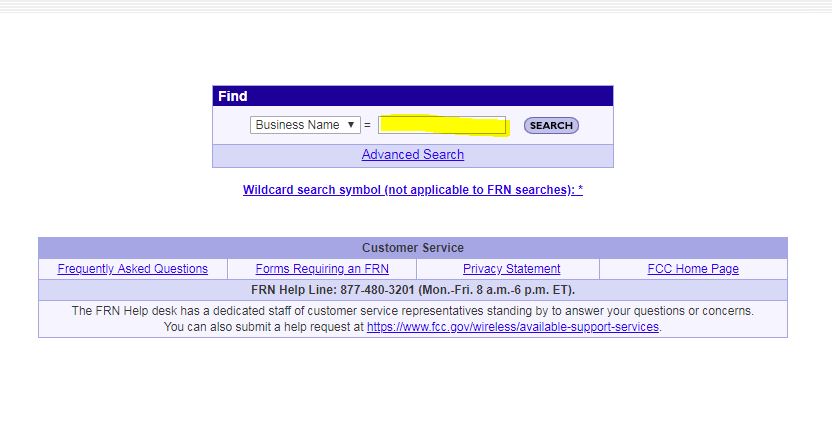
Open the website https://apps.fcc.gov/coresWeb/simpleSearch.do and enter the full name of the company in the yellow box in the picture below.

If you can’t find the FRN number here, then this company must not have done FCC ID certification. At least this company name is here. If didn’t search even your company name on the FCC website, then you must have not successfully applied for FCC ID.

For example, take Fotorama (Hong Kong) Limited as an example to make a query. As shown in the figure below, this company has been registered on the FCC official website on 06/10/2011, then this company is likely to have FCC certification, but it cannot Sure, after completing this step, it is not certain that the customer has actually done FCC ID certification, and then proceed to the next step.

Query the company’s Grantee Code number (authorization code)

For customers who apply for an FCC ID for the first time, they can apply for Grantee Code after applying for an FRN number (a fee of about tens of dollars is required, and the details are subject to the FCC official), and they only need to apply once. Grantee Code (3 or 5 letters or numbers). Each Grantee Code only represents a company. The 3 or 5 digit number is randomly provided by the FCC and is not determined by the customer.

Open the page on the website https://apps.fcc.gov/oetcf/eas/reports/GenericSearch.cfm and enter the first 3 digits or the first 5 letters or horizontal bar code of the FCC ID number. For example, take Fotorama (Hong Kong) Limited as an example for query. As shown in the figure below, the manufacturer’s Grantee Code is ZNK.

Check the FCC ID certification that the company has done before

Query by Grantee Code number

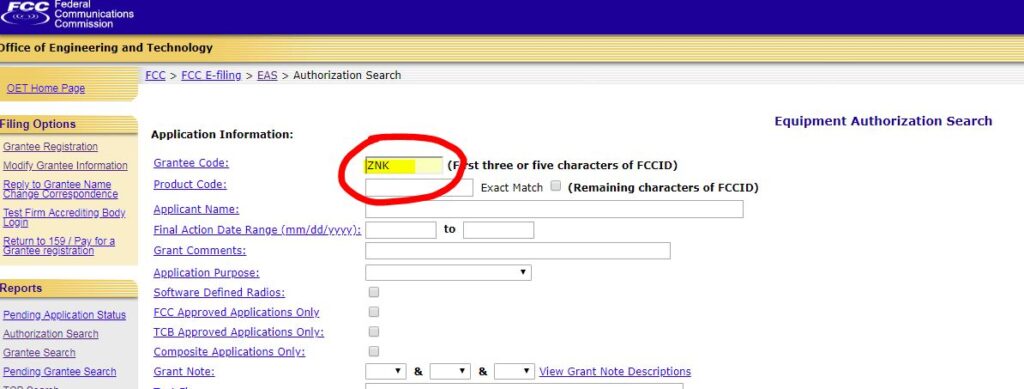
For example, in Grantee Code: query, the premise is that the client’s Grantee Code number (the first 3 digits or the first 5 digits of the FCC ID) is ZNK, then the last step is to query. Open the website https://apps.fcc.gov/oetcf/eas/reports/GenericSearch.cfm page, enter ZNK in the red box, and then click Start Search at the bottom of the page.

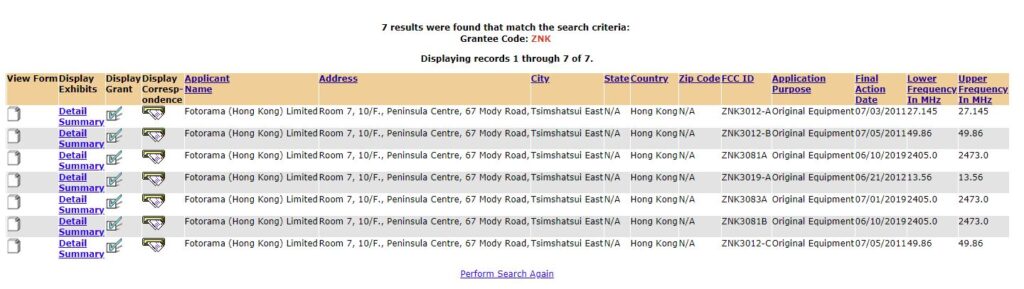
Then the search shows that the customer has made 7 reports. Three products were FCC ID certified in 2011, two products were FCC ID certified in 2012, and three product certifications were made on 06/10 and 07/01 respectively in 2019. The details are shown in the figure below.

Search by company name

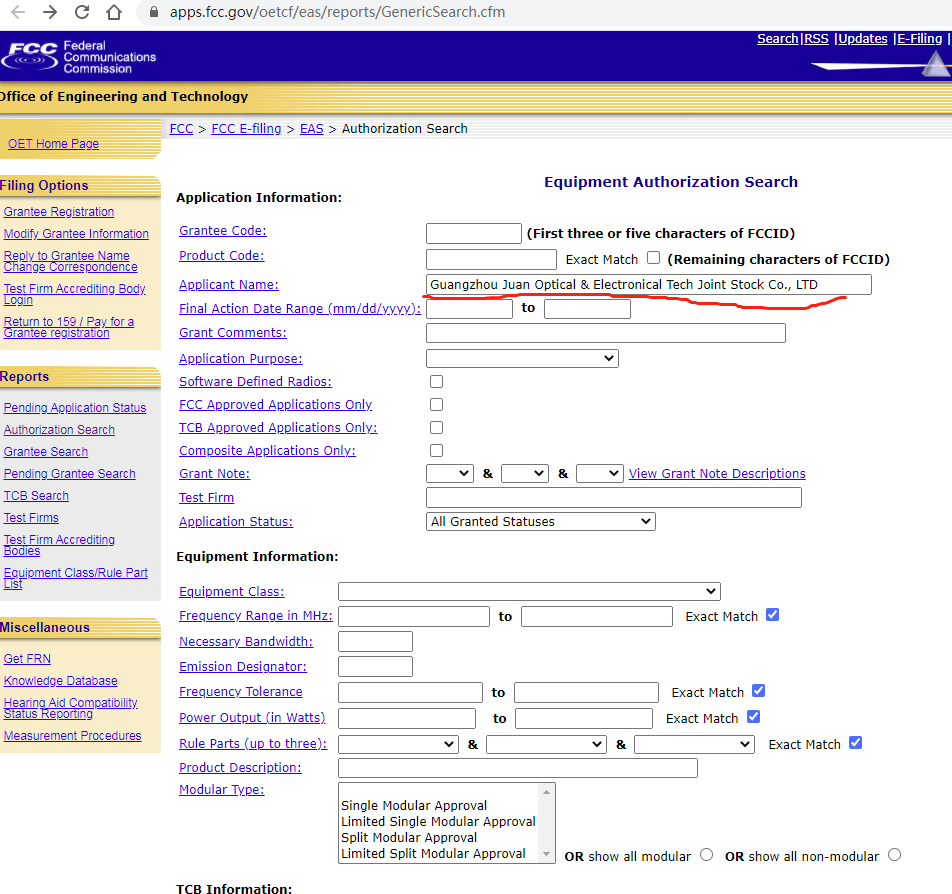
For example, open the website https://apps.fcc.gov/oetcf/eas/reports/GenericSearch.cfm, enter Guangzhou Juan Optical & Electronic Tech Joint Stock Co., LTD in Applicant Name: and click Start Search at the bottom of the page.

FCC ID rules

The FCC ID includes the Grantee Code company code (3 or 5 letters or numbers), and each Grantee Code only represents one company. The 3-digit or 5-digit number is randomly provided by the FCC and is not determined by the customer. Once the application is successful, it will become a fixed number, as the first 3 or 5 digits of the company’s application for FCC ID numbers. And the product code (10-12 letters or numbers) of the product. Therefore, the product ID number, the first three or five digits are Grantee Code, and the latter is self-edited by the applicant (up to 10-12 digits). Usually the product model is used for self-encoding. The complete FCC ID cannot be more than 15 at most. Of course, It can be less than 15.

  • The three-character Grantee Code always starts with an alphabetic character and does not contain the numbers 1 and/or 0.
  • The five-character Grantee Code always starts with a numeric character and does not contain the number 1 and/or 0.
  • The product code may include a hyphen (-).
  • The maximum number of digits of FCC ID cannot be greater than 15 digits.

You are welcome to consult us, please contact David Zeng info@emc.wiki or 1513888718@qq.com , We can provide one-stop testing, EMC debug and certification services.

IEC lighting standards

IEC灯具标准(IEC luminaires standards)

编号 中文名称 英文名称

IEC 60092-306-1980 船舶电气设施 第306部分:设备 灯具和附件 Electrical installations in ships. Part 306 : Equipment – Luminaires and accessories

IEC 60570-2003 灯具用电源导轨装置 Electrical supply track systems for luminaires

IEC 60598-1 AMD 1-2006 灯具.第1部分:一般要求和试验.热塑灯具的热物性试验.修改件1 Luminaires – Part 1: General requirements and tests – Thermal test for thermoplastic luminaires – Amendment 1

IEC 60598-1 Edition 6.1-2006 灯具.第1部分:一般要求和试验 Luminaires – Part 1: General requirements and tests

IEC 60598-1 Interpretation Sheet 1-2004 灯具.第1部分:一般要求和试验 Luminaires – Part 1: General requirements and tests

IEC 60598-1-2003 灯具.第1部分:一般要求和试验 Luminaires – Part 1: General requirements and tests

IEC 60598-2-1 AMD 1-1987 灯具 第2部分:特殊要求 第1节:固定式通用灯具 修改1 Luminaires. Part 2 : Particular requirements. Fixed general purpose luminaires

IEC 60598-2-1-1979 灯具 第2部分:特殊要求 第1节:固定式通用灯具 Luminaires. Part 2 : Particular requirements. Fixed general purpose luminaires*Requirement

IEC 60598-2-10-2003 灯具.第2-10部分:特殊要求.便携式儿童用灯具 Luminaires – Part 2-10: Particular requirements; Portable luminaires for children

IEC 60598-2-11-2005 灯具.第2-11部分:特殊要求.鱼缸用灯具 Luminaires – Part 2-11: Particular requirements – Aquarium luminaires

IEC 60598-2-12-2006 灯具.第2-12部分:特殊要求.安装干线插座的通夜照明灯 Luminaires – Part 2-12: Particular requirements – Mains socket-outlet mounted nightlights

IEC 60598-2-13-2006 灯具.第2-13部分:特殊要求.落地凹槽式灯具 Luminaires – Part 2-13: Particular requirements – Ground recessed luminaires

IEC 60598-2-17 AMD 2-1990 灯具 第2部分:特殊要求 第17节:舞台照明、电视、电影和摄影场所(室内外)用灯具 修改2 Luminaires; part 2: particular requirements; section seventeen: luminaires for stage lighting, television, film and photographic studios (outdoor and indoor); amendment 2 to IEC 60598-2-17:1984

IEC 60598-2-17-1984 灯具 第2部分:特殊要求 第17节:舞台照明、电视、电影和摄影场所(室内外)用灯具 Luminaires. Part 2 : Particular requirements. Section seventeen – Luminaires for stage lighting, television and film studios (outdoor and indoor)

IEC 60598-2-18-1993 灯具 第2部分:特殊要求 第18节:游泳池和类似场所用灯具 Luminaires; part 2: particular requirements; section 18: luminaires for swimming pools and similar applications

IEC 60598-2-19 AMD 1-1987 灯具 第2部分:特殊要求 第19节:通风式灯具(安全要求) 修改1 Luminaires. Part 2 : Particular requirements. Air-handling luminaires. Safety requirements

IEC 60598-2-19 AMD 2-1997 灯具 第2部分:特殊要求 第19节:通风式灯具(安全要求) 修改2 Luminaires – Part 2: Particular requirements – Section 19: Air-handling luminaires (safety requirements); Amendment 2

IEC 60598-2-19-1981 灯具 第2部分:特殊要求 第19节:通风式灯具(安全要求) Luminaires. Part 2 : Particular requirements. Air-handling luminaires. Safety requirements

IEC 60598-2-2 AMD 1-1997 灯具.第2部分:特殊要求.第2节:凹槽式灯具.修改件1 Luminaires – Part 2: Particular requirements – Section 2: Recessed luminaires; Amendment 1

IEC 60598-2-2 Edition 2.1-1997 灯具.第2部分:特殊要求.第2节:凹槽式灯具 Luminaires – Part 2: Particular requirements – Section 2: Recessed luminaires

IEC 60598-2-2-1997 灯具 第2部分:特殊要求 第2节:嵌入式灯具 Luminaires – Part 2: Particular requirements – Section 2: Recessed luminaires

IEC 60598-2-20 AMD 1-1998 灯具.第2部分:特殊要求.第20节:照明器用链.第1次修订 Luminaires – Part 2: Particular requirements – Section 20: Lighting chains; Amendment 1

IEC 60598-2-20 AMD 2-2002 灯具.第2-20部分:灯串.修改件2 Luminaires – Part 2-20: Lighting chains; Amendment 2

IEC 60598-2-20 Edition 2.1-1998 灯具.第2-20部分:特殊要求.照明线 Luminaires – Part 2-20: Particular requirements – Lighting chains

IEC 60598-2-20 Edition 2.2-2002 灯具.第2-20部分:照明器用链的特殊要求 Luminaires – Part 2-20: Particular requirements; Lighting chains

IEC 60598-2-20 Interpretation Sheet 1-2001 灯具.第2部分:特殊要求.第20节:灯串 Luminaires – Part 2: Particular requirements – Section 20: Lighting chains

IEC 60598-2-20 Interpretation Sheet 2-2003 灯具.第2部分:特殊要求.第20节:灯串 Luminaires – Part 2: Particular requirements – Section 20: Lighting chains

IEC 60598-2-20 Interpretation Sheet 3-2003 灯具.第2部分:特殊要求.第20节:灯串 Luminaires – Part 2: Particular requirements – Section 20: Lighting chains

IEC 60598-2-20-1998 灯具 第2部分:特殊要求 第20节:灯串 Luminaires – Part 2-20: Particular requirements – Lighting chains

IEC 60598-2-22 AMD 1-2002 灯具.第2-22部分:凹槽式灯具的特殊要求.修改件1 Luminaires – Part 2-22: Particular requirements; Luminaires for emergency lighting; Amendment 1

IEC 60598-2-22 Edition 3.1-2002 灯具.第2-22部分:特殊要求.应急照明灯具 Luminaires – Part 2-22: Particular requirements; Luminaires for emergency lighting

IEC 60598-2-22-1997 灯具 第2部分:特殊要求 第22节:应急照明灯具 Luminaires – Part 2-22: Particular requirements – Luminaires for emergency lighting

IEC 60598-2-23 AMD 1-2000 灯具 第2部分:特殊要求 第23节:钨丝灯用特低电压照明系统 修改1 Luminaires – Part 2-23: Particular requirements – Extra low voltage lighting systems for filament lamps

IEC 60598-2-23 Edition 1.1-2001 灯具.第2-23部分:特殊要求.白热丝灯超低压照明系统 Luminaires – Part 2-23: Particular requirements – Extra low voltage lighting systems for filament lamps

IEC 60598-2-23-1996 灯具 第2部分:特殊要求 第23节:钨丝灯用特低电压照明系统 Luminaires – Part 2: Particular requirements – Section 23: Extra low voltage lighting systems for filament lamps

IEC 60598-2-24-1997 灯具 第2部分:特殊要求 第24节:限制表面温度的灯具 Luminaires – Part 2-24: Particular requirements – Luminaires with limited surface temperatures

IEC 60598-2-25 AMD 1-2004 修改件1.灯具.第2-25部分:特殊要求.医院临床区和康复大楼用灯具 Amendment 1 – Luminaires – Part 2-25: Particular requirements – Luminaires for use in clinical areas of hospitals and health care buildings

IEC 60598-2-25 Corrigendum 1-1994 灯具.第2部分:特殊要求.第25节:医院康复大楼和临床区用灯具 Luminaires – Part 2: Particular requirements – Section 25: Luminaires for use in clinical areas of hospitals and health care buildings

IEC 60598-2-25-1994 灯具 第2部分:特殊要求 第25节:医院康复大楼和临床区用灯具 Luminaires – Part 2: Particular requirements – Section 25: Luminaires for use in clinical areas of hospitals and health care buildings

IEC 60598-2-3-2002 灯具.第2-3部分:特殊要求.道路和街道照明用灯具 Luminaires – Part 2-3: Particular requirements; Luminaires for road and street ligthing

IEC 60598-2-4-1997 灯具 第2部分:特殊要求 第4节:便携式通用灯具 Luminaires – Part 2: Particular requirements – Section 4: Portable general purpose luminaires

IEC 60598-2-5 Interpretation Sheet 1-2001 灯具.第2-5部分:特殊要求.投光灯 Luminaires – Part 2-5: Particular requirements – Floodlights

IEC 60598-2-5-1998 灯具 第2部分:特殊要求 第5节:投光灯 Luminaires – Part 2-5: Particular requirements – Floodlights

IEC 60598-2-6 AMD 1-1996 灯具 第2部分:特殊要求 第6节:内装变压器的钨丝灯灯具 修改1 Luminaires – Part 2: Particular requirements – Section 6: Luminaires with built-in transformers for filament lamps; Amendment 1

IEC 60598-2-6 Interpretation Sheet 1-2001 灯具.第2部分:特殊要求.第6节:内装变压器的钨丝灯灯具 Luminaires – Part 2: Particular requirements – Section 6: Luminaires with built-in transformers for filament lamps

IEC 60598-2-6-1994 灯具 第2部分:特殊要求 第6节:内装变压器的钨丝灯灯具 Luminaires – Part 2: Particular requirements – Section 6: Luminaires with built-in transformers for filament lamps

IEC 60598-2-7 AMD 1-1987 灯具 第2部分:特殊要求 第7章节:庭园用便携式灯具 修改1 Luminaires. Part 2 : Particular requirements. Portable luminaires for garden use

IEC 60598-2-7 AMD 2-1994 灯具 第2部分:特殊要求 第7节:庭园用便携式灯具 修改2 Luminaires – Part 2: Particular requirements – Section 7: Portable luminaires for garden use; Amendment 2

IEC 60598-2-7-1982 灯具 第2部分:特殊要求 第7节:庭园用便携式灯具 Luminaires. Part 2 : Particular requirements. Portable luminaires for garden use

IEC 60598-2-8 AMD 1-2000 灯具 第2部分:特殊要求 第8节:手提灯 修改1 Luminaires – Part 2-8: Particular requirements – Handlamps; Amendment 1

IEC 60598-2-8 AMD 2-2007 灯具.第2-8部分:特殊要求.手提灯.修改件2 Luminaires – Part 2-8: Particular requirements – Handlamps; Amendment 2

IEC 60598-2-8 Edition 2.1-2001 灯具.第2-8部分:特殊要求.手提灯 Luminaires – Part 2-8: Particular requirements – Handlamps

IEC 60598-2-8 Edition 2.2-2007 灯具.第2-8部分:特殊要求.手提灯 Luminaires – Part 2-8: Particular requirements – Handlamps

IEC 60598-2-8-1996 灯具 第2部分:特殊要求 第8节:手提灯 Luminaires – Part 2: Particular requirements – Section 8: Handlamps

IEC 60598-2-9 AMD 1-1993 灯具 第2部分:特殊要求 第9节:摄影和电影灯具(非专业用) 修改1 Luminaires; part 2: particular requirements; section 9: photo and film luminaires (non-professional); amendment 1

IEC 60598-2-9-1987 灯具 第2部分:特殊要求 第9节:摄影和电影灯具(非专业用) Luminaires; part 2: particular requirements; section nine: photo and film luminaires (non-professional)

IEC 60634-1993 灯具热试验用热试验源(H.T.S.)灯 Heat test source (H.T.S.) lamps for carrying out heating tests on luminaires

IEC 61347-2-11 Corrigendum 1-2001 灯的控制装置.第2-11部分:与灯具同用的各种电子电路的特殊要求 Lamp controlgear – Part 2-11: Particular requirements for miscellaneous electronic circuits used with luminaires

IEC 61347-2-11-2001 灯的控制装置 第2-11部分:与灯具同用的各种电子电路的特殊要求 Lamp controlgear – Part 2-11: Particular requirements for miscellaneous electronic circuits used with luminaires

IEC 61995-1-2005 家用和类似用途灯具连接设备.第1部分:一般要求 Devices for the connection of luminaires for household and similar purposes – Part 1: General requirements

IEC 62471-2006 灯具和灯具系统的光生物学安全性 Photobiological safety of lamps and lamp systems

ISO 3559-1976 道路车辆 装在机动车及其挂车上的灯具的工作电压 Road vehicles; Working voltages for lights fitted to motor vehicles and to their trailers

You are welcome to consult us, please contact David Zeng info@emc.wiki or 1513888718@qq.com , We can provide one-stop testing, EMI debug and certification services.

Classification of certified products

When we do certification, we must first classify products. The principle of the applicable standards for certification is that products with product standards shall be used first, industry standards without product standards shall be used, and general standards shall be used for those without industry standards. No matter which type of standard is used or to know which standard to use, we must first classify products and then adapt them according to the scope of the standard. Basically all electronic and electrical products, in general, the common ones can be divided into the following categories:

Typical classifications are as follows

  • Multimedia Equipment (MME) products
  • Professional lighting products
  • Multimedia products
  • Home appliances
  • Lighting products
  • Wireless products

Multimedia Equipment (MME) products

  • Computer: PDA/Pocket PC, desktop computer, notebook computer;
  • Computer peripheral products: keyboard, mouse, scanner, printer, monitor;
  • Communication network products: telephones, hubs, modems, routers, telephone switches, fax machines, multifunctional copy/scan/print systems;
  • Information processing products: copiers, cash registers, digital cameras, etc.
  • Office supplies: paper shredders, gluing machines, punching machines, photo printing equipment
  • Power equipment: UPS uninterruptible power supply, power adapter/supply

Professional lighting products

Professional audio, video, audio and video and lighting control equipment for entertainment venues. For example:

  • Stage lights
  • Various atmosphere lights
  • Stage lighting and music console

Home appliances

Household appliances, such as appliances whose main functions are realized by motors, switches, or regulators. These appliances include: household appliances, electric tools, adjustment controllers using semiconductor devices, electric equipment driven by electric motors, electric toys, and vending machines.

Typical home appliance products are:

  • fan
  • Electric kettle
  • refrigerator
  • washing machine
  • charger
  • Range hood
  • Vacuum cleaner
  • Sweeper
  • Water Purifier
  • Soy Milk Maker
  • Various mixers
  • Various baking pans and stoves
  • popcorn machine

Lighting products

The lamps referred to here are mainly used for lighting purposes, not lamps for entertainment, atmosphere, and professional purposes, for example.

Typical lamps are as follows:

  • chandelier
  • Track Lighting
  • Garden lights
  • Hand lamp
  • Downlight
  • light post
  • desk lamp
  • Grille light
  • Aquarium Light
  • Street lamp
  • Spotlight
  • Energy-saving lamps
  • T8 tube

Wireless products

Refers to products with functions such as wireless frequency transmission, wireless communication, and remote control. For example, there are various products that are intentionally launched such as BT Bluetooth, WIFI, Zigbee, 433MHz, etc.

Typical wireless products are:

  • Bluetooth speaker (2.4g)
  • Wireless router (2.4g\5g)
  • Wireless keyboard (2.4g)
  • Wireless mouse (2.4g)
  • Wireless reader
  • Wireless transceiver
  • wireless microphone
  • Remote control (non-infrared)
  • Wireless network device
  • Wireless video transmission system
  • Low-power wireless products, etc.

You are welcome to consult us, please contact David Zeng info@emc.wiki or 1513888718@qq.com , We can provide one-stop testing, EMI debug and certification services.

What are PK, QP, AV in EMC test?

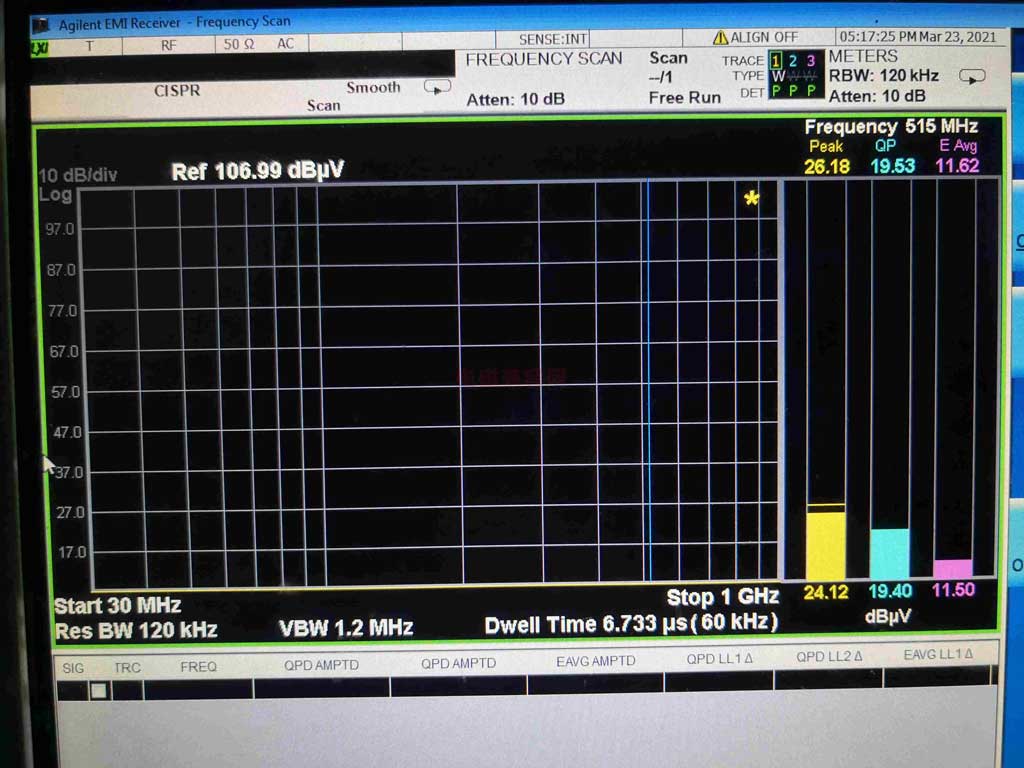
PK, QP, and AV in emc test refer to three different detectors in EMI test receiver or spectrum analyzer.

From the three column diagrams in the above figure, it can be seen that from left to right, the PK detector reading value, the QP detector reading value, and the AV detector reading value are respectively decremented. The reading of the same frequency point is detected by different detectors, in which the PK value is the largest and the AV value is the smallest.

PK> QP> AV

Detector for EMI measurement — PK peak detector, QP quasi-peak detector, AV average detector

The use of quasi-peak detection is a characteristic of civil electromagnetic disturbance emission testing. Since civil electromagnetic compatibility product family standards are all converted from CISPR standards, these standards are compiled to ensure the smooth flow of communication and broadcasting. Therefore, harassment has an impact on communication and broadcasting. The influence of is ultimately judged by human subjective auditory effects. Average detection and peak detection are not enough to describe the impact of pulse amplitude, width and frequency on vision. Quasi-peak detection must be used. Only quasi-peak detection is more consistent. The human ear responds to sounds regularly.

The respective characteristics of several detection methods:

  1. PK peak detection: Its charging time constant is very small, even a very narrow pulse can be quickly charged to a stable value. After the intermediate frequency signal disappears, due to the large discharge time constant of the circuit, the output voltage of the detection can be Stay at the peak for a long time. The feature of peak detection is first used in the harassment emission test of military equipment, because many military equipment can cause explosions or malfunctions of digital equipment as long as a single pulse is stimulated, and there is no need to pay attention to the accumulation of time like audio equipment. The PK value mainly considers the pulse amplitude or the larger peak-to-peak pulse measurement value!
  2. QP quasi-peak detector: The time constant of the impulse and discharge point of this detector is between the average value and the peak value. The output of the detector during the measurement period is not only related to the pulse amplitude, but also related to the pulse repetition frequency, and its output is related to Interference has the same effect on hearing. The magnitude of the QP value will be considered for the pulse amplitude and pulse repetition rate. For example, the PK amplitude of the motor characteristic is often very high, but the radiation is still qualified. That is because the pulse repetition rate of the same frequency of the disturbance signal of the motor is relatively high. Low, so QP is often qualified under certain circumstances. Therefore, if the PK value exceeds the standard, the reading point QP may not necessarily exceed the standard.
  3. AV average detector: Its biggest feature is that the detector has the same charge and discharge time constant, which is especially suitable for continuous wave measurement. The main consideration of the AV value is that the measured value of the pulse with a high repetition rate is relatively large!
  4. The main problems and improvement measures of quasi-peak test
    The main problem with the quasi-peak detection method for testing is the long measurement time.

Because the quasi-peak measurement takes a long time and the efficiency of the test is relatively low, as an improvement, the peak detector is commonly used for the first round of testing in practice, because among the three types of detection, the measured value obtained by the peak detector should be the highest. If the first round of measurement If the value is lower than the quasi-peak value and the average value given by the standard, then the subsequent test does not need to be performed, and it can be determined that the test has passed. If part of the measured value in the peak test is higher than the standard quasi-peak value and average value, then take the excess frequency band to do the quasi-peak value and average value test. Even so, the entire test time is shorter than all the quasi-peak value and average value. Value detection test.

PK peak detector
For EMI measurement, a peak detector is used for preliminary measurement. The measurement speed of peak detection mode is faster than other modes. The signal is usually displayed in peak mode on a spectrum analyzer or EMC analyzer. Since the amplitude of the signal measured in the peak mode is always greater than or equal to the value measured in the quasi-peak or average mode, it is very easy to scan once and compare the result with the limit line. If all signals are below the limit line, the product has already complied with the regulations and no further testing is required.

Characteristics of peak detector
The IF circuit part of the EMC analyzer has an envelope or peak detector whose time constant can ensure that the output voltage of the detector always tracks the peak change of the IF signal. In other words, the detector tracks the changes in the envelope of the IF signal, rather than the instantaneous value of the IF sine wave.

QP quasi-peak detector
Most of the measurement limit lines for radiation and conduction are based on the quasi-peak detection mode. The quasi-peak detector gives different weight values ​​according to the repetition frequency of the signal, which is also a method of measuring its interference factor. As the signal repetition frequency increases, the quasi-peak detector does not have time to discharge completely, resulting in an increase in output voltage. For continuous wave signals, the measurements of peak detection and quasi-peak detection are the same. Since the reading of the quasi-peak detector is always less than or equal to the peak detector, why not use the quasi-peak detector? Isn’t it easier to pass the EMI test? It is indeed easier to pass the test by doing this, but the quasi-peak detector measurement is faster than the peak detector measurement It was 2 to 3 orders of magnitude slower.

Characteristics of quasi-peak detector
The charging speed of the quasi-peak detector is much faster than the discharge speed. Therefore, the higher the signal repetition rate, the higher the output voltage of the quasi-peak detector. The quasi-peak detector can linearly respond to signals of different amplitudes. A signal with high amplitude and low repetition rate may have the same output as a signal with low amplitude and high repetition rate.

AV average detector
Certain conducted emission measurements require the use of an average detector with a quasi-peak detector. In addition, the measurement of radiated emissions above 1 GHz is also carried out using an average detector. The output of the average detector is always less than or equal to the output of the peak detector.
Characteristics of average detector
Average detection is similar to peak detection in many respects. The output of the envelope detector is the modulation envelope. When the post-detection bandwidth is greater than the resolution bandwidth, peak detection is performed. If average detection is to be performed, the detected signal must pass through a filter with a bandwidth much smaller than the resolution bandwidth. This filter averages the high frequency components (such as noise) of the signal output by the envelope detector.

RMS average detector
The weight detector used by the RMS average weight receiver is a root mean square detector (applicable to pulse repetition frequencies higher than the corner frequency fc) and an average detector (applicable to pulse repetition frequencies lower than the corner frequency fc). In combination, the following characteristics of the impulse response curve are obtained: 10 dB/decade when higher than the corner frequency, and 20 dB/decade when lower than the corner frequency. See CISPR 16-1-1 2010 for specific response characteristics.

The reading law of several detection methods:
PK> QP> AV
If the PK value readings are lower than the QP and AV limits, then the standard defaults that there is no need to read the QP value, and it is directly qualified. Therefore, most of the time everyone has to directly qualify for the PK margin. Because QP and AV cannot be higher than PK.
If the PK value is higher than the QP value limit, then a QP reading point is required. If the QP reading point can be qualified, then the product is still judged to be qualified.
For conduction testing, for example, in the frequency band of 150kHz~30MHz, the standard requires both QP and AV values ​​to be qualified. If one of the frequency points is unqualified, then the entire conduction is unqualified.
Why do you want to read QP? That is because the limit required by the standard is the QP value, and the PK value is the read value of the pre-scan.

EN IEC 61000-3-2: 2019+A1: 2021 VS EN 61000-3-2: 2014 Significant Technical Changes

In September 2021, the European Committee for Electrotechnical Standardization (CENELEC) issued the standard ” Harmonics current emission limits for equipment with input currents of less than or equal to 16A per phase ” EN IEC 61000-3-2: 2019+A1: 2021. At present, this version has not been included in the OJ notice of the European Union. EN 61000-3-2:2014 is still a valid version recognized by the European Union.

This edition includes the following significant technical changes with respect to the previous edition:

1. An update of the emission limits for lighting equipment with a rated power ≤ 25 W to take into account new types of lighting equipment;

2. The addition of a threshold of 5 W under which no emission limits apply to all lighting equipment;

3. The modification of the requirements applying to the dimmers when operating  non-incandescent lamps;

4. The addition of test conditions for digital load side transmission control devices;

5. The removal of the use of reference lamps and reference ballasts for the tests of lighting equipment;

6. The classification of professional luminaires for stage lighting and studios under Class A;

7. A clarification about the classification of emergency lighting equipment;

8. An update of the test conditions for television receivers;

9. An update of the test conditions for induction hobs, taking also into account the other  types of cooking appliances.

Introduction of common safety standards for lithium batteries in the North American market

Commonly used standards and applicable product ranges for lithium batteries:

  1. UL1642:

Lithium-ion battery cell (cell) standard, applicable to rechargeable lithium battery and non-rechargeable lithium battery.

  1. UL2054:

Batteries for household and commercial products (battery) have a wide range of applications, suitable for rechargeable lithium batteries and non-rechargeable lithium batteries.

  1. UL62133:

Introduced by the IEC62133 standard, it is suitable for rechargeable lithium batteries and lithium batteries.

  1. UL2056:

Suitable for mobile power (power bank) products.

  1. UL62368-1:

Applicable to IT/AV product standards, and can also be used to evaluate mobile power (power bank) products.

  1. UL2595:

Suitable for battery-driven equipment products, such as: lamps, hand-held power tools, sweeping robots, garden tools, etc.

  1. UL2743:

It is suitable for car emergency starting power lithium battery.

  1. UL2271 & UL2272:

It is suitable for lithium batteries for electric vehicles (including balance vehicles and twisted vehicles).

  1. IEEE1625 & IEEE1725:

CTIA (American Wireless Communications and Internet Association) certification of lithium battery standards, suitable for mobile phone lithium batteries, laptop computers and IPAD lithium batteries.

  1. UL1973:

The safety standards for energy storage battery systems mainly cover all types of energy storage batteries used for photovoltaics, wind energy, backup power sources, and communication base stations.

  1. UL2580:

Batteries for electric vehicles, battery packs for driving electric vehicles, capacitive systems, hybrid systems, and subsystems or modules. For example: electric car battery pack, electric forklift battery pack, etc.

CISPR 32:2015/AMD1:2019

Amendment 1 – Electromagnetic compatibility of multimedia equipment – Emission requirements

Abstract

CISPR 32:2015 is available as CISPR 32:2015 RLV which contains the International Standard and its Redline version, showing all changes of the technical content compared to the previous edition.

CISPR 32:2015 applies to multimedia equipment (MME) as defined in 3.1.24 and having a rated r.m.s. AC or DC supply voltage not exceeding 600 V. This publication covers two classes of MME (Class A and Class B). The MME classes are specified in Clause 4. The objectives of this publication are:
1) to establish requirements which provide an adequate level of protection of the radio spectrum, allowing radio services to operate as intended in the frequency range 9 kHz to 400 GHz;
2) to specify procedures to ensure the reproducibility of measurement and the repeatability of results.
This second edition cancels and replaces the first edition published in 2012. This edition constitutes a technical revision. The contents of the corrigendum of June 2016 have been included in this copy.

IEC 62368-1:2018

Audio/video, information and communication technology equipment – Part 1: Safety requirements

Abstract

IEC 62368-1:2018 is applicable to the safety of electrical and electronic equipment within the field of audio, video, information and communication technology, and business and office machines with a rated voltage not exceeding 600 V. This document does not include requirements for performance or functional characteristics of equipment.
This is a product safety standard that classifies energy sources, prescribes safeguards against those energy sources, and provides guidance on the application of, and requirements for, those safeguards.
The prescribed safeguards are intended to reduce the likelihood of pain, injury and, in the case of fire, property damage.
This third edition cancels and replaces the second edition published in 2014. This edition constitutes a technical revision.
This edition includes the following significant technical changes with respect to the previous edition:
– addition of requirements for outdoor equipment;
– new requirements for optical radiation;
– addition of requirements for insulating liquids;
– addition of requirements for work cells;
– addition of requirements for wireless power transmitters;
– addition of requirements for fully insulated winding wire (FIW);
– alternative method for determination of top, bottom and side openings for fire enclosures;
– alternative requirements for sound pressure.
This group safety publication is primarily intended to be used as a product safety standard for the products mentioned in the scope, but shall also be used by technical committees in the preparation of standards for products similar to those mentioned in the scope of this standard, in accordance with the principles laid down in IEC Guide 104 and lSO/lEC Guide 51.
The contents of the corrigendum of April 2020 have been included in this copy.
Key words: Audio, Video, Communication, Safety

Singapore – IMDA Published Updated Short Range Device (SRD) Technical Specification

Singapore Infocomm Media Development Authority (IMDA) recently published an updated Short Range Devices (SRD) Technical Specification – IMDA TS SRD Issue 1 Revision 2, Aug 2021 version.

This Technical Specification has replaced the IMDA TS SRD Issue 1 Revision 1 (April 2018), and has been revised to cater for wider variety of SRD applications
coexisting in the frequency sharing environment to the extent possible by implementing different criteria for spectrum access.


Source Link: Singapore – IMDA published updated Short Range Device (SRD) Technical Specification

EU – ETSI Releases Technical Specifications for Securing Smart Phones

ETSI announced the release of TS 103 732 for Consumer Mobile Device Protection Profile.   Technical specifications related to cyber Security and privacy risks are addressed in conjunction with ETSI 303 645 for mobile devices and tablets etc. 

ETSI TS 103 732 is the first of a series of ETSI EN 303 645 derivative standards on consumer cybersecurity that ETSI will be delivering within the next twelve to eighteen months.